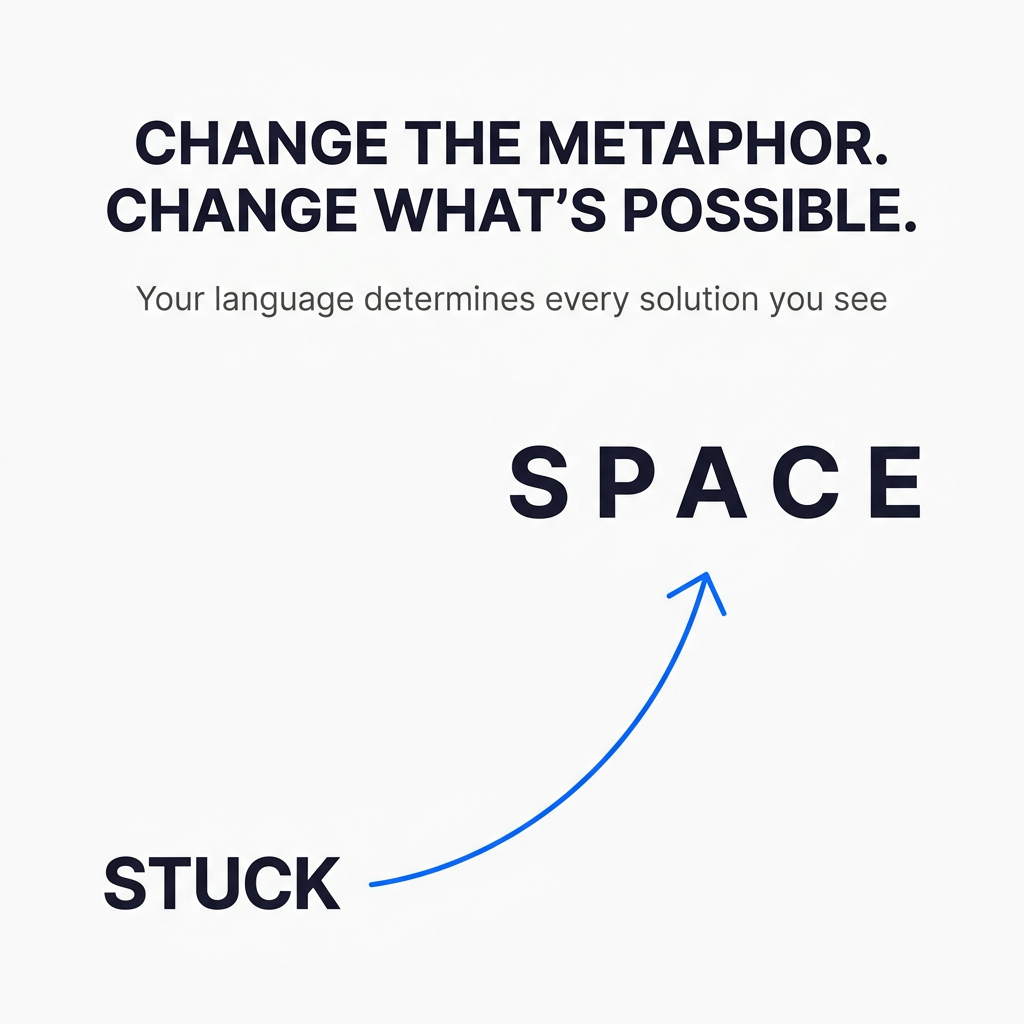
TL;DR: Metaphors are not decorative language. They’re the cognitive mechanism your brain uses to solve problems. When you make unconscious metaphors conscious through NLP chunking (up for abstraction, down for specifics, sideways for new domains), you unlock solution spaces you couldn’t see before. This is practical problem-solving infrastructure, not artistic flourish.
Core Insights:
-
Your brain treats metaphors as embodied reality. When you say “I’m stuck,” your sensory-motor cortex activates within 200 milliseconds as if facing physical immobility.
-
Unconscious metaphors shape what solutions seem possible. “Pushing a boulder” leads to force strategies, while “lost in fog” leads to visibility strategies.
-
NLP chunking provides a systematic method: chunk up for broader patterns, down for specifics, sideways for parallel structures in different domains.
-
Chunking sideways generates breakthroughs because concepts at the same abstraction level share transferable properties across contexts.
-
Organizations amplify this through shared metaphors. Describing a challenge as “battle” versus “garden” produces fundamentally different behaviors.
What Are Metaphors Really Doing?
I’ve spent years watching people get stuck on problems they could solve if they looked at them differently. The issue isn’t intelligence or effort.
It’s perspective.
When someone tells me they can’t see the forest for the trees, or something feels too high to grasp, or everything’s blurry, they think they’re describing their situation. They’re not. They’re revealing how their brain organizes the problem.
These aren’t casual word choices. They’re cognitive maps. Visual, auditory, kinesthetic expressions showing you exactly how someone’s mind has structured a challenge.
When you make those unconscious metaphors conscious, you change them.
Research from the University of Arizona shows that when you process metaphors, your brain’s sensory-motor region activates within 200 milliseconds. This isn’t abstract thinking. It’s embodied experience.
Your brain treats “I’m stuck” like actual physical immobility. Shift the metaphor, and you shift the perceived reality of the problem itself.
Reality Check: Metaphors are not descriptions of your situation. They’re the cognitive architecture creating your experience of that situation.
How Metaphors Shape Solution Spaces
When I work with clients who are stuck, I don’t start by analyzing their problem directly. I let them describe it in whatever language comes naturally.
Then I listen for the metaphors.
Someone might say their project feels like pushing a boulder uphill. Another person describes their team as lost in fog. A third tells me they’re drowning in details.
Each metaphor isn’t a description. It’s a complete framework determining what solutions even seem possible.
If you’re pushing a boulder, you think about leverage and force. If you’re lost in fog, you think about visibility and navigation. If you’re drowning, you think about surfacing and breathing room.
Same issue. Entirely different solution spaces.
What I do is make the metaphor conscious. I ask: Is it really a boulder? Is it really fog?
When someone realizes they chose that framework unconsciously, something shifts. They relax.
Because suddenly they have a choice.
Pattern I’ve Noticed: The moment people see their metaphor as a choice rather than reality, the problem loses its fixed quality. New possibilities appear.
What Is the NLP Chunking Framework?
I use a simple tool from neuro-linguistic programming. It works on three axes: up, down, and sideways.
Chunking up means moving toward abstraction.
If you start with “steering wheel,” you chunk up to “car part,” then to “vehicle,” then to “transportation.” You’re climbing toward broader categories and universal principles.
Chunking down means moving toward specificity.
From “steering wheel,” you go to “wooden steering wheel” or “leather-wrapped steering wheel” or “this steering wheel in my car.” You’re descending into details and components.
Chunking sideways is where the magic happens.
This is lateral movement at the same level of abstraction.
From “steering wheel,” you chunk up one level to “car parts,” then look sideways to find other examples: wheels, pedals, seats, mirrors. They’re all at the same chunk level because they share the same overarching category.
This sideways movement is how you generate fresh metaphors. According to NLP training research, when you get skilled at this, you notice an exponential increase in your ability to think around problems.

What This Means: Chunking gives you conscious control over abstraction levels. You’re no longer stuck with your first metaphor.
How to Use This in Practice
Let me walk you through what this looks like. Say someone tells me they can’t see the forest for the trees.
I don’t immediately try to solve their problem. I tinker with their metaphor.
First, I check if the metaphor fits. I ask questions. Is it really a forest you’re looking at? Does that feel accurate?
I’m watching for congruence. That moment when their verbal description matches their nonverbal response. When they nod and their whole body says “yes, that’s exactly it.”
Then we start playing with the metaphor itself.
What if we took a helicopter ride over the forest instead of walking through it? What if we zoomed in on one single tree instead of trying to see them all? What if we examined the details of individual trees so we could distinguish between them?
I’m not solving the real-world problem yet. I’m exploring solutions within their metaphorical framework.
And here’s what happens: they start generating their own ideas.
“Oh, if I had a helicopter view, I’d see the patterns I’m missing.”
“If I focused on one tree, I could make progress instead of feeling overwhelmed.”
When they come up with the solution themselves, even in metaphor, it’s already accepted.
Then I ask: How would this solution look in the real world? And they translate it back.
The metaphor was scaffolding. A container where they could explore freely without the weight of the actual problem crushing their thinking.
Why This Works: The metaphor creates psychological distance from the problem, allowing pattern recognition without emotional overwhelm.
Why Chunking Sideways Creates Breakthroughs
The reason lateral chunking generates such insights is structural.
Concepts at the same abstraction level share transferable properties even when they look completely different on the surface.
A journey and a project both have starting points, obstacles, progress markers, and destinations.
A garden and a business both involve cultivation, pruning, seasonal cycles, and growth patterns.
A symphony and a team both require coordination, timing, individual excellence, and collective harmony.
When you recognize these parallel structures, wisdom from one domain informs another. This isn’t wordplay. Studies in the International Journal of Design show that metaphors play a role in design creativity, with synthesis of design solutions being the strongest factor in metaphor use.
Innovation comes from seeing the same pattern in a different context.
Core Principle: Breakthrough insights occur when you recognize structural similarity across apparently unrelated domains.
How to Build Metaphorical Fluency
You develop this skill deliberately. Here’s how I teach it.
Start with any concept. Let’s use “deadline.”
Chunk up: What’s the category above deadline?
Time constraint. What’s above that? Project management. What’s above that? Resource allocation.
Chunk down: What’s a specific example of a deadline?
The report due Friday. What’s more specific? The financial report due Friday at 5pm to the CFO.
Chunk sideways: Go up one level to “time constraint,” then look for other examples at that same level.
Budget limits. Team capacity. Regulatory requirements. They’re all constraints in different domains.
Now you ask: How do people handle budget limits creatively? How do teams work around capacity constraints? What do I learn from how industries manage regulatory requirements?
You’ve opened up three new solution spaces for your deadline problem.
The practice is simple. Pick random objects throughout your day and chunk them up, down, and sideways. Train your mind to move consciously through abstraction levels.
When you get fluent at this, you stop being trapped by the first metaphor that comes to mind.
Practice Method: Spend five minutes daily chunking everyday objects. Your coffee cup. Your desk. Your commute. The skill transfers to complex problems automatically.
What Changes When People Learn This
I’ve watched the same pattern play out dozens of times.
Someone comes to me stuck. We work through their metaphors. And then something fundamental shifts.
It’s not that they suddenly have all the answers. It’s that they realize their thinking isn’t fixed. The way they’ve been perceiving their situation was one choice among many. An unconscious choice, but a choice nonetheless.
That realization brings relief. Real, visible relief.
Because if you chose this interpretation unconsciously, you choose another one consciously. You’re not stuck with your first frame. You’re not trapped by how you initially saw things.
This goes deeper than problem-solving technique.
People walk around carrying metaphors they inherited without questioning. “Life is a competition.” “Success is climbing the ladder.” “Relationships are work.”
These aren’t truths. They’re frameworks.
And frameworks determine what actions seem possible.
When someone realizes this, really realizes it, they stop over-identifying with their beliefs. They get humble about what they know versus what they’re assuming.
That humility creates space for new thinking.
Observation from Practice: The relief people experience when they recognize thinking as choice rather than reality is profound. Fear decreases. Creativity increases.
How This Scales to Teams and Organizations
The same principles apply when you’re working with teams and organizations.
The difference is that you’re dealing with shared metaphors.
I’ve seen this play out in real time. When immigration gets described as “a flood” or “a virus,” entire organizations align around that metaphor. It shapes policy, behavior, resource allocation.
Everyone following that description acts accordingly.
If your team sees a challenge as a battle, you get defensive strategies and competitive thinking. If they see it as a garden, you get cultivation and patient growth.
Same challenge. Completely different organizational responses.
What I do with organizations is help them identify their limiting metaphors and create more solution-focused ones. I’m transparent about the mechanism. I explain that language shapes the solutions you allow yourself to consider.
Then I back it up with research.
Studies show that cross-domain innovation outperforms specialization. The most impactful scientific papers come from teams that combine disparate specialties, and that impact increases exponentially with disciplinary distance.
When you train teams to think metaphorically across domains, you’re not teaching soft skills. You’re installing cognitive infrastructure for innovation.
Organizational Reality: Shared metaphors create shared reality. Change the collective metaphor, and you change collective behavior without force.
The Biggest Misconception About Metaphorical Thinking
When people first encounter this work, they think it’s playful. Artistic. Something without practical implications.
They’re completely unaware of how many times a day they use metaphors and unconsciously accept those metaphors as reality.
When I say “metaphor,” they think poetry. Literary devices. Decorative language for creative writing.
They don’t realize it’s happening to them constantly. In every meeting. Every strategy session. Every time they describe a problem.
The metaphors you use aren’t describing reality.
They’re creating it.
And here’s what makes this tricky: there’s an invisible barrier between what people assume to be truth and what they recognize as a way of looking at things.
Everyone collectively agrees not to know the absolute truth so we function in society. But then we over-identify with our assumed beliefs.
We defend them. Build our identities around them. Forget they were ever interpretations.
That over-identification causes problems. Real problems.
Because when your core metaphors get questioned, it feels existential. Like you might disappear if the organizing story falls apart.
I’ve found that people are scared. Really scared. Of losing themselves. Of uncertainty. Of what happens if their identity-defining beliefs turn out to be metaphors they inherited.
What I’ve Learned: The resistance to examining metaphors isn’t intellectual. It’s existential. People fear that questioning their framework means losing themselves.
How to Hold Space for Metaphor Exploration
When I work with someone at that edge, where their foundational metaphors are being questioned, I approach it with lightheartedness.
I show them I don’t know the truth either. That it’s okay to sit in ambiguity. That there are so many moments in life where we can’t know what’s true and what’s false, and that’s fine.
I maintain a calm posture. Use humor. Make it warm.
I’m pacing their uncertainty with care, addressing their fears the same way you’d care for a child with anxiety. With love. With the understanding that those fears are real and valid.
That vibe, that presence of “we’re in this together and it’s safe to not know,” creates the container where exploration becomes possible.
Because transformation doesn’t happen through force. It happens through safety and choice.
My Approach: Humility, warmth, and humor create psychological safety. People explore new metaphors when they feel held, not pushed.
Frequently Asked Questions
How do I know if I’m using a limiting metaphor?
Listen to your language when describing problems. If your metaphor suggests only one type of solution (force, escape, defense), it’s probably limiting. Good metaphors open multiple pathways.
What if my metaphor feels true, not chosen?
That’s the sign of an unconscious metaphor. The feeling of “truth” is your brain’s familiarity with the pattern, not objective reality. Try chunking sideways to find alternative metaphors at the same abstraction level.
How long does it take to build metaphorical fluency?
With daily practice chunking everyday objects, most people notice shifts within two weeks. Full fluency, where you automatically recognize and shift metaphors, develops over months.
Do I need NLP training to use this?
No. The chunking framework is simple enough to self-teach. Start with physical objects, practice the three directions (up, down, sideways), then apply to problems.
How do I get my team to adopt a new shared metaphor?
Transparency works best. Explain how metaphors shape behavior, show research backing it up, then collaboratively explore what metaphor better serves your collective goals.
What if someone resists changing their metaphor?
Resistance usually signals identity attachment. Approach with lightness and curiosity, not force. Show you’re exploring together, not correcting them. Create safety first.
Are some metaphors objectively better than others?
No. Metaphors are tools. The best metaphor is the one that opens solution spaces appropriate to your context and values. A “battle” metaphor might serve in true crisis but limits during collaboration.
How is this different from positive thinking?
Positive thinking tries to change emotional valence. Metaphorical thinking changes structural framework. You’re not making problems “positive,” you’re revealing hidden solution architectures through pattern recognition.
Key Takeaways
-
Metaphors are cognitive infrastructure, not decorative language. Your brain processes them as embodied reality within 200 milliseconds.
-
Unconscious metaphors limit solution spaces. “Pushing a boulder” triggers different strategies than “tending a garden” for the same problem.
-
NLP chunking provides systematic metaphor exploration: up for abstraction, down for specifics, sideways for parallel domains.
-
Chunking sideways creates breakthroughs because concepts at the same abstraction level share transferable properties across contexts.
-
Making unconscious metaphors conscious gives you choice. That choice creates relief and opens new possibilities.
-
Organizations operate through shared metaphors. Change collective language, and you change collective behavior.
-
Resistance to examining metaphors is existential, not intellectual. Approach with humility, warmth, and safety, not force.