by Christian Kresmann, Founder - Beyond Creativity | 2026, Jun, 22 | business, filmmaking, leadership
Three minutes to read this. Years to see what I’m talking about.
Leadership presence is trainable. But not the way we’re doing now.
Why Most Leadership Development Misses the Point
I’ve been in acting studios for years. Also sat through corporate leadership workshops. The gap between how actors train and how executives prepare is massive.
Actors show up to weekly studio classes. Places like the Chubbuck Studio in Los Angeles. They drill presence, state management, emotional availability. Every Tuesday night. For years. Training woven into their routine the same way a violinist runs scales.
Executives get a two-day offsite once a year. Read a leadership book on the flight home. Back to meetings by Monday.
The split shows up fast. Actors develop presence as a skill. Executives talk about presence as a concept they’re supposed to have.
Three Things Actors Understand About Training That Leaders Miss
1. Preparation Is About State, Not Information
Walk into a green room before a high-stakes scene. You won’t find actors cramming lines. You’ll find them regulating their nervous system. Dropping into their body. Running an internal check: Am I open? Grounded? Available?
Walk into a conference room before a high-stakes pitch. Executives are loading three more slides.
The actor knows the scene lands based on their inner condition. The executive bets on the deck.
Both matter. But only one of them trained the thing that transmits the message. Their presence.
What this means for you: Information prep is table stakes. State prep is what separates flat delivery from impact. Your nervous system broadcasts louder than your words.
2. Presence Is a Skill, Not a Personality Trait
Most people treat presence like charisma. You either have the vibe or you don’t.
Actors know better. Presence is disciplined attention. The trained ability to stay open under pressure instead of collapsing into your head.
Trainable. But only if you train.
Weekly classes. Repeated exposure to discomfort. Feedback loops that make you notice when you vanish into thought, then pull you back into the room.
Corporate leadership development skips this entirely. Stays conceptual. Talks about executive presence like a vibe you project by wearing the right jacket and speaking with confidence.
That’s performance. Not presence.
What this means for you: Presence isn’t about looking the part. It’s about staying in your body when the pressure hits. The room feels the difference immediately.
3. Calm Is Active Attention, Not the Absence of Chaos
Actors treat calm as a state they cultivate. Not something that shows up when conditions align.
Calm means open, grounded, available. Even when the scene collapses.
Leaders need the same capacity. But most don’t train for this state. They hope calm shows up when the quarter tanks or the team implodes.
Nope.
Calm under pressure is a trained state. Requires repetition. Weekly studio work. The same rigor a cellist brings to their instrument.
Because that’s what we’re talking about. The instrument isn’t your strategy or your slide deck.
It’s your nervous system.
What this means for you: Waiting for calm to arrive when stakes are high is a losing bet. Calm is something you build through practice, not something you summon on demand.
The Real Question
If you’re walking into high-stakes moments with an instrument you’ve never learned to play, what do you expect to happen?
Training your nervous system isn’t optional. It’s the foundation everything else sits on.
Actors figured this out decades ago. They built studios. Weekly classes. Repetition until the skill becomes reflex.
Most leadership development hasn’t caught up. Still focused on frameworks and slide decks. Missing the thing that determines whether the message lands or dies in the air.
I’m not saying throw out strategy. I’m saying add the other half. The half that makes strategy worth hearing.
How to Start Training Presence
You don’t need to enroll in acting school. But you do need consistent practice.
Start small:
• Set aside 10 minutes three times a week. Sit. Notice your breath. Notice when your attention drifts. Bring focus back. Repeat.
• Before your next meeting, spend 60 seconds checking your state. Am I tense? Where? Am I grounded? Drop your attention into your body instead of staying stuck in your head.
• Record yourself presenting. Watch without sound. What does your body communicate? Tension? Openness? Presence or performance?
The gap between actors and executives isn’t talent. It’s training.
One group treats their nervous system like an instrument that needs tuning.
The other group hopes everything works out.
Common Questions About Presence Training
Is presence training the same as meditation?
Not exactly. Meditation trains attention. Presence training applies that attention under pressure. You’re learning to stay open and grounded when stakes are high, not just when you’re sitting quietly.
How long does this training take to show results?
You’ll notice shifts in two to three weeks of consistent practice. Real skill develops over months. Actors train for years before presence becomes second nature.
Do I need a coach or class for this?
Helps. Feedback speeds up the process. But you don’t need formal training to start. Begin with basic body awareness and state checks before meetings.
What if I’m naturally introverted? Does presence training work differently?
Presence isn’t about being loud or extroverted. It’s about being fully there. Introverts often have an advantage here because they’re already comfortable with internal focus.
Does this replace traditional leadership development?
No. Strategy, communication frameworks, and decision-making models all matter. Presence training fills the gap those programs miss. It’s the delivery system for everything else.
How do actors practice presence outside of class?
They check their state before stepping on set. Run quick body scans between takes. Notice tension and release through breath. Small rituals repeated hundreds of times until they become automatic.
What’s the biggest mistake people make when trying to develop presence?
Treating presence like a performance they put on. Real presence is the opposite. It’s dropping the performance and showing up as you are, fully grounded and available.
Key Takeaways
• Presence is a trainable skill, not an innate trait. Actors prove this through consistent, repetitive practice in weekly studio classes.
• State management matters more than information overload. Your internal condition determines how your message lands, not how many slides you prepare.
• Calm is an active, cultivated state of attention. You train for calm the same way musicians train their instrument, through deliberate repetition.
• Most corporate leadership development skips the nervous system entirely. The gap between conceptual understanding and embodied skill is where leaders lose impact.
• You don’t need acting school to start. Ten minutes of consistent body awareness practice three times a week builds the foundation.
• The instrument isn’t your strategy. It’s your nervous system. Train accordingly.

by Christian Kresmann, Founder - Beyond Creativity | 2026, Apr, 16 | business, creativity, leadership, mindset, spirituality
TL;DR: AI won’t replace human creators. It’ll expose who was hiding behind technique instead of actually having something to say. Audiences feel when a human was present, even when they can’t name what’s missing. The future splits into three lanes: purely human, purely machine, and honest hybrids. As AI floods the market with cheap content, human presence becomes the scarcest and most valuable resource.
P.S.: I use an A.I. tool to better the reading experience for you. I know some like the raw kind of writing. I do, too. And I like it as much when a text is sophisticated. 🙂
Anyway. Here we go.
Core Answer:
-
People detect the absence of human presence in AI-generated work, even when they can’t explain why
-
AI forces creative clarity by exposing muddy thinking instantly
-
Studies show consumers value human-made art 62% higher and pay premiums for authenticity
-
The only irreplaceable human element is intentionality: the why behind every choice
-
Three distinct content lanes are emerging: human-made premium, machine-made volume, and transparent hybrids
Why Am I Still Taking Acting Workshops?
A friend asked me yesterday why I’m bothering with acting workshops when Netflix will probably replace all actors with AI avatars in a few years.
Fair question.
Here’s my answer: audiences know when you’re not there.
They can’t explain it. They just feel it.
That feeling is the only thing human creators have left.
What AI Actually Does to Creative Work
AI doesn’t kill creativity.
It kills the excuse that you needed perfect technique to matter.
I spent forty-five minutes with an AI agent recently. It generated 915 data entries for a feature film: production partners, nonprofits, influencers, celebrities who might support our cause.
Work that would’ve taken me a hundred hours.
But here’s what nobody mentions.
If I hadn’t been precise about what I wanted, the AI would’ve given me 915 pieces of garbage.
The tool didn’t decide which nonprofits mattered. It didn’t know why certain influencers aligned with the film’s theme. It didn’t understand our cause.
I brought all of that clarity.
The machine executed at superhuman speed.
AI is a genie out of the bottle. You wish for something, it creates. But if your wish is muddy, you get nine hundred polished turds.
The tool forces you to know exactly what you want before you touch it.
Not a limitation. A diagnostic for whether you have something to say.
Key Point: AI exposes unclear thinking instantly. If you don’t know precisely what you want, the output will reveal that confusion at scale.
How Audiences Detect the Absence of Humans
Research backs this up in ways that should terrify anyone coasting on technical skill alone.
Psychologist Mark Runco found that intentionality plays a central role in human creativity. AI-generated outputs meet criteria for novelty and usefulness. But they lack two essential components: choice and intention.
Audiences detect this absence even when they can’t name it.
In one study, participants valued AI-labeled art 62 percent less than art identified as human-made.
Same work. Different label. Massive value drop.
Another study found that 52% of consumers become less engaged when they suspect content is AI-generated.
They feel something’s missing even when they can’t articulate what.
The mess is the message.
Imperfection isn’t a flaw anymore. It’s proof someone was present when the thing got made.
Key Point: People sense when human intentionality is missing, leading to measurable drops in perceived value and engagement, even when technical quality is identical.
The Three Lanes of Creative Production
The separation is already happening.
In 2025, Spotify removed over 75 million spammy tracks from its platform. Many were AI-generated.
The fake band Velvet Sundown accumulated over a million streams before being revealed as entirely synthetic.
The future isn’t one thing. It’s three distinct paths.
1. Purely human-made
Work where someone’s presence is the entire point. Where the imperfections, the stutters, the micro-expressions matter because they’re proof a real person gave a damn.
2. Purely machine-made
Fast food content. Optimized for speed and volume. Cheap, efficient, forgettable. The flood is coming.
3. Honest hybrids
Creators who use AI transparently and own why. Who understand the tool amplifies what you already have, including your confusion.
Audiences are voting with their wallets.
An overwhelming 98 out of 100 music professionals stated it’s important for them to know whether music was created by a human or AI. And 96% are open to paying more for authenticity.
This is the birth of what some are calling the “Human Premium.” A tangible monetary value assigned to the knowledge that a piece of art was born from human experience.
Key Point: Three distinct content lanes are splitting open, with human-made work commanding measurable premiums as AI floods the market with cheap alternatives.
What Remains When Technical Skills Become Free
When technical execution becomes free, the only value left is the why behind the choice.
I’ve practiced yoga for five years. Not for flexibility. Not for relaxation.
For the connection between mind, body, and something more I can’t describe yet.
That practice wasn’t preparation for stillness. It was training for the only battlefield that matters.
AI is growing faster than most people track. If we don’t level up our own way of being (our life energy, our presence, our spiritual awareness), we get drowned out by the sheer speed and capability of the machines.
This isn’t about developing better creative skills or technical knowledge.
It’s about deepening your own presence so you don’t become noise.
Research shows that AI-enabled stories are more similar to each other than stories by humans alone.
Individual creativity goes up. Collective novelty goes down.
The fast food content flood is coming. That makes the fine dining experience of human presence even more valuable.
Key Point: As AI accelerates, the irreplaceable human element is presence and intentionality, not technical skill. Deepening self-awareness becomes the only sustainable competitive advantage.
Why Collaborative Friction Matters
I realized something on a recent film shoot.
The bigger the project, the more I feel involved. Not because I’m doing more. Because I realize I can’t do it alone.
I have to contribute to everybody’s success.
That changes what I bring to the work. I let go. I trust that other people’s ideas will come together with mine into something none of us could’ve made alone.
Audiences feel that collaborative friction.
The messy, unpredictable energy that comes from multiple human beings working through doubt and compromise to land on something they all believe in.
AI delivers technical precision all day long. But it can’t recreate that feeling. It can’t fake the sense that real people were in the room, present, making choices that mattered to them.
When you’re forced to trust someone else’s vision alongside yours, you end up with something that has more life in it.
More unpredictability.
People know when you’re not there. They can’t explain it. They just feel it.
Key Point: The collaborative friction between real humans creates unpredictable energy that audiences instinctively recognize and value, something AI collaboration fundamentally can’t replicate.
What Happens When You Amplify Muddy Thinking
AI boosts creative output by 25% and value by 50%.
But only if you’re intentional about what gets amplified.
If your thinking is muddy, AI just gives you more mud, faster.
The tool removes all the technical barriers that used to disguise bad ideas. No more hiding behind budget constraints, equipment limitations, or crew availability.
If your idea is half-formed or your intention is unclear, the output reflects that immediately.
Brutal honesty wrapped in efficiency.
This forces a kind of creative clarity we needed all along but didn’t have the bandwidth to develop. You can’t throw busy work at a team and hide behind the process anymore.
You can’t coast through meetings, research, and revisions without ever confronting whether the core idea was clear in the first place.
If you can’t articulate precisely what you want, the AI mirrors that confusion back at you instantly.
The value isn’t in doing anymore. It’s in knowing why and knowing what with absolute clarity.
Key Point: AI amplifies everything, including unclear thinking. The removal of technical barriers forces confrontation with whether your core idea has substance or you’re just hiding behind process.
Where Human Intentionality Still Matters
We’ve been here before.
The tractor replaced the axe. The chainsaw replaced manual labor. The calculator replaced mental arithmetic.
Each time, we had to figure out what it means for us when those tools become available.
AI is just the next wave. Except now it’s our cognitive labor getting automated instead of our physical labor.
But here’s what matters.
When the chainsaw replaced the axe, you still had to decide where to cut the tree.
The intentionality remained human.
With AI handling cognitive tasks, the question becomes: what’s the equivalent of deciding where to cut?
Attention. Intention.
Where we choose to direct our focus within that infinite possibility space.
AI executes once you’ve pointed it in a direction. But it can’t determine where that focus should land.
It can’t decide what matters, what’s worth caring about, or why something should exist in the first place.
That’s still entirely on us.
Key Point: Like previous technological shifts, AI automates execution but leaves the irreducibly human task of deciding where to direct attention and why something matters.
The Economics of Human Presence
Some people want fast food. Others want fine dining.
The same split is happening with content and services.
Most content right now is fast food. Designed for quick consumption. Not for meaning or lasting impact.
AI is about to make fast food content infinitely cheaper and faster to produce.
Which means the fine dining experience (where someone put their attention and intention into crafting something with real presence) becomes the only differentiation that matters.
The more AI saturates the market with technically proficient work, the more people will pay a premium for proof that a human being gave a damn about what they made.
Scarcity creates value.
Human attention is about to become the scarcest resource.
OpenAI CEO Sam Altman predicts that “real estate, handmade goods, art…there will be a huge premium” on things like that as AI makes mass production cheap.
AI doesn’t kill human creativity. It reveals what it’s worth.
Key Point: As AI commodifies technical execution, human presence becomes scarce and valuable. The fast food content flood makes fine dining experiences command measurable premiums.
The Real Question We’re Avoiding
If we outsource everything to AI, what’s the point of being human?
Not a philosophical question. A practical one.
If AI does everything we do, faster and cheaper, then the only thing left is what AI fundamentally can’t replicate.
Presence. Intentionality. The feeling that someone was there when the thing got made.
We’re not protecting our jobs. We’re protecting the feeling that we matter.
And that only exists when our presence changes the outcome.
The machines aren’t going to replace us.
They’re going to strip away everything that isn’t human about what we do. All the technical tricks we’ve hidden behind. All the polish we’ve used to compensate for lack of something real to say.
AI will do that better than us, faster than us, cheaper than us.
And that’s going to leave us standing there with only one question.
What do we have that can’t be automated?
Most of us aren’t ready for that conversation. But it’s coming whether we like it or not.
The good news?
The answer has been there all along.
We just forgot to look.
Common Questions About AI and Human Creativity
Will AI completely replace human creators?
No. AI automates technical execution but can’t replicate intentionality or presence. Studies show audiences value human-made work 62% higher and actively seek proof of human involvement, creating a “Human Premium” in the market.
How do audiences know when something is AI-generated?
They feel it, even when they can’t name it. Research shows 52% of consumers become less engaged when they suspect AI generation. People detect the absence of human choice and intention at an intuitive level.
What’s the “Human Premium”?
The measurable monetary value assigned to human-made work. 96% of music professionals are willing to pay more for authenticity. As AI floods the market with cheap content, scarcity of human attention creates premium value.
Should I use AI tools in my creative work?
Yes, but with clear intentionality. AI amplifies what you bring to it, including confusion. The tool forces precision about what you want. Use it transparently, own why you’re using it, and ensure your human presence remains central.
What creative skills still matter when AI handles technical execution?
Intentionality, presence, and clarity about why something should exist. The ability to collaborate with other humans in ways that create unpredictable friction. Deepening self-awareness so your attention and choices carry weight.
What are the three lanes of creative production?
Purely human-made (premium work where presence is the point), purely machine-made (cheap volume content), and honest hybrids (transparent AI use with human intentionality driving choices).
How do I stay relevant as AI capabilities grow?
Stop hiding behind technical skill. Develop clarity about what you’re trying to say and why. Deepen your presence through practices that connect mind, body, and awareness. Focus on the irreplaceable human elements: attention, intention, and the ability to make choices that matter.
Will human-made content become more expensive?
Yes. As AI makes technical proficiency free and floods markets with cheap alternatives, scarcity economics flip. Human attention becomes the scarcest resource, commanding measurable premiums from audiences seeking authentic connection.
Key Takeaways
-
AI doesn’t replace human creativity. It exposes who was hiding behind technique instead of having something real to say.
-
Audiences detect the absence of human presence and intentionality, even when they can’t articulate why, leading to measurable drops in engagement and perceived value.
-
Three distinct content lanes are emerging: purely human-made premium work, purely machine-made volume content, and transparent hybrids where humans own their AI use.
-
The irreplaceable human element is intentionality (the why behind every choice), not technical execution. Attention and presence become the only sustainable competitive advantages.
-
AI forces brutal clarity by amplifying everything, including muddy thinking. If you can’t articulate precisely what you want, the output reveals that confusion at scale.
-
As AI commodifies technical skills, human attention becomes the scarcest and most valuable resource, creating a “Human Premium” where audiences pay measurably more for proof someone gave a damn.
-
The real question isn’t whether AI will replace us, but what we have that fundamentally can’t be automated. The answer: presence that changes outcomes.
by Christian Kresmann, Founder - Beyond Creativity | 2026, Apr, 13 | business, creativity, leadership
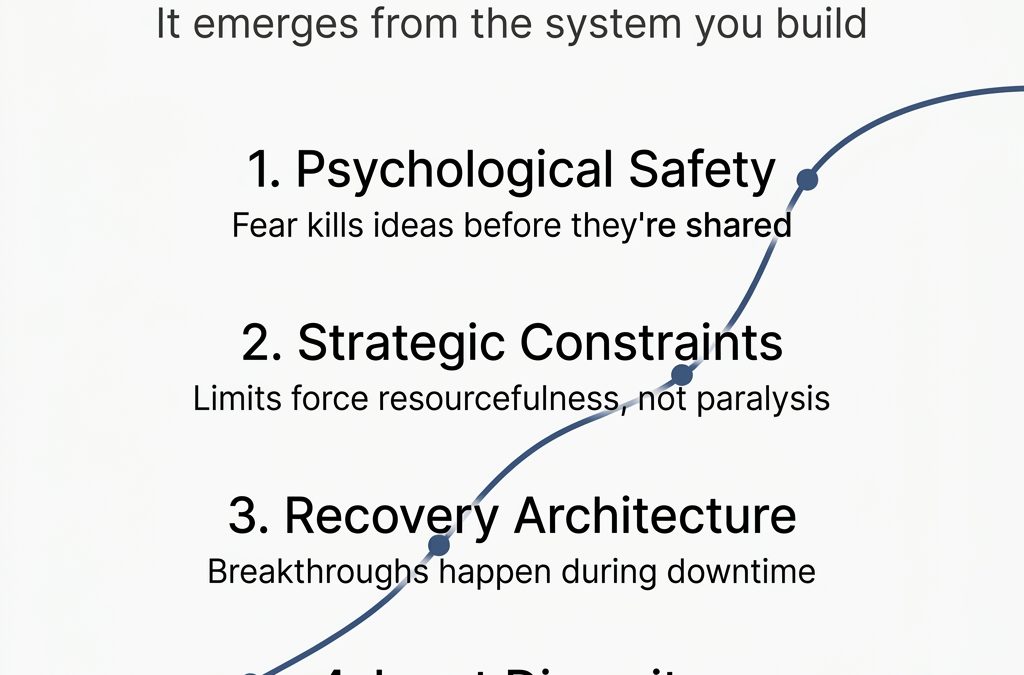
TL;DR: Creativity isn’t a trait you hire for. It’s what happens when you remove the barriers blocking it. Most organizations sit on unrealized creative potential because they focus on finding the right people instead of building the right conditions. Four structural elements determine whether creativity emerges: psychological safety, strategic constraints, recovery architecture, and input diversity.
The Core Problem:
-
Brilliant people go silent in unsafe environments
-
Unlimited freedom creates paralysis, not innovation
-
Relentless execution without recovery kills creative thinking
-
Homogeneous teams produce predictable solutions
-
The fix isn’t better hiring. It’s better systems.
Years back, I thought the problem was finding the right people.
Hire the creative ones. The divergent thinkers. People with unusual backgrounds who see things differently. Put them in a room and watch innovation happen.
That’s not how it works.
I watched brilliant people go silent in the wrong environment. I saw average teams produce extraordinary work when the conditions shifted. The pattern became impossible to ignore: creativity isn’t a personality trait you hire for. It’s an emergent property of the system you build.
That’s not how it works.
I’ve watched brilliant people go silent in the wrong environment. I’ve seen average teams produce extraordinary work when the conditions shifted. The pattern became impossible to ignore: creativity isn’t a personality trait you hire for—it’s an emergent property of the system you build.
Most leaders focus on inputs when they should be designing conditions. You don’t force creativity into existence. You remove what’s blocking it. You architect an environment where it becomes the natural response instead of the exception.
Here’s what I learned about the four structural elements that determine whether creativity emerges or dies.
Here’s what I’ve learned about the four structural elements that determine whether creativity emerges or dies in your organization.
What Is Psychological Safety and Why Does It Matter?
People won’t share ideas when they’re afraid.
This sounds obvious until you realize how organizations treat psychological safety as a nice-to-have cultural add-on instead of the load-bearing structure it actually is.
This sounds obvious until you realize how many organizations treat psychological safety as a nice-to-have cultural add-on instead of the load-bearing structure it actually is.
Research shows psychological safety accounts for 47% of the variance in workplace creativity. That’s not a marginal factor. That’s nearly half of what determines whether your team generates new solutions or retreats into safe, predictable patterns.
The correlation is strong (r = 0.68), meaning as psychological safety increases, creative output follows in near lockstep.
The correlation is strong—r = 0.68—meaning as psychological safety increases, creative output follows in near lockstep.
Here’s what I find interesting: safety doesn’t directly produce creativity. It creates conditions for happiness at work, which then unlocks creative involvement. You can’t skip steps. Surface interventions fail because they don’t touch the root structure.
Psychological safety isn’t about being nice.
It’s about building an environment where people say “I don’t know” without losing status. Where admitting mistakes becomes information instead of ammunition. Where challenging the established approach doesn’t require career-level courage.
When I work with teams stuck in creative paralysis, the first thing I look for isn’t their ideation process. It’s whether anyone feels safe saying the current approach isn’t working.
If they don’t, no brainstorming technique helps.
Key Point: Psychological safety isn’t a cultural perk. It’s the structural foundation that determines whether your team’s creativity surfaces or stays buried. Without it, you’re asking people to take risks they’ve been trained to avoid.
If they don’t, no brainstorming technique will help.
How Do Constraints Enable Creativity?
Freedom doesn’t fuel creativity the way most people think.
I used to believe removing constraints would unlock potential. Give people unlimited resources, infinite time, complete autonomy, and watch them soar. What I observed instead was paralysis dressed up as exploration.
I used to believe removing constraints would unlock potential. Give people unlimited resources, infinite time, complete autonomy, and watch them soar. What I observed instead was paralysis dressed up as exploration.
A meta-analysis reviewing 145 empirical studies dismantles the myth that eradicating rules and boundaries makes creativity thrive. The research shows individuals, teams, and organizations benefit from a healthy dose of constraints. It’s only when constraints become excessive that they stifle innovation.
Cognitive scientist Margaret Boden puts it plainly: “Constraints, far from being opposed to creativity, make creativity possible.”
Constraints shift your mindset from abundance to resourcefulness.
When you have everything available, your brain doesn’t engage problem-solving mode. It scans options. When you have clear limits, your brain activates a different system, one that focuses on what’s available and finds novel combinations within those boundaries.
I’ve seen this play out repeatedly. The team with a tight budget often produces more elegant solutions than the team with unlimited resources. The writer facing a strict word count finds sharper language than the one with infinite space.
The most valuable constraint is the human one. When designers embrace real limits (limited dexterity or low lighting), products become exceptionally useful under normal conditions. Designing for the edge forces you to solve for higher friction, and once solved, the benefit cascades outward.
This is why accessible innovations become mainstream. The curb cut was designed for wheelchairs and now serves everyone with rolling luggage, strollers, and bicycles.
Key Point: Constraints aren’t limitations. They’re focusing mechanisms. The question isn’t whether to impose them, but which constraints activate resourcefulness without crushing possibility.
The question isn’t whether to impose constraints. It’s which constraints activate resourcefulness without crushing possibility.
Why Does Recovery Matter for Creative Performance?
Your best ideas don’t happen at your desk.
Neuroscience research reveals short breaks between tasks boost problem-solving abilities by up to 40%. The brain’s default mode network (active during rest, not focus) is where creative insight happens. Problems often get solved when we stop consciously working on them.
Memory consolidation requires downtime. Emotional integration requires downtime. Some of your most valuable cognitive work happens off-task.
Yet most organizations treat recovery as a luxury instead of a performance architecture.
Yet most organizations treat recovery as a luxury instead of a performance architecture.
I watched leaders push teams into back-to-back meetings, celebrate those who skip lunch, and reward people who respond to emails at midnight. Then they wonder why innovation stalls.
Breaks aren’t distractions from productivity. They’re the foundation of it.
A 2021 study found two out of three US executives expect vacations increase creativity, yet scientific evidence was scarce until recently. Research now shows employees’ cognitive flexibility increased after vacation, with recovery experiences during time off directly predicting creative performance.
Recovery isn’t a single action. It’s an architecture. The quality of recovery matters more than quantity. Movement, nature, mindfulness, and naps outperform passive scrolling or fragmented breaks.
When I restructured my own work rhythm to include deliberate recovery periods, the shift wasn’t subtle. Ideas that used to take days of forced effort started arriving during walks. Solutions emerged in the shower. Connections formed while I was doing nothing related to the problem.
The insight: your brain is still working when you’re not.
The insight: your brain is still working when you’re not.
Building recovery into your team’s architecture means protecting white space in calendars. It means normalizing walks between meetings. It means recognizing that the person who leaves at 5pm might be more creative than the one who stays until 8pm.
Key Point: Recovery isn’t a reward for productivity. It’s the mechanism that enables it. Your brain needs downtime to process, consolidate, and connect. Without it, you’re running a system at capacity with no room for insight.
How Does Input Diversity Drive Innovation?
Creativity happens at intersections.
Steve Jobs said it in a 1994 interview: the key to creativity is exposing yourself to the best things humans have done and bringing those things into what you’re doing. What made the original Macintosh special was that the people working on it were musicians, poets, artists, zoologists, and historians who also happened to be the best computer scientists in the world.
You can’t cross-pollinate anything with itself.
When everyone on your team has the same background, reads the same books, attends the same conferences, and thinks through the same frameworks, you’re not building diversity. You’re building an echo chamber with good intentions.
Research on cross-pollination confirms it’s a powerful tool for generating new ideas and promoting innovation. When individuals with different perspectives and experiences come together, they generate more creative solutions. The automotive industry learned from aviation to create more fuel-efficient cars. The diversity of ideas requires actual differences.
Communities at crossroads benefit from increased creativity because diverse perspectives collide. Ancient Alexandria. Modern Hong Kong. These weren’t accidents. They were intersections where different fields and cultures met.
The practical application is simpler than most leaders realize: set aside some portion of a weekly meeting to ask each person what they read, saw, or came across. If one idea cross-pollinates to others, the time becomes valuable.
Here’s the challenge most organizations face: when teams are busy doing routine things, they’re not going to make time for innovation. Teams rely on their typical ways of doing things, creating echo chambers and blind spots.
Cross-pollination can’t be forced. Employees need psychological safety to share new ideas and ask questions. Leaders must nurture trust and give teams permission to not pass, but try.
I noticed the most innovative teams I worked with share a common pattern: they deliberately bring in outside perspectives. They invite people from unrelated fields to review their work. They study industries that have nothing to do with their own. They treat input diversity as a strategic advantage, not a cultural checkbox.
Key Point: Creativity emerges at the intersection of different fields, perspectives, and experiences. Homogeneous teams produce predictable solutions. Diverse inputs create the friction where new ideas form.
What Are the Key Takeaways?
You can’t hire your way to creativity.
You hire talented people and watch them go silent in a psychologically unsafe environment. You assemble brilliant minds and watch them drown in unlimited options. You build diverse teams and watch them burn out from relentless execution without recovery. You bring in outside perspectives and watch them bounce off a culture that doesn’t have space for new ideas.
The environment determines what emerges.
When I assess why creativity has stalled in an organization, I don’t start by evaluating people. I look at the conditions: Do people speak without fear? Do they have clear constraints that focus their thinking? Is recovery built into the rhythm or treated as weakness? Are diverse inputs welcomed or collected for appearances?
These aren’t soft factors. They’re structural elements that determine whether the creativity already present in your people has any chance of surfacing.
Most organizations are sitting on unrealized creative potential.
The problem isn’t the people. It’s the invisible walls the system has built around them. Remove those walls and you don’t need to hire different people. You need to stop blocking the ones you already have.
Start with one element. Build psychological safety by modeling vulnerability yourself. Introduce one meaningful constraint that forces resourcefulness. Protect recovery time in your team’s calendar. Ask what people are reading outside your industry.
Creativity isn’t something you inject into a team by hiring the right person. It’s something you allow by building the right conditions.
The question isn’t whether your people are creative enough.
The question is whether your environment lets them be.
Frequently Asked Questions
What is the biggest barrier to workplace creativity?
Lack of psychological safety. When people fear judgment, status loss, or negative consequences for speaking up, they retreat into safe, predictable patterns. Research shows psychological safety accounts for 47% of variance in creative output.
Do constraints help or hurt creative thinking?
Constraints help when they’re strategic. A meta-analysis of 145 studies shows that healthy constraints boost creativity by forcing resourcefulness. The brain shifts from scanning endless options to finding novel combinations within boundaries. Excessive constraints stifle innovation, but complete freedom creates paralysis.
How do breaks improve problem-solving?
Neuroscience shows short breaks boost problem-solving by up to 40%. The brain’s default mode network (active during rest) is where creative connections form. Memory consolidation, emotional processing, and insight generation all happen during downtime, not focused work.
What makes input diversity effective for innovation?
Real diversity of perspectives, not surface demographics. When people from different fields, backgrounds, and experiences collide, they generate solutions homogeneous teams miss. Cross-pollination requires actual differences in thinking, not people who think alike from different departments.
How do I know if my environment blocks creativity?
Ask four questions: Do people speak up without fear? Do they have clear constraints that focus thinking? Is recovery built into the rhythm? Are outside perspectives welcomed? If any answer is no, you’re blocking the creativity already present in your team.
Where should I start if creativity has stalled?
Pick one structural element. Model vulnerability to build psychological safety. Introduce one meaningful constraint. Protect recovery time in calendars. Ask what people are learning outside your industry. Small shifts in conditions create large shifts in creative output.
What’s the difference between hiring creative people and building creative environments?
Hiring focuses on inputs (the people). Environment focuses on conditions (the system). Brilliant people go silent in unsafe, constrained, exhausting, homogeneous environments. Average teams produce extraordinary work when conditions shift. The environment determines what emerges.
Final Takeaways
-
Creativity isn’t a personality trait. It’s an emergent property of the system you build.
-
Psychological safety is the foundation. Without it, people won’t share ideas, admit mistakes, or challenge assumptions.
-
Strategic constraints focus thinking and activate resourcefulness. Complete freedom creates paralysis.
-
Recovery isn’t a luxury. It’s where memory consolidation, insight generation, and creative connections happen.
-
Input diversity requires actual differences in perspective, not surface-level variety.
-
Most organizations sit on unrealized creative potential because the environment blocks what’s already there.
-
The fix isn’t better hiring. It’s removing the invisible walls your system built around your people.
The question is whether your environment lets them be.
by Christian Kresmann, Founder - Beyond Creativity | 2026, Apr, 9 | business, creativity, leadership, mindset
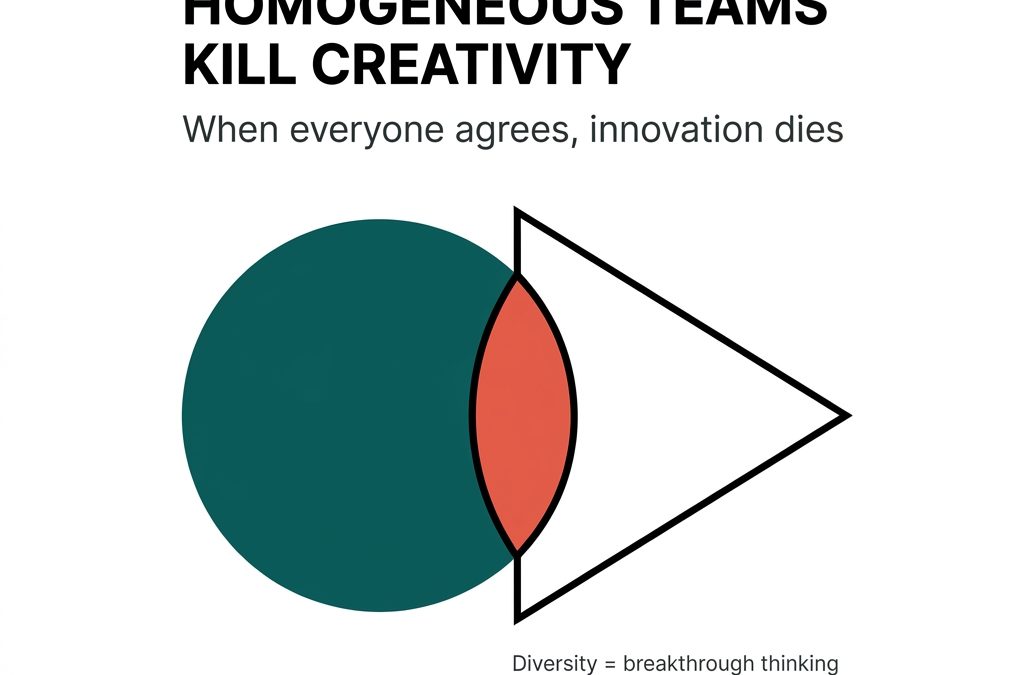
TL;DR: Homogeneous teams kill creativity by eliminating cognitive friction. Diversity isn’t a moral stance, it’s a creative technology. When different worldviews collide, they generate solutions that uniform thinking cannot access. The discomfort you feel when perspectives clash? That’s where breakthrough thinking lives.
Core Answer:
-
Cognitive diversity (different ways of thinking) matters more than traditional diversity metrics for creative outcomes
-
Homogeneous teams mistake agreement for truth and become structurally incapable of breakthrough thinking
-
Creative friction between different perspectives reveals invisible assumptions and unlocks new solutions
-
Leaders must build internal capacity to handle discomfort before diversity initiatives become genuine
-
The question shifts from “how do we accommodate differences?” to “what perspectives are we missing?”
What I’ve Learned From Film Sets
I’ve been in the film-industry for over a decade. The pattern I keep seeing: the best creative breakthroughs come from collision, not brilliance.
Cinematography sees light and shadow. Sound design hears texture and silence. Costume reads character through fabric. These perspectives clash. Something unexpected emerges from that friction. No single brilliant mind generates what their collision creates.
This isn’t about traditional diversity metrics. I’m talking about cognitive diversity. Different ways of thinking about the same problem.
Homogeneity doesn’t limit creativity. It kills it.
Key insight: Creative breakthroughs emerge from cognitive friction between different worldviews, not from individual genius.
Why Sameness Feels Safe
Every organization I work with has the same invisible problem.
They normalize. Create shared values. Standardize processes. Build governance structures. They call it alignment. Culture. Team cohesion.
They’re building walls.
I understand why. When everyone thinks similarly, meetings run smoother. Decisions happen faster. Less friction. Less disagreement. Less discomfort when someone challenges assumptions.
That comfort? That’s the signal creative growth has stopped.
Research confirms this. Homogeneous teams are more susceptible to groupthink, where the desire for harmony leads to irrational decisions. When people around you think like you, you stop encountering ideas that challenge your worldview.
You mistake agreement for truth.
Key insight: Comfort in decision-making signals the absence of cognitive diversity, not team effectiveness.
Diversity as Creative Technology
I need you to reframe diversity for a moment.
Not as a moral stance. Not as a checkbox. As creative technology. A structural requirement for innovation.
Genuine creativity requires divergent thinking. The ability to generate multiple solutions from different angles. Divergent thinking doesn’t happen when everyone in the room shares the same mental models, life experiences, and unconscious assumptions about how the world works.
The data is striking. Stanford research shows teams with differing perspectives generate 60% more creative solutions than homogeneous groups. They consider 48% more solutions to problems. Companies with diverse management teams earn 19% more revenue from innovation.
This isn’t about being nice. This is about accessing cognitive territory that uniform thinking cannot reach.
Key insight: Diversity functions as a mechanism for accessing solutions that homogeneous thinking structurally cannot generate.
How This Shows Up on Film Sets
Let me show you what this looks like in practice.
On a film set, departments operate from completely different worldviews. The production designer thinks spatial storytelling. The director of photography thinks emotional tone through color temperature. The sound mixer thinks about what silence communicates.
When these minds collaborate, they challenge each other’s invisible assumptions.
I’ve watched a costume designer’s choice completely shift how a cinematographer lights a scene. I’ve seen a sound designer’s perspective force a director to reconsider the entire emotional arc of a sequence. These aren’t conflicts. They’re creative friction generating solutions none of them could find alone.
The acting world demonstrates this principle visibly. When diverse creative teams develop films, directors, producers, writers who bring different lived experiences, they unlock stories homogeneous teams cannot access. Films like Black Panther and Soul captured nuances that made them resonate deeply because the creators shared their characters’ identities and experiences.
The authenticity you feel? That’s what happens when diverse perspectives shape the work from the beginning.
Key insight: Different departmental worldviews create productive friction that generates creative solutions no single perspective could produce.
The Fear Response as Diagnostic Tool
Here’s how you know if your team has built invisible walls.
Watch what happens when something unexpected enters the room. An idea that wasn’t calculated. A perspective that challenges consensus. A solution that doesn’t fit the established pattern.
If the response is fear, if people shut it down, if they get defensive, if they explain why it won’t work before considering it, you’re looking at a team that has normalized homogeneity.
If the response is curiosity, if people lean in, if they ask questions, if they explore implications even when uncomfortable, you’re looking at a team with creative capacity.
The leader sets this tone. I’ve seen it hundreds of times. If the person at the top encourages out-of-the-box thinking, stays calm when surprised, creates space for failure, the entire team relaxes into creative possibility. Everyone becomes solution-focused. Ideas flow.
If the leader tolerates diversity only on paper? If they promise openness but react with fear when assumptions get challenged? The team learns to keep divergent thinking to themselves.
Key insight: Team responses to unexpected ideas (fear versus curiosity) reveal whether diversity is genuine or performative.
The Culture Fit Trap
Most organizations don’t realize they’re building homogeneous teams.
They think they’re hiring for culture fit. They want people who share their values, who communicate in similar ways, who won’t disrupt the existing dynamic.
They’re hiring people who think like they already think.
I’ve experienced this pattern repeatedly. Leaders say they want diversity and innovation. They promise it on paper. When someone brings genuinely different thinking, when it creates the uncomfortable friction that precedes breakthrough, they cannot handle it.
They haven’t learned how to handle themselves. They’re afraid of losing control, of looking incompetent, of having their worldview challenged in front of others.
So they hire people who confirm existing assumptions. They call it culture fit. They mistake it for team cohesion. And they wonder why creativity has stagnated.
Key insight: “Culture fit” often functions as unconscious homogeneity that leaders mistake for team effectiveness.
The Inner Work Nobody Discusses
Here’s what I’ve learned from working with leaders who want to change this pattern.
The tools for handling diversity’s friction already exist. You have to do the internal work first.
In traditional yoga culture, there’s this principle: become the leader of yourself before you lead others. The Isha Yoga Center teaches specific practices for inner engineering. For controlling how you react from the inside so external circumstances don’t control you.
When leaders do this work, they build capacity to stay grounded when diversity brings the messy, unexpected stuff. They handle disagreement without feeling threatened. They sit with uncertainty without forcing premature closure.
Without that foundation, all the diversity initiatives in the world are performance.
I’ve noticed something else. People who’ve experienced genuine suffering, chronic illness, loss of loved ones, significant failure, tend to be more resilient and relaxed in creative environments. They’ve already met the unexpected and survived it. They’re not afraid of friction because they know it’s part of the process.
That lived experience becomes a form of diversity itself. The internal diversity of having wrestled with real hardship gives them access to perspectives and emotional ranges that someone who’s lived a comfortable, predictable life doesn’t have.
Key insight: Leaders need internal capacity (through practices like yoga or lived hardship) to handle the discomfort diversity creates before external initiatives become genuine.
What Diverse Teams Reveal
The real value of diversity isn’t adding new ideas to the mix.
Diverse perspectives reveal the limitations of your current thinking that you couldn’t see from inside it.
When someone with a genuinely different worldview looks at your problem, they see assumptions you didn’t know you were making. They spot patterns you’ve normalized. They ask questions that feel obvious to them but have never occurred to you.
This is why research shows creative diversity matters more than individual creativity. Teams with varied thinking styles outperform teams of individually brilliant people who all think the same way. You don’t need high collective creativity. You need creative diversity and collaboration.
The friction between different perspectives generates solutions uniform thinking cannot access. Different lived experiences collide and create new territory.
Key insight: Diverse teams don’t just add perspectives, they expose invisible assumptions in your current thinking you couldn’t see from within it.
Where Is Your Thinking Too Uniform?
Look at your own environment honestly.
Where have you surrounded yourself with people who think like you? Where have you normalized processes that feel comfortable because they confirm your existing worldview? Where are you mistaking agreement for innovation?
This isn’t about guilt. It’s about recognition.
Most of us build these invisible walls without realizing it. We hire people we connect with easily. We collaborate with people who understand us intuitively. We create systems that reward thinking aligned with ours.
Slowly, without noticing, we’ve created an echo chamber where breakthrough thinking becomes structurally impossible.
The question isn’t whether you value diversity in theory. The question is whether you’ve built the internal capacity to handle what diversity brings: discomfort, friction, challenges to assumptions, solutions that don’t fit your mental models.
Because that’s where creativity lives. Not in the comfort of sameness, but in the collision of genuinely different ways of seeing the world.
Key insight: Building capacity for discomfort matters more than intellectual commitment to diversity.
Frequently Asked Questions
What is cognitive diversity?
Cognitive diversity refers to differences in how people think, process information, and solve problems. It includes different mental models, life experiences, educational backgrounds, and approaches to creativity. This matters more for innovation than surface-level demographic diversity alone.
How do I know if my team lacks cognitive diversity?
Watch how your team responds to unexpected ideas. If the default response is fear, defensiveness, or immediate rejection, you’ve built homogeneity. If the response is curiosity and exploration, you have genuine diversity. Also look for: quick consensus without debate, comfort in all meetings, and hiring people who “fit in” easily.
Does diversity always create conflict?
Diversity creates friction, not necessarily conflict. Friction is the productive discomfort when different worldviews challenge each other’s assumptions. This feels uncomfortable but generates breakthrough thinking. Conflict happens when people lack the internal capacity to handle that friction constructively.
How do leaders build capacity to handle diverse perspectives?
Internal work comes first. Practices like yoga, meditation, or other forms of self-regulation help leaders stay grounded when challenged. Leaders who’ve experienced genuine hardship (illness, loss, failure) often have this capacity naturally because they’ve already survived the unexpected.
What’s wrong with hiring for culture fit?
Culture fit often becomes code for “thinks like we already think.” You end up hiring people who confirm your existing assumptions rather than challenge them. This creates the illusion of team cohesion while eliminating the cognitive friction necessary for innovation.
Can diversity work without individual creativity?
Yes. Research shows creative diversity (different thinking styles collaborating) matters more than individual creativity levels. A team of moderately creative people with diverse perspectives outperforms a team of brilliant people who all think the same way.
What perspectives am I missing in my environment?
Look at who you hire, who you listen to, whose ideas get implemented. If everyone shares similar backgrounds, education, life experiences, or ways of processing information, you’re missing perspectives. The real question: what solutions exist that you cannot see because of your current cognitive homogeneity?
Is this about demographic diversity or thought diversity?
Both matter, but they’re connected differently than most people realize. Different lived experiences (which often correlate with demographic differences) create genuinely different ways of thinking. The goal isn’t demographic diversity for its own sake, it’s accessing the cognitive diversity that different life experiences produce.
Key Takeaways
-
Cognitive diversity (different ways of thinking) is a creative technology, not a moral obligation. It generates solutions homogeneous teams structurally cannot access.
-
Homogeneous teams mistake agreement for truth and comfort for effectiveness. When meetings feel easy, creative growth has likely stopped.
-
Creative friction between different worldviews reveals invisible assumptions and unlocks breakthrough thinking. The discomfort is the signal, not the problem.
-
Leaders must build internal capacity to handle diversity’s friction before external initiatives become genuine. This comes through practices like yoga or lived experience with hardship.
-
“Culture fit” often creates unconscious homogeneity. You hire people who confirm existing assumptions rather than challenge them.
-
Teams reveal their true diversity through emotional responses to unexpected ideas. Fear signals performative diversity. Curiosity signals genuine capacity.
-
The reframe shifts from “how do we accommodate differences?” to “what perspectives are we missing that would unlock solutions we cannot see yet?”
When you cherish diversity as the mechanism for creative problem-solving rather than an obligation, everything changes about how you build teams, approach problems, and define creativity itself.
The rooms where creativity thrives don’t look the same. Don’t think the same. Don’t operate from the same assumptions.
That’s exactly why they work.
by Christian Kresmann, Founder - Beyond Creativity | 2026, Apr, 6 | business, creativity, leadership, mindset
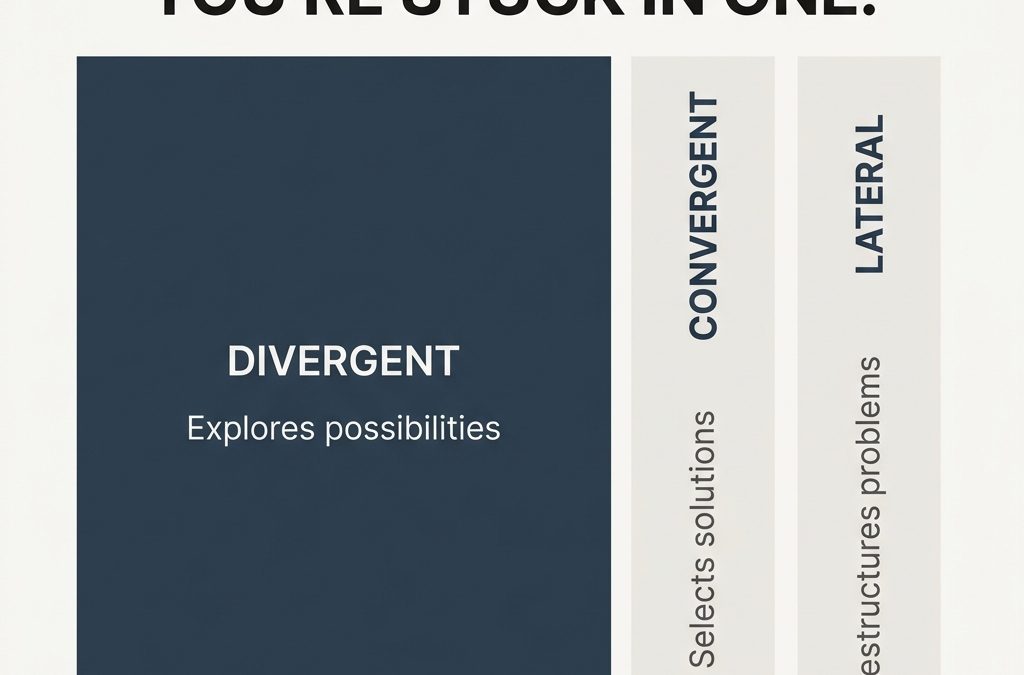
TL;DR: Your brain has three problem-solving modes, but you’re stuck using one. Divergent thinking explores possibilities. Convergent thinking selects solutions. Lateral thinking restructures problems. The people who break through learn to switch between all three. Here’s how to identify your default mode and expand your range.
-
Your brain suppresses the modes you’re not using, creating invisible walls in how you solve problems.
-
98% of children think divergently at genius level. Education buries this to 2% in adults.
-
Switching modes feels uncomfortable because of measurable “switch cost,” but cognitive flexibility leads to better life outcomes.
-
To expand: name your current mode, practice the one you avoid, separate modes by time or environment, accept temporary performance dips.
What Are the Three Problem-Solving Modes?
In 1956, psychologist J.P. Guilford identified two fundamental thinking patterns: divergent and convergent thinking. Edward de Bono later added lateral thinking.
These aren’t personality types. They’re cognitive functions everyone has.
Divergent thinking explores possibilities. You generate ideas without judgment. Volume and variety matter more than quality at this stage.
Convergent thinking selects solutions. You evaluate options through logical steps, refine them, and pick what works.
Lateral thinking restructures the problem. You don’t move forward step by step. You jump sideways to find what linear thinking misses.
Here’s the part nobody tells you: your brain actively suppresses the modes you’re not using.
MIT research found the mediodorsal thalamus suppresses representations not currently needed. This sharpens focus. But there’s a cost. Your brain builds invisible walls around your problem-solving range.
What this means: Each thinking mode is a tool. Your brain turns off the tools you’re not using to protect attention. This narrows your options without you noticing.
How Do You Identify Your Default Mode?
Most people don’t know which mode they’re operating in.
Research identifies this as one of the biggest obstacles to cognitive flexibility. People conflate these modes with identity instead of recognizing them as tools to be consciously selected.
Here’s how each mode shows up in your work:
You default to divergent thinking if:
-
You pump out brilliant ideas but struggle to finish projects
-
You see possibilities everywhere and feel overwhelmed by options
-
Structure feels limiting, so you resist
-
People call you creative but unreliable
You default to convergent thinking if:
-
You execute flawlessly but rarely question the direction
-
You want clear processes and measurable outcomes
-
Ambiguity or open-ended exploration makes you uncomfortable
-
People call you dependable but predictable
You default to lateral thinking if:
-
You challenge assumptions without thinking, sometimes to your detriment
-
You see connections others miss but struggle to explain your logic
-
Conventional approaches bore you
-
People call you insightful but hard to follow
None of these defaults are wrong.
The problem is staying locked in one.
What this means: Your default mode is where you feel comfortable. The other two modes hold your growth potential.
Why Does Switching Feel Impossible?
When you try to shift between modes, your brain resists.
Task switching and set shifting produce what researchers call “switch cost.” Response times slow. Accuracy drops. This happens because your brain needs time to shut down the previous response set and reconfigure for the new task.
The temporary performance dip is real. Measurable.
But here’s what research shows: individuals with greater cognitive flexibility have improved life outcomes, better social functioning, and reduced cognitive decline with age.
The discomfort of switching is the price of mental freedom.
I learned this during the hardest stretch of my life. When I was diagnosed with multiple sclerosis, I faced paralysis and blindness. I chose my mind as the one thing no disease would take. I spent 10 years rewiring my nervous system, learning to switch between analytical precision, creative exploration, and unconventional problem-solving.
Comfortable? Nope.
Necessary? Absolutely.
What this means: Your brain fights mode-switching because reconfiguration costs energy. The discomfort is evidence of neurological change, not failure.
What Happens When You Master All Three Modes?
Mode-switching separates exceptional performers from everyone else.
Recent cognitive research shows convergent thinking isn’t the opposite of creativity but part of the creative process. Ideas you produce during divergent thinking must be evaluated, selected, and refined through convergent reasoning to become practical innovations.
Breakthrough work happens at the intersection, not in isolation.
I see this pattern weekly in my coaching practice. The clients who move fastest are the ones who:
-
Generate multiple possibilities without attachment (divergent)
-
Evaluate those possibilities with clear criteria (convergent)
-
Challenge their own assumptions when stuck (lateral)
They don’t favor one mode. They toggle between all three based on what the situation requires.
Organizations embracing structured creative problem-solving innovate three times faster than those who don’t. Teams using these methods cut time-to-market by 40% compared to traditional approaches.
This isn’t about working harder. This is about expanding your range.
What this means: Each mode produces different results. Mastery comes from knowing which mode the moment needs, then switching to it deliberately.
How Do You Expand Your Problem-Solving Range?
Cognitive flexibility is trainable. But not how you think.
Research shows 98% of children think divergently at genius level. Education reduces this to 2% in adults. The capacity isn’t lost. Conditioning buried it.
Here’s what works:
1. Name the mode you’re in
Before you switch, recognize where you are.
Ask yourself: Am I generating options, evaluating them, or challenging the frame entirely?
Awareness precedes choice.
2. Practice the mode you avoid
If you default to divergent thinking, spend time converging. Set a timer. Force yourself to choose one idea and execute.
If you default to convergent thinking, spend time diverging. Generate 10 solutions to a problem without evaluating any of them.
If you default to lateral thinking, practice both divergent generation and convergent selection in sequence.
The discomfort signals expansion.
3. Build transitions into your process
Don’t try to do everything at once. Separate your modes by time or space.
Morning: divergent exploration. Afternoon: convergent refinement. Evening: lateral review.
Or separate by environment. Diverge while walking. Converge at your desk. Challenge assumptions in conversation.
Your brain adapts its flexibility level to suit environmental demands. Use context as a trigger.
4. Accept the switch cost
You’ll feel slower when you first start switching. Your accuracy will drop temporarily.
This is normal. This is growth.
The neuroscience is clear: each mode has a distinct neural signature. Upper alpha synchronization during divergent thinking. Desynchronization during convergent thinking. Your brain needs time to reconfigure.
Give it that time.
What this means: Cognitive flexibility is a muscle. Train it by deliberately using the modes you avoid, even when uncomfortable.
What Changes When You Master All Three?
I’ve watched this transformation hundreds of times.
The divergent thinker who learns to converge suddenly ships work instead of drowning in possibilities.
The convergent thinker who learns to diverge suddenly innovates instead of optimizing the same patterns.
The lateral thinker who learns both suddenly becomes someone others follow instead of admire from a distance.
The invisible wall most professionals never recognize: the belief you are your default mode.
You’re not stuck because you lack capability.
You’re stuck because you’ve unconsciously limited your range.
The capacity to switch is already there. You need to practice using it.
Where Should You Start?
Pick one problem you’re facing right now.
Spend 10 minutes in pure divergent mode. Generate as many solutions as possible without judgment.
Then spend 10 minutes in pure convergent mode. Evaluate each solution against clear criteria and choose one.
Then spend 10 minutes in lateral mode. Challenge the problem itself. What assumptions are you making? What would change if the opposite were true?
Notice which mode felt natural. Notice which mode felt uncomfortable.
The uncomfortable one is where your growth lives.
I’ve spent a decade helping people dissolve the walls they mistake for themselves. This is one of the most common: the belief you are your default mode.
You’re not.
You’re someone who chooses which tool to use based on what the moment requires.
Start practicing now.
Frequently Asked Questions
What’s the difference between divergent and lateral thinking?
Divergent thinking generates multiple solutions to a defined problem. Lateral thinking restructures the problem itself. Divergent asks “what else works?” Lateral asks “what if we’re solving the wrong problem?”
How long does it take to develop cognitive flexibility?
The neuroscience shows measurable changes within weeks of deliberate practice. But mastery takes months to years, depending on how deeply ingrained your default mode is. Expect discomfort for the first 30 days.
Which mode is most important for creative work?
None of them. Creative breakthroughs require all three. Divergent generates raw material. Convergent refines and selects. Lateral reframes when you’re stuck. The mode matters less than knowing when to switch.
What if I’m strong in two modes but weak in one?
Common pattern. Focus 80% of your practice time on the weak mode. The discomfort signals you’re expanding into new territory. Your strong modes will stay sharp with minimal maintenance.
Does cognitive flexibility decline with age?
Research shows cognitive flexibility declines naturally with age, but deliberate practice reverses this. People who train mode-switching maintain and even improve flexibility into their 70s and beyond.
How do I know if I’m actually switching modes or just thinking I am?
Track outputs, not intentions. Divergent mode produces volume (10+ ideas). Convergent mode produces decisions (one chosen path). Lateral mode produces reframes (new problem definitions). Measure what you produce, not what you feel.
What if my job only rewards one mode?
Short-term thinking. Organizations innovate three times faster when they use all three modes. If your role only values convergent execution, you’re vulnerable to automation and disruption. Build range now, even if your environment doesn’t reward it yet.
Is there a fourth mode researchers have identified?
Some researchers propose additional modes, but divergent, convergent, and lateral remain the most validated across decades of cognitive science. Master these three before exploring theoretical extensions.
Key Takeaways
-
Your brain has three problem-solving modes: divergent (explores possibilities), convergent (selects solutions), and lateral (restructures problems). Most people unconsciously lock into one.
-
Your brain suppresses unused modes to protect focus, creating invisible walls in your problem-solving range. This is neurological, not personal failure.
-
Switching modes produces measurable “switch cost” (slower response, lower accuracy), but people with cognitive flexibility have better life outcomes and reduced cognitive decline.
-
To expand your range: name your current mode, practice the mode you avoid, separate modes by time or environment, and accept temporary performance dips as evidence of growth.
-
Breakthrough work happens at the intersection of all three modes. Organizations using structured creative problem-solving innovate three times faster and cut time-to-market by 40%.
-
98% of children think divergently at genius level. Education buries this to 2% in adults. The capacity isn’t lost. Deliberate practice uncovers it.
-
You’re not your default mode. You’re someone who chooses which tool to use based on what the moment requires. Start practicing now.
by Christian Kresmann, Founder - Beyond Creativity | 2026, Apr, 3 | acting, business, creativity, leadership, mindset, spirituality

TL;DR: We ask meaningful questions but fail to listen to the answers, turning genuine inquiry into performance. This creates emotional harm equivalent to physical pain and erodes trust in relationships. The fix is simple: if you ask, wait for the answer.
Core insights:
-
Asking questions without listening communicates “you don’t matter” and activates the same brain regions as physical pain
-
Only 2% of people are skilled at active listening, yet 60% of workplace failures stem from poor listening
-
Real listening creates inter-brain synchrony, a neurological bond that technology can’t replicate
-
The solution: if you’re not interested in the answer, don’t ask the question
What Performative Curiosity Looks Like
Someone asks how your new job is going.
You start to answer. Mid-sentence, their eyes drift. They check their phone. Or they interrupt with their own story about their career transition three years ago.
The question wasn’t a question. It was theater.
I’ve watched this pattern repeat across family dinners, professional meetings, coffee with friends. The setting changes. The behavior stays the same.
Someone poses a meaningful question, then vanishes before the answer arrives.
Why Deeper Questions Get Less Attention
Here’s what I notice: the deeper the question, the faster people disappear.
“How are you handling your father’s illness?”
“What does this career change mean for you?”
“How did that conversation with your partner go?”
These aren’t small talk. These are invitations into someone’s inner world. And the person asking often treats them like they’re discussing the weather.
Research shows only 2% of people are skilled at active listening. Meanwhile, 69% of leaders say it’s essential. That gap tells you everything.
We value something we refuse to practice.
The result? 65% of employees feel misunderstood due to poor listening skills. And 60% of workplace failures stem from inadequate listening, not lack of knowledge or skill.
We’re failing at the one thing that matters.
Key point: We ask vulnerable questions but treat them like small talk, creating a gap between what we say matters and what we practice.
What Being Unheard Does to Your Brain
When someone asks you a question but doesn’t listen to your answer, something specific happens in your body.
It feels like a slap in the face.
That’s not metaphor. Research shows social rejection and being ignored activate the same brain regions as physical pain. Your brain processes being unheard like a scraped knee or kicked shin.
It’s neurological violence.
I feel it as layers. First comes the sense of being unimportant. Then the realization that I’m not seen or heard. Finally, the understanding that what I think and how I go about life doesn’t matter to this person.
Each layer compounds.
And here’s what makes it worse: the person asking the question is often doing it because they don’t feel seen and heard either. They’re using you as an outlet for their own thoughts and opinions. They want to feel smart, to show they understand how the world works.
The question becomes a way of showing off.
Key point: Being ignored triggers the same neural pathways as physical pain. When we ask questions we don’t listen to, we’re inflicting neurological harm.
How We Lost Our Attention Span
Our attention spans have collapsed. Dr. Gloria Mark’s research tracked them declining from 150 seconds in 2004, to 75 seconds in 2012, to 47 seconds in 2024.
We’re losing the capacity to stay present long enough to hear a full answer.
People check their phones up to 80 times per day while believing they only check 25 times. Half of us admit we don’t stop checking our smartphones even when we should be focusing.
The mental garbage we carry interrupts our capacity for human connection. The vacation we’re planning. The meeting we’re worried about. The argument we had this morning.
We think these preoccupations are important. They’re not. They’re noise masquerading as meaning.
And here’s the paradox: we think we’re too busy for the kind of attention real listening requires. But the chance to relax, to be present, to connect is already available in the moment with the person in front of us.
We’re too distracted to notice.
Key point: Our attention spans have dropped to 47 seconds. We’re physically losing the ability to listen, treating connection as less important than the noise in our heads.
What Genuine Listening Feels Like
I notice when someone is genuinely listening through an invisible bond between us. There’s a magnetism that either strengthens or fades.
When it’s there, time stops. It also feels like eternity. Our life energies tie together. There is no other human being in the world for me. Only the person in front of me.
Yale research discovered that face-to-face conversations create coordinated neural activity between two brains. A literal synchronization that’s suppressed during Zoom or digital interactions. Real listening creates what scientists term “inter-brain synchrony” that technology doesn’t replicate.
This isn’t poetry. It’s neuroscience.
When two people genuinely connect through eye contact and deep listening, their brainwaves sync up. This synchrony enhances empathy, trust, and emotional regulation.
But it only happens with authentic presence. Performative questioning kills it.
Key point: Real listening creates inter-brain synchrony, a neurological bond where two people’s brainwaves align. Performative questions destroy this connection.
The One Rule That Changes Everything
If you’re not interested in the answer, don’t ask the question.
That’s it. That’s the whole thing.
Don’t prompt someone to share if their words will be met with distraction or indifference. Don’t request vulnerability you have no intention of honoring.
There’s a distinction worth noting: casual exchanges about weather or commutes don’t carry the same weight. Those surface-level pleasantries serve a different function. They’re social lubricant.
The issue arises with questions that matter. Questions that touch on things of substance.
Those require space, patience, and listening.
Key point: The rule is simple. If you ask a meaningful question, wait for the answer. Anything less is performative cruelty.
What Fake Listening Communicates
When we ask a question but don’t wait for the answer, we communicate something specific: you don’t matter. Your feelings don’t matter. All I care about is my own well-being.
And here’s the part we miss: my well-being would be far greater by including you.
We think too much of ourselves. We think we’re the most important person in the world. We ignore that we’re a tiny speck in the whole cosmos. We’re unimportant even in the city we live in, even more unimportant in our country, and especially insignificant among the 8 billion people on this planet.
Underneath that is a basic thought pattern: we divide and exclude rather than recognizing that every life on earth is part of ourselves.
If we understood that every life is part of ourselves, we would slow down. We would taste every answer given. We would have compassion about the story between the words spoken out loud.
Because we would be listening to ourselves.
Key point: Not listening tells someone they don’t matter. We miss that our well-being depends on including others, not prioritizing ourselves.
Why Real Engagement Is So Rare
True engagement requires more than surface-level inquiries. It demands follow-up questions, sustained attention, and genuine curiosity about the response.
Leaders especially should master this: asking “How’s the new job?” then absorbing the answer instead of rushing to the next topic or pivoting the conversation back to themselves.
The frustration intensifies when someone prompts a response, then talks over the answer with their own thoughts, redirecting everything back to their experience.
The conversation becomes a monologue disguised as dialogue.
Research shows 74% of employees say being heard at work boosts engagement and motivation. Yet more than half of managers fail to listen effectively to their teams.
We’ve normalized asking questions as performance rather than genuine inquiry.
Key point: 74% of employees say being heard boosts engagement, but most managers fail to listen. We’ve turned questioning into performance art.
How I Know When I’m Failing at This
I catch myself sometimes starting to do the thing I hate when others do it to me.
I notice the other person drifting away with their thinking. It’s in their eye movement. They get restless. The invisible bond between us slowly fades. The magnetism loses its power.
I also notice it when I start to articulate worse. When I ramble. When I lose my focus and presence. When I get lost in my thoughts.
That’s the signal. That’s when I shift focus back to the other person.
I like to listen 80% of the time and only speak 20% of the time. Unless I’m asked to speak. Then I go all in as a coach or trainer or actor or speaker on stage.
But in regular conversations, I like to give space.
Because real questions deserve real attention.
Key point: The signal that I’m not listening: the other person gets restless, I start to ramble, the bond fades. That’s when I shift back to them.
The Long-Term Damage of Not Being Heard
Prolonged experiences of not being heard lead to increased stress hormones, diminished self-worth, emotional isolation, trust breakdown, and learned helplessness where people stop trying to be heard even when opportunities arise.
The psychological cost compounds over time.
From the day we’re born, being seen and heard by others are fundamental human needs. Going unheard for extended periods leads to erosion of self-worth, emotional suppression, chronic stress, and physical health consequences.
This isn’t rudeness. It’s a form of violence we’ve normalized.
And here’s what makes it tragic: the solution is simple.
Wait for the answer.
If the answer matters enough to ask about, it matters enough to wait for. Real questions deserve real attention.
Anything less is noise masquerading as conversation.
Key point: Chronic experiences of being unheard cause stress, diminished self-worth, and learned helplessness. The damage compounds over time.
What Shifts When We Actually Listen
If someone understood that every life on earth is part of themselves, what would change about how they ask questions?
They would slow down.
They would taste every answer given.
They would have compassion about the story between the words spoken out loud.
Because they would be listening to themselves.
The invisible bond would strengthen instead of fade. The magnetism would grow. Time would stop in the best possible way.
And both people would walk away having experienced something rare: genuine human connection.
That’s what’s available when we stop performing curiosity and start practicing it.
The question is whether we’re willing to slow down long enough to find out.
Common Questions About Active Listening
How do I know if someone is genuinely listening to me?
You’ll feel an invisible bond, a magnetism between you. Their eye contact stays consistent. They ask follow-up questions. Time seems to slow down. You feel seen, not judged.
What’s the difference between small talk and questions that require real listening?
Small talk serves as social lubricant (weather, commutes). Real questions invite vulnerability (“How are you handling your father’s illness?”). The latter requires patience, space, and genuine attention.
Why do people ask questions they don’t want answered?
Often because they don’t feel seen and heard themselves. They use questions as a way to show off their thinking, to feel smart, to get their opinions out. It’s performance, not curiosity.
What happens in my brain when someone ignores me after asking a question?
Social rejection and being ignored activate the same brain regions as physical pain. Your brain processes being unheard like a scraped knee. It’s neurological violence, not just rudeness.
How do I catch myself when I’m not listening?
Watch for these signals: the other person gets restless, their eyes drift, you start rambling, you lose focus. The invisible bond between you fades. When you notice that, shift your attention back to them.
What’s inter-brain synchrony?
When two people genuinely connect through eye contact and deep listening, their brainwaves sync up. This neurological alignment enhances empathy, trust, and emotional regulation. It only happens with authentic presence.
How long should I wait before responding to someone’s answer?
Long enough to taste every word. Long enough to hear the story between the words spoken out loud. If you’re already formulating your response while they’re talking, you’re not listening.
What’s the long-term cost of not being heard?
Increased stress hormones, diminished self-worth, emotional isolation, trust breakdown, and learned helplessness. People eventually stop trying to be heard even when opportunities arise. The damage compounds over time.
Key Takeaways
-
Asking questions without listening activates the same brain regions as physical pain. It’s neurological violence we’ve normalized.
-
Only 2% of people are skilled at active listening, yet 60% of workplace failures stem from poor listening, not lack of knowledge.
-
Real listening creates inter-brain synchrony where two people’s brainwaves align, enhancing empathy and trust. Performative questions destroy this bond.
-
Our attention spans have collapsed from 150 seconds in 2004 to 47 seconds in 2024. We’re physically losing the ability to listen.
-
The simple rule: if you’re not interested in the answer, don’t ask the question. Anything less is performative cruelty.
-
When we ask but don’t listen, we communicate “you don’t matter.” We miss that our well-being depends on including others.
-
The solution is simple: slow down, taste every answer, have compassion for the story between the words. Real questions deserve real attention.