by Christian Kresmann, Founder - Beyond Creativity | 2026, Jun, 30 | leadership, mindset
TL;DR: Your attention works like a spotlight. Where you point it determines your reality. Most suffering comes from unconsciously aiming that spotlight at unchangeable problems. The Spotlight Principle teaches you to redirect your attention deliberately, transforming your experience without changing your circumstances.
Core insights:
-
Attention is active, not passive. You control where it points.
-
Victim Grammar traps you by making you the passive receiver of events.
-
The Pivot Question moves your spotlight: “What do I want to be true here instead?”
-
You cannot control circumstances, but you can control where you direct your consciousness.
There is a man I think about sometimes. I never learned his name.
He was sitting in a wheelchair in the hospital corridor where I was waiting for test results. This was during the period when doctors had told me I might go blind. That I might lose the use of my legs. That multiple sclerosis was, in all likelihood, what had come to live inside my nervous system.
I was sitting there, watching this man in the wheelchair navigate a narrow turn near the nurses’ station. He was focused. Precise. There was something in his posture — not defeat, not performance — just a kind of clean attention to the task in front of him.
And I thought: what does he see?
Not literally. I mean: where is his light pointing right now?
That question cracked something open in me. Not because it was comforting. Because it was clarifying. Whatever the test results said, whatever my body was about to become or not become, there was still this: a beam of consciousness I was holding. And I was the one deciding where to aim it.
That observation became a decade of research, practice, and one book. It is the heart of what I call the Spotlight Principle.
How Does the Spotlight Principle Work?
Attention is not passive. It is not something that happens to you.
You’re doing it constantly, almost completely unconscious of the process.
The Spotlight Principle starts with a simple proposition: consciousness works like a spotlight in a dark theater.
Wherever you point it, that area becomes vivid, real, present. Everything outside the beam still exists, but it fades. It loses its urgency. It stops generating emotion and behavior.
Sounds obvious when you say it out loud.
Sounds less obvious when you watch what it does to a life.
The leader who keeps rehearsing the conversation that went wrong.
The creative professional who sees every new project through the filter of the last failure.
The person who has changed jobs, cities, relationships, habits, and finds themselves in the same emotional landscape within six months.
They’re not unlucky. They’re not broken.
They’re pointing their spotlight at the same things, with the same precision, every single time.
Nothing changes because the most important variable never changes: where attention is directed.
Key point: Your attention creates your reality. Most people direct it unconsciously at the same patterns, then wonder why their life feels the same.
What Is Victim Grammar?
Language is not just how we describe reality.
It is how we construct it.
This took me a long time to accept, even with all the research behind it. Most of us think of words as labels we attach to pre-existing experience. We see something, feel something, then find the words for it.
The sequence is often reversed. The words we reach for first shape what we perceive.
How Victim Grammar Works
Victim Grammar is a set of linguistic structures that position the speaker as the passive receiver of events rather than an active agent within them.
Notice the difference:
“My anxiety won’t let me.”
“I feel anxious, and I am choosing not to yet.”
Both sentences describe a real internal state.
The first locates the cause entirely outside the self. The anxiety is a force with its own will. It won’t let the person do the thing. The person is a bystander in their own experience.
The second sentence acknowledges the same feeling while preserving agency. The anxiety is still present. The not-doing is still happening.
The architecture of the sentence keeps the person in the driver’s seat.
This isn’t a trick. It’s not positive thinking. It’s precision.
Precision matters because your brain takes its structural cues from language. When you speak consistently in passive constructions, you train your nervous system to scan for evidence that external forces control your life.
Your nervous system is good at finding what it looks for.
Victim Grammar keeps the spotlight aimed at what is happening to us. The alternative is not denial.
The alternative is redirection.
Key point: The language you use shapes the reality you perceive. Passive language trains your brain to see yourself as powerless.
How to Use the Pivot Question
The most practical tool in the Spotlight Principle is simple.
When you notice your attention has locked onto something that generates suffering without generating change (a regret, a grievance, a fear playing on loop), you ask:
What do I want to be true here instead?
Not “what should I feel?”
Not “what is the positive spin on this?”
Not even “what am I grateful for?”
Those questions often fail because they ask you to perform a different emotion while leaving the spotlight exactly where it is.
This question is different.
It asks the spotlight to move.
If I could point my attention somewhere that would serve me right now, where would that be?
The answer doesn’t need to be big. It rarely is.
“I want to be someone who gets back to work after a bad meeting” is enough.
“I want to still care about this project at the end of the day” is enough.
Even “I want to not be completely consumed by this right now” is a legitimate answer.
What matters is the act of redirection itself.
The neural pathway from stimulus to suffering is not inevitable. There is a gap. In that gap, if you have practiced finding it, there is a question.
The Pivot Question is a tool for locating that gap.
Key point: The Pivot Question redirects your spotlight from suffering to possibility. Small answers are enough. The act of redirection matters more than the size of the answer.
What Multiple Sclerosis Taught Me About Control
I want to be honest about what my MS diagnosis changed, and what it did not.
It didn’t make me serene. It didn’t install permanent equanimity I could access on demand.
I was scared for a long time. I grieved the body I had assumed I would keep. I had weeks where the spotlight went to dark places and I didn’t have the skill or energy to move it.
What changed was structural, not emotional.
Lying in a hospital bed with a headache that had lasted three weeks, I found myself doing an inventory.
If I lose my sight, I thought, I still have my mind. If I lose my legs, I still have my mind. If this is the worst-case scenario, my mind is still the space where I live.
That thought was not comforting in the way comfort usually feels.
It was more like finding a floor. Something solid underfoot after a long period of not knowing if there was one.
What I found was not hope.
It was orientation.
I realized I had been trained, like almost everyone, to locate my sense of freedom and capability in my circumstances.
Good circumstances, felt capable. Bad circumstances, felt trapped.
This is such a common arrangement we rarely notice it is an arrangement at all. We treat it as physics.
The MS diagnosis made it impossible to pretend the arrangement was physics.
The external circumstances were objectively terrible, and yet the choice about where to point my attention remained intact.
That choice is always intact. That is what I learned.
Key point: Freedom lives in where you direct your attention, not in your circumstances. That choice remains intact no matter what happens to you.
Why Transformation Does Not Require Suffering
Here is the part that surprises people.
This work doesn’t have to be slow. It doesn’t have to be painful.
It doesn’t require years of excavation before anything shifts.
Transformation has a reputation for being hard because we have confused difficulty with depth.
We have come to believe that if something moves quickly, it must be superficial. That real change must be earned through suffering.
That is a model. A useful one in certain contexts.
Not a law.
What I have observed, across years of research and hundreds of coaching sessions, is this: structural shifts in attention happen quickly when the person finds the right question.
Not the right answer. The right question. The one that moves the spotlight.
This is why I wrap a lot of this work in stories, in film, sometimes in comedy.
Not because I’m avoiding the depth. Because the depth is more accessible when you’re not braced for pain.
Humor, when it’s not performing lightness but feeling it, opens something. It reduces the defensive crouch that keeps people from looking at their own patterns.
The model is a map. The territory is your life.
Maps are meant to make the territory easier to navigate, not harder. If your map is making the journey more difficult, try a different one.
Key point: Real transformation does not require years of suffering. The right question moves your spotlight faster than excavation ever will.
Where Are You Pointing the Light Right Now?
This is the question the Spotlight Principle eventually comes back to. Not as a challenge. As a genuine inquiry.
Not where should you point it. Not where would a healthier, wiser, more evolved version of you point it. Just: right now, in this moment, this actual one — where is your attention?
What is vivid? What is fading? What is generating your current sense of reality?
Because that spotlight is moving whether you direct it consciously or not. The only question is who is holding it.
For the first few weeks after my diagnosis, before I had language for any of this, I would come back to that image of the man in the wheelchair. He was not pretending his circumstances were different. He was simply not allowing them to hold his attention completely. He had, I imagine without knowing, developed some practice of directing his light.
I do not know what his life was like. I do not know what he had lost or was still losing. I know only what I saw: a person who was, in some quiet and non-performative way, still choosing where to look.
That is the whole thing. That is what the book is about. That is what a decade of research, an acting career, a chronic illness, and a lot of very honest coaching conversations have taught me.
You cannot control the theater. You can control the spotlight.
And the question is always the same: where are you pointing it right now?
Frequently Asked Questions
What is the Spotlight Principle?
The Spotlight Principle is a framework for understanding how attention shapes reality. Your consciousness works like a spotlight in a dark theater. Whatever you point it at becomes vivid, real, and emotionally charged. Everything outside the beam fades. Where you direct your attention determines your experience of life.
How is the Spotlight Principle different from positive thinking?
Positive thinking asks you to change your emotions while keeping your attention in the same place. The Spotlight Principle asks you to move your attention entirely. It’s not about feeling better about a problem. It’s about redirecting focus to what serves you.
What is Victim Grammar and why does it matter?
Victim Grammar is language that positions you as the passive receiver of events. Phrases like “my anxiety won’t let me” or “this situation is making me feel” train your brain to see external forces as controlling your life. The language you use shapes the reality you perceive.
How do I use the Pivot Question?
When your attention locks onto something that generates suffering without generating change, ask: “What do I want to be true here instead?” This moves your spotlight from the problem to possibility. The answer doesn’t need to be big. Even “I want to not be consumed by this right now” is enough.
Does redirecting attention mean avoiding problems?
No. Redirecting attention means choosing where to focus. If a problem needs solving, point your spotlight at the solution. If a problem cannot be solved, point your spotlight at what you can control. Avoidance keeps the spotlight on the problem while pretending otherwise. Redirection moves it deliberately.
How long does it take to see results from the Spotlight Principle?
Structural shifts in attention happen quickly when you find the right question. Transformation does not require years of excavation. The practice is simple. The results depend on how consistently you redirect your spotlight.
Can the Spotlight Principle help with trauma or serious mental health issues?
The Spotlight Principle is a tool for conscious attention redirection. It works alongside therapy and treatment, not as a replacement. If you are dealing with trauma or mental health challenges, work with qualified professionals. This framework can support that work.
What if I keep pointing my spotlight back at the same problems?
That’s normal. You’ve practiced pointing your spotlight at certain patterns for years, maybe decades. The neural pathways are strong. The practice is noticing when your attention has locked onto suffering without change, then asking the Pivot Question. Repetition builds new pathways.
Key Takeaways
-
Your attention is not passive. It is the most active thing you do, and where you point it determines your reality.
-
Most people direct their spotlight unconsciously at the same patterns, then wonder why their life feels stuck.
-
Victim Grammar traps you in passive language that trains your brain to see you as powerless.
-
The Pivot Question moves your spotlight: “What do I want to be true here instead?”
-
You cannot control your circumstances, but you can control where you direct your consciousness. That choice is always intact.
-
Transformation does not require years of suffering. The right question moves your spotlight faster than excavation.
-
The Spotlight Principle is not about avoiding problems. It is about deliberately choosing where to focus your attention.

by Christian Kresmann, Founder - Beyond Creativity | 2026, Jun, 16 | leadership, mindset, spirituality
TL;DR: Self-limiting beliefs feel like personality, but they’re patterns maintained by where you focus your attention. Shift your spotlight from inadequacy to what’s working, and invisible walls dissolve. You’re not broken. You’re looking at the wrong thing.
I spent three months watching a director freeze in meetings.
She’d walk in prepared. Sharp slides. Clear agenda. The moment someone challenged her numbers, her voice dropped. Hands fidgeting. She’d backpedal on recommendations she’d built over weeks.
Outside those rooms, she ran forty people. Made decisions worth millions. Delivered projects on time.
Inside, something else took over.
She told me what I’d heard from dozens of others: “I freeze under pressure.”
The sentence felt true to her. Years of evidence backed her up. But she wasn’t describing personality.
She was describing where her attention had been pointing.
What Is the Spotlight Principle?
I started noticing a pattern after working with hundreds of professionals.
Capable people running at 60% capacity. Not because they lacked skill. They’d built an identity around a constraint they never consciously chose.
The freeze wasn’t her. A wall.
The stopping wasn’t character. Architecture.
Invisible walls get maintained by attention. I call this the Spotlight Principle.
Your spotlight is where your focus lands. What you notice. What you’ve trained yourself to see. For years, her spotlight had been pointing at evidence of inadequacy. Every stumble. Every hesitation. Every time she didn’t speak up fast enough.
The wall felt load-bearing because she’d been lighting it for years.
Key Point: The Spotlight Principle states that invisible walls persist because you keep your attention trained on them. Shift focus, and the wall starts to dissolve.
How Patterns Become Personality
The problem with invisible walls is they don’t announce themselves as temporary.
They feel permanent. Structural. Like wiring.
I’ve watched this happen in three stages.
First, something happens. A presentation bombs. A project fails. Someone criticizes your work in front of others. The moment lasts five minutes.
Second, you interpret. You don’t think “that went badly.” You think “I’m bad at this.” The event becomes evidence of something deeper. Something about who you are.
Third, you start looking for confirmation. Your spotlight swings toward anything matching the story. You notice every hesitation. Every mistake. Every moment proving you were right about yourself.
The wall gets built one brick at a time. Each brick is a moment your attention landed on evidence of the constraint.
After a while, you stop seeing the bricks. You see the wall.
Key Point: Patterns become personality through a three-stage process: event, interpretation, confirmation. Your attention solidifies temporary moments into permanent identity.
What Multiple Sclerosis Taught Me About Attention
I didn’t develop the Spotlight Principle in a coaching session.
I developed lying in a hospital bed, partially paralyzed, wondering if I’d walk normally again.
Multiple sclerosis taught me something most people never learn: your mind is the one thing no disease takes without your permission.
I had two choices about where to point my attention.
I focused on what I’d lost. The functions not working. The future I’d imagined, now gone.
Or I focused on what remained. The parts still working. The small improvements happening each day.
Same body. Same diagnosis. Completely different experience depending on where the spotlight pointed.
I realized: most walls people live inside have nothing to do with capacity.
They’re well-lit limitations.
Key Point: Lived experience with MS revealed that attention determines experience more than circumstance. Where you point your focus shapes what becomes real.
The Most Expensive Sentence You’ll Say
“I’m like this.”
Three words. Massive cost.
When you say “I’m like this,” you convert a dissolvable pattern into permanent identity. You take something changeable and lock it in place.
The director who froze in meetings wasn’t describing a fact. She described a habit of attention.
For years, her spotlight had been trained on moments of hesitation. She’d stopped noticing the meetings where she didn’t freeze. The presentations going well. The times she held her ground under pressure.
Those moments existed. She wasn’t looking at them.
I asked her to try something for two weeks.
Every time she walked out of a meeting, write down one thing she did well. Not what went wrong. Not what she should have said differently. One thing working.
She looked at me like I’d suggested she solve her problems with affirmations.
She tried.
By week three, something shifted. Not because she’d become more confident. Her spotlight had started pointing somewhere else.
She began noticing moments where she didn’t freeze. Where her voice stayed steady. Where she held her position when challenged.
The wall didn’t disappear overnight. But stopped feeling like personality.
Started feeling like something she moved through.
Key Point: The phrase “I’m like this” converts temporary patterns into permanent identity. Redirecting attention for two weeks starts dissolving walls you thought were you.
Where Is Your Spotlight Pointing Right Now?
Most people don’t realize they’re choosing where their attention lands.
Feels automatic. Like you’re noticing what’s there.
But attention is selective. You don’t see everything at once. Your brain filters. Decides what matters. What gets highlighted. What gets stored as evidence.
If your spotlight has been pointing at inadequacy, you’ll find evidence everywhere.
If pointing at what’s working, you’ll find that instead.
Same life. Different focus. Completely different experience.
I’m not suggesting you ignore real problems. I’m suggesting you stop treating temporary patterns as permanent personality.
The freeze under pressure isn’t who you are.
The inability to finish projects isn’t character.
The lack of confidence isn’t wiring.
Those are walls. Walls stay up when you keep lighting them.
Key Point: Attention is selective, not objective. Your spotlight finds what you train to see. Point at inadequacy, find inadequacy. Point at capacity, find capacity.
How to Redirect Your Spotlight (Step by Step)
You don’t need willpower to change where your attention points.
You need a different question.
Most people ask: “What’s wrong with me?”
The question trains your spotlight to hunt for evidence of inadequacy. You’ll find something. You’ll find something because you’re looking for something.
Try this instead: “What’s one thing working today?”
Not everything. Not a complete transformation. One thing.
Do this for two weeks. Write the thing down. Make the thing physical.
Your spotlight will start to shift. Not because you’ve forced the shift. Because you’ve given your spotlight a new target.
The wall won’t collapse immediately. But the wall will stop feeling like you.
The wall will start feeling like something you built. Which means the wall is something you dismantle.
Key Point: Changing attention doesn’t require force. Ask “What’s one thing working today?” for two weeks. Write down the answer. Your spotlight redirects automatically.
What Happens When the Wall Dissolves
I’ve watched this happen enough times to know what comes next.
The director who froze in meetings started speaking up earlier. Not because she became more confident. She stopped expecting herself to freeze.
Her spotlight had moved. She started noticing moments where her voice stayed steady. Where she held her ground. Where she said what needed saying.
Those moments had been there. She hadn’t been looking at them.
When the wall dissolves, you don’t become a different person.
You become the person you were, without the architecture in the way.
The capacity was there. The skills were there. The walls were blocking the view.
Key Point: Dissolving walls doesn’t create new capacity. The wall dissolves reveals capacity already present but obscured by where your attention had been focused.
The Wall Was Never You
Most people spend years trying to fix themselves.
They read books. Take courses. Work harder. Push through resistance.
None of the effort works because they’re treating the wall as if the wall is load-bearing.
The wall isn’t.
The wall is well-lit. The wall has been in your line of sight for so long the wall feels structural.
Move the spotlight. Something changes.
The freeze isn’t you. The stopping isn’t character. The lack of confidence isn’t wiring.
Those are patterns. Patterns dissolve when you stop feeding them attention.
You’re not broken. You’re looking at the wrong thing.
Point the light somewhere else.
Frequently Asked Questions
What is the Spotlight Principle?
The Spotlight Principle states that invisible walls or self-limiting beliefs persist because you maintain focused attention on them. Where your attention points determines what feels real and permanent about yourself. Shift your spotlight from inadequacy to capacity, and walls start dissolving.
How long does switching the spotlight take before I see results?
Most people notice shifts within two to three weeks of consistently redirecting attention. The wall doesn’t collapse overnight, but stops feeling like permanent personality within this timeframe when you write down one thing working each day.
Is this the same as positive thinking or affirmations?
No. Positive thinking tries to overlay good feelings on top of bad beliefs. The Spotlight Principle redirects attention to evidence already present but ignored. You’re not creating new reality. You’re noticing what was there.
What if I have real limitations, not invisible walls?
Real constraints exist. The Spotlight Principle addresses the gap between your capacity and your performance. If you’re operating at 60% because attention is trained on inadequacy, redirecting spotlight reveals the 40% already available.
Why do capable people build walls around constraints they never chose?
Because a single negative event gets interpreted as evidence of identity (“I’m bad at this”), then attention hunts for confirmation. The pattern solidifies through repeated focus, not because the constraint is real.
Does this work for serious trauma or clinical issues?
The Spotlight Principle addresses self-limiting patterns maintained by attention. Trauma and clinical conditions often require professional support. This approach complements therapy but doesn’t replace treatment for serious psychological issues.
How do I know if I’m looking at a wall or actual personality?
Walls feel permanent but are situational. If you perform differently in different contexts (like the director who ran forty people but froze in meetings), you’re looking at a wall, not personality.
What’s the one action I take today to start dissolving walls?
Write down one thing you did well today. Not everything. One thing. Do this for fourteen days. Your spotlight will start redirecting automatically.
Key Takeaways
-
Self-limiting beliefs feel like personality but are patterns maintained by focused attention on inadequacy.
-
The Spotlight Principle: invisible walls persist because you keep lighting them with your focus.
-
Patterns become personality through three stages: negative event, interpretation as identity, confirmation seeking.
-
Redirecting attention doesn’t require willpower. Ask “What’s one thing working?” daily for two weeks.
-
Dissolving walls doesn’t create new capacity. Dissolving walls reveals capacity already present.
-
“I’m like this” is the most expensive sentence you say. The sentence converts temporary patterns into permanent identity.
-
You’re not broken. You’re looking at the wrong thing. Point your spotlight somewhere else.
by Christian Kresmann, Founder - Beyond Creativity | 2026, Apr, 16 | creativity, mindset
TL;DR: A simple shift in how I framed a salad dressing problem revealed a pattern I’d seen before with multiple sclerosis. Most challenges aren’t unsolvable. They’re incorrectly framed. Your body tells you when you’re asking the wrong question through a physical sensation of expansion or contraction.
Core insight:
-
Wrong question: “Can’t find low-calorie dressings that taste good” (passive, limiting)
-
Right question: “How can I create low-calorie, delicious, vegan dressings?” (active, possibility-seeking)
-
The shift unlocked solutions that existed all along but stayed hidden behind the wrong frame
-
This same pattern applies to health challenges, relationships, projects, and creative blocks
-
Your physical response (expansion vs. contraction) is the diagnostic tool
The Salad Problem Nobody Talks About
Two years into a weight loss journey that started right after my PhD defense, I hit the same loop. Weight drops. Climbs back. Drops again.
Here’s where it got stupid though.
I love salad. Fresh, crunchy, satisfying. The dressing is what made it work. Those creamy, tangy sauces that turn raw vegetables into something you actually want to eat.
But most dressings pack enough calories to defeat the entire point of choosing salad.
I tried low-calorie versions. They tasted like disappointment mixed with vinegar. Switched back to high-calorie ones. Right back to square one. Eventually I just stopped eating salad altogether.
The logic seemed sound. Low-calorie options don’t taste good, why bother?
Case closed.
Key point: I’d accepted the constraint as fixed instead of questioning if the problem was even real.
What a Yoga Mat Taught Me About Questions
Then one morning during yoga, somewhere between downward dog and warrior pose, a memory surfaced.
Years back, at a yoga seminar, the instructor shared these incredible dressings. Low calorie. Delicious. Vegan. Nourishing. I’d completely forgotten about them. Or more accurately, I’d convinced myself I couldn’t recreate them on my own.
That’s when it hit me.
I’d never actually asked the right question.
The question I’d been asking was passive: “Can’t find low-calorie dressings that taste good.”
But what if I reframed it as an active search: “How can I create low-calorie, delicious, vegan, nourishing salad dressings?”
Such a subtle shift. But it opened a completely different door.
I contacted the yoga instructor. Asked for her recipes. Started googling that exact question. Asked ChatGPT the same thing. And surprise, surprise, answers came flooding in.
A whole world of possibilities emerged. Not because the solutions didn’t exist before, but because I’d boxed myself in with the wrong question.
Key point: The constraint wasn’t reality. The constraint was the question itself.
When I’d Seen This Pattern Before
This wasn’t the first time I’d seen this pattern.
Years ago, when I was diagnosed with multiple sclerosis, I spent three weeks in bed. Crying. Asking all the wrong questions.
“Why does this always happen to me?”
“What did I do to deserve this?”
Those questions led absolutely nowhere. They just spiraled inward, tighter and tighter, straight into helplessness.
Then I shifted the question: “How do I never have symptoms anymore? What’s actually within my control?”
That reframe unlocked pathways I couldn’t see before. It led me to experimental vitamin D protocols. Yoga practices that stabilized my nervous system. A whole decade of rewiring how my body and mind worked together.
The breakthrough wasn’t finding new information. It was asking a question that invited possibility instead of just accepting limitation.
Key point: The questions you ask determine what solutions even become visible.
How Your Body Knows When You’re Asking the Wrong Question
Through my doctorate in creative problem solving and years of coaching, I’ve learned something: your body tells you when you’re asking the wrong question.
It’s a sensory experience. Kinesthetic, if you want the fancy term.
Does your inner experience expand or shrink?
When it expands (you start getting ideas, visions of possibilities, a sense of movement), you’re on the right track.
When it shrinks (you feel stuck, closed in, kind of trapped), you’re asking the wrong question.
You can feel it in your chest, your breath, even your posture. The body knows way before the mind catches up.
Research backs this up too. Fifty years of studies show that people who master reframing make better decisions, generate more original ideas, and lead more remarkable lives. Yet most companies and individuals spend almost no time examining whether they’re even solving the right problem.
A study of 350 decision-making processes at medium to large companies found that more than half failed to get the desired results. Why? Perceived time pressure caused people to jump straight into problem-solving mode without actually examining the problem from all angles first.
Key point: Expansion or contraction is your diagnostic signal. Learn to trust it.
Where You Might Be Asking the Wrong Question
Most challenges aren’t actually unsolvable. They’re just incorrectly framed.
Stuck on a project? Maybe the question isn’t “Why isn’t this working?” Try asking “What different approach haven’t we tested yet?”
Frustrated in a relationship? Shift from “Why don’t they understand me?” to “How can we improve communication from both sides?”
Feeling blocked creatively? Instead of “Why can’t I come up with good ideas?” try “What constraints am I imposing that don’t actually exist?”
The quality of your questions determines the quality of your answers. Stanford engineering professor Tina Seelig even suggests “frame-storming” (brainstorming around the question you’ll pose) before you start brainstorming solutions.
Your answer is already baked into your question.
Key point: Reframing the question often matters way more than finding better answers to the wrong question.
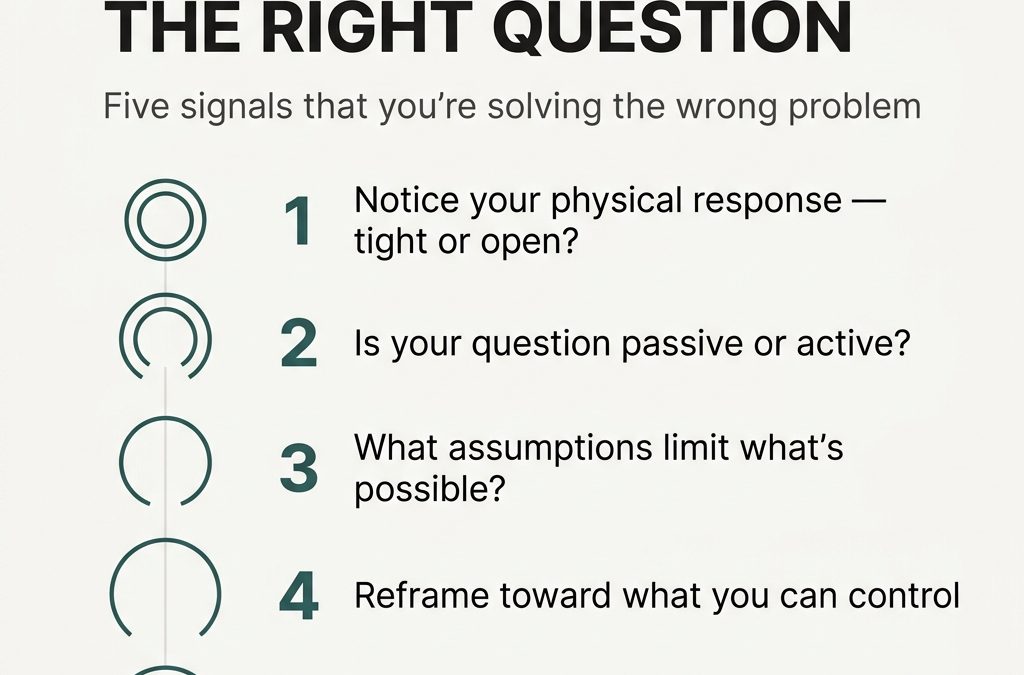
The Five-Step Diagnostic You Can Run Right Now
When you’re stuck, try running this check:
1. Notice your physical response. Does thinking about this problem make you feel tight and contracted, or more open and curious?
2. Examine the question you’re asking. Is it passive (“Can’t find X”) or active (“How do I create X”)?
3. Look for hidden constraints. What assumptions are you making about what’s even possible?
4. Reframe toward capability. Shift from “Why is this happening to me?” to “What’s actually within my control here?”
5. Test the new question. Does your inner experience expand? Do new possibilities start appearing?
This isn’t some motivational thinking exercise. It’s diagnostic. You’re not trying to just feel better. You’re trying to locate the actual problem.
Through a decade of working with leaders, creatives, and people facing all kinds of invisible barriers, I’ve seen this pattern over and over: most people excel at solving the wrong problems.
They jump into action because it taps into their existing knowledge, experience, and skills. They commit to a path before realizing they’re solving the wrong thing. And then they continue anyway because by now they’re invested.
The disaster becomes totally predictable.
Key point: Solving the wrong problem efficiently just gets you nowhere faster.
What Actually Shifted After the Salad Dressing
I now have this whole collection of low-calorie dressings that actually taste good. Tahini-lemon. Orange-peanut. Variations I never would’ve found if I’d just stayed stuck in that original question.
But the real shift wasn’t about food.
It was recognizing that attention shapes perception, and perception shapes what you see as reality. When you shift your focus from obstacles to possibilities, solutions that were always sitting there suddenly become visible.
The salad dressing thing was just the latest reminder of a pattern I first learned lying in bed with MS, asking why this was happening to me. And then asking how I could heal. That second question unlocked everything the first one kept hidden.
Sometimes the answer isn’t about finding something new.
It’s just asking a better question.
And your body already knows which questions lead where. You just need to pay attention to whether you’re expanding or contracting.
That’s your diagnostic. That’s the signal.
The rest is just following where it leads.
Common Questions About Question Reframing
What if I reframe the question but still don’t find solutions?
The reframe itself doesn’t guarantee you’ll find solutions. It just opens the search space. If you’re still stuck after reframing, you might need to reframe again from a different angle, or maybe the constraint is actually real (limited resources, external barriers you can’t change). The diagnostic is still useful though: does the new frame make your thinking expand or contract?
How do I know if I’m expanding or contracting?
Expansion feels like your breath deepening, posture opening up, ideas starting to flow. Contraction feels like chest tightening, breath getting shorter, mental loops. It’s a physical sensation, not just a thought. Pay attention to your body for like 10 seconds after you ask the question.
Does this work for every type of problem?
Nope. Some problems are genuinely unsolvable with your current resources or knowledge. The reframe helps you figure out which is which: problems that are truly constrained versus problems where you’ve just mentally boxed yourself in. If multiple reframes all lead to contraction, you’re probably facing a real constraint.
What’s the difference between positive thinking and question reframing?
Positive thinking tries to change how you feel about a problem. Question reframing changes what problem you’re actually solving. One is emotional management. The other is problem diagnosis. Reframing doesn’t necessarily make you feel better. It makes you see differently.
How long does it take to get good at this?
You’ll notice the pattern pretty much immediately once you start paying attention. Getting skilled at catching yourself in the wrong question before you waste weeks solving it? That takes some practice. I’d say maybe a few months of conscious application before it starts becoming automatic.
What if other people are framing the problem for me?
You don’t control how others frame problems. You only control whether you accept their frame. When someone hands you a problem, just pause. Ask yourself: is this actually the problem, or is this just one way to look at it? Then reframe it privately and see if new options show up.
Can you reframe too much and never actually take action?
Yeah, definitely. Some people use endless reframing as a way to avoid doing the hard things. The diagnostic is still the same: does another reframe make you expand (genuine new insight) or are you just stalling (contraction disguised as thinking)? After two or three reframes, just pick one and move.
What if the right question feels uncomfortable?
The right question often feels uncomfortable because it points straight toward capability and responsibility. “Why is this happening to me?” feels way safer than “What’s within my control?” That second question expands your options but it also removes the comfort of helplessness. Discomfort isn’t the same as contraction though. You can feel both expansion and discomfort at the exact same time.
Key Takeaways

by Christian Kresmann, Founder - Beyond Creativity | 2026, Apr, 16 | business, creativity, leadership, mindset, spirituality
TL;DR: AI won’t replace human creators. It’ll expose who was hiding behind technique instead of actually having something to say. Audiences feel when a human was present, even when they can’t name what’s missing. The future splits into three lanes: purely human, purely machine, and honest hybrids. As AI floods the market with cheap content, human presence becomes the scarcest and most valuable resource.
P.S.: I use an A.I. tool to better the reading experience for you. I know some like the raw kind of writing. I do, too. And I like it as much when a text is sophisticated. 🙂
Anyway. Here we go.
Core Answer:
-
People detect the absence of human presence in AI-generated work, even when they can’t explain why
-
AI forces creative clarity by exposing muddy thinking instantly
-
Studies show consumers value human-made art 62% higher and pay premiums for authenticity
-
The only irreplaceable human element is intentionality: the why behind every choice
-
Three distinct content lanes are emerging: human-made premium, machine-made volume, and transparent hybrids
Why Am I Still Taking Acting Workshops?
A friend asked me yesterday why I’m bothering with acting workshops when Netflix will probably replace all actors with AI avatars in a few years.
Fair question.
Here’s my answer: audiences know when you’re not there.
They can’t explain it. They just feel it.
That feeling is the only thing human creators have left.
What AI Actually Does to Creative Work
AI doesn’t kill creativity.
It kills the excuse that you needed perfect technique to matter.
I spent forty-five minutes with an AI agent recently. It generated 915 data entries for a feature film: production partners, nonprofits, influencers, celebrities who might support our cause.
Work that would’ve taken me a hundred hours.
But here’s what nobody mentions.
If I hadn’t been precise about what I wanted, the AI would’ve given me 915 pieces of garbage.
The tool didn’t decide which nonprofits mattered. It didn’t know why certain influencers aligned with the film’s theme. It didn’t understand our cause.
I brought all of that clarity.
The machine executed at superhuman speed.
AI is a genie out of the bottle. You wish for something, it creates. But if your wish is muddy, you get nine hundred polished turds.
The tool forces you to know exactly what you want before you touch it.
Not a limitation. A diagnostic for whether you have something to say.
Key Point: AI exposes unclear thinking instantly. If you don’t know precisely what you want, the output will reveal that confusion at scale.
How Audiences Detect the Absence of Humans
Research backs this up in ways that should terrify anyone coasting on technical skill alone.
Psychologist Mark Runco found that intentionality plays a central role in human creativity. AI-generated outputs meet criteria for novelty and usefulness. But they lack two essential components: choice and intention.
Audiences detect this absence even when they can’t name it.
In one study, participants valued AI-labeled art 62 percent less than art identified as human-made.
Same work. Different label. Massive value drop.
Another study found that 52% of consumers become less engaged when they suspect content is AI-generated.
They feel something’s missing even when they can’t articulate what.
The mess is the message.
Imperfection isn’t a flaw anymore. It’s proof someone was present when the thing got made.
Key Point: People sense when human intentionality is missing, leading to measurable drops in perceived value and engagement, even when technical quality is identical.
The Three Lanes of Creative Production
The separation is already happening.
In 2025, Spotify removed over 75 million spammy tracks from its platform. Many were AI-generated.
The fake band Velvet Sundown accumulated over a million streams before being revealed as entirely synthetic.
The future isn’t one thing. It’s three distinct paths.
1. Purely human-made
Work where someone’s presence is the entire point. Where the imperfections, the stutters, the micro-expressions matter because they’re proof a real person gave a damn.
2. Purely machine-made
Fast food content. Optimized for speed and volume. Cheap, efficient, forgettable. The flood is coming.
3. Honest hybrids
Creators who use AI transparently and own why. Who understand the tool amplifies what you already have, including your confusion.
Audiences are voting with their wallets.
An overwhelming 98 out of 100 music professionals stated it’s important for them to know whether music was created by a human or AI. And 96% are open to paying more for authenticity.
This is the birth of what some are calling the “Human Premium.” A tangible monetary value assigned to the knowledge that a piece of art was born from human experience.
Key Point: Three distinct content lanes are splitting open, with human-made work commanding measurable premiums as AI floods the market with cheap alternatives.
What Remains When Technical Skills Become Free
When technical execution becomes free, the only value left is the why behind the choice.
I’ve practiced yoga for five years. Not for flexibility. Not for relaxation.
For the connection between mind, body, and something more I can’t describe yet.
That practice wasn’t preparation for stillness. It was training for the only battlefield that matters.
AI is growing faster than most people track. If we don’t level up our own way of being (our life energy, our presence, our spiritual awareness), we get drowned out by the sheer speed and capability of the machines.
This isn’t about developing better creative skills or technical knowledge.
It’s about deepening your own presence so you don’t become noise.
Research shows that AI-enabled stories are more similar to each other than stories by humans alone.
Individual creativity goes up. Collective novelty goes down.
The fast food content flood is coming. That makes the fine dining experience of human presence even more valuable.
Key Point: As AI accelerates, the irreplaceable human element is presence and intentionality, not technical skill. Deepening self-awareness becomes the only sustainable competitive advantage.
Why Collaborative Friction Matters
I realized something on a recent film shoot.
The bigger the project, the more I feel involved. Not because I’m doing more. Because I realize I can’t do it alone.
I have to contribute to everybody’s success.
That changes what I bring to the work. I let go. I trust that other people’s ideas will come together with mine into something none of us could’ve made alone.
Audiences feel that collaborative friction.
The messy, unpredictable energy that comes from multiple human beings working through doubt and compromise to land on something they all believe in.
AI delivers technical precision all day long. But it can’t recreate that feeling. It can’t fake the sense that real people were in the room, present, making choices that mattered to them.
When you’re forced to trust someone else’s vision alongside yours, you end up with something that has more life in it.
More unpredictability.
People know when you’re not there. They can’t explain it. They just feel it.
Key Point: The collaborative friction between real humans creates unpredictable energy that audiences instinctively recognize and value, something AI collaboration fundamentally can’t replicate.
What Happens When You Amplify Muddy Thinking
AI boosts creative output by 25% and value by 50%.
But only if you’re intentional about what gets amplified.
If your thinking is muddy, AI just gives you more mud, faster.
The tool removes all the technical barriers that used to disguise bad ideas. No more hiding behind budget constraints, equipment limitations, or crew availability.
If your idea is half-formed or your intention is unclear, the output reflects that immediately.
Brutal honesty wrapped in efficiency.
This forces a kind of creative clarity we needed all along but didn’t have the bandwidth to develop. You can’t throw busy work at a team and hide behind the process anymore.
You can’t coast through meetings, research, and revisions without ever confronting whether the core idea was clear in the first place.
If you can’t articulate precisely what you want, the AI mirrors that confusion back at you instantly.
The value isn’t in doing anymore. It’s in knowing why and knowing what with absolute clarity.
Key Point: AI amplifies everything, including unclear thinking. The removal of technical barriers forces confrontation with whether your core idea has substance or you’re just hiding behind process.
Where Human Intentionality Still Matters
We’ve been here before.
The tractor replaced the axe. The chainsaw replaced manual labor. The calculator replaced mental arithmetic.
Each time, we had to figure out what it means for us when those tools become available.
AI is just the next wave. Except now it’s our cognitive labor getting automated instead of our physical labor.
But here’s what matters.
When the chainsaw replaced the axe, you still had to decide where to cut the tree.
The intentionality remained human.
With AI handling cognitive tasks, the question becomes: what’s the equivalent of deciding where to cut?
Attention. Intention.
Where we choose to direct our focus within that infinite possibility space.
AI executes once you’ve pointed it in a direction. But it can’t determine where that focus should land.
It can’t decide what matters, what’s worth caring about, or why something should exist in the first place.
That’s still entirely on us.
Key Point: Like previous technological shifts, AI automates execution but leaves the irreducibly human task of deciding where to direct attention and why something matters.
The Economics of Human Presence
Some people want fast food. Others want fine dining.
The same split is happening with content and services.
Most content right now is fast food. Designed for quick consumption. Not for meaning or lasting impact.
AI is about to make fast food content infinitely cheaper and faster to produce.
Which means the fine dining experience (where someone put their attention and intention into crafting something with real presence) becomes the only differentiation that matters.
The more AI saturates the market with technically proficient work, the more people will pay a premium for proof that a human being gave a damn about what they made.
Scarcity creates value.
Human attention is about to become the scarcest resource.
OpenAI CEO Sam Altman predicts that “real estate, handmade goods, art…there will be a huge premium” on things like that as AI makes mass production cheap.
AI doesn’t kill human creativity. It reveals what it’s worth.
Key Point: As AI commodifies technical execution, human presence becomes scarce and valuable. The fast food content flood makes fine dining experiences command measurable premiums.
The Real Question We’re Avoiding
If we outsource everything to AI, what’s the point of being human?
Not a philosophical question. A practical one.
If AI does everything we do, faster and cheaper, then the only thing left is what AI fundamentally can’t replicate.
Presence. Intentionality. The feeling that someone was there when the thing got made.
We’re not protecting our jobs. We’re protecting the feeling that we matter.
And that only exists when our presence changes the outcome.
The machines aren’t going to replace us.
They’re going to strip away everything that isn’t human about what we do. All the technical tricks we’ve hidden behind. All the polish we’ve used to compensate for lack of something real to say.
AI will do that better than us, faster than us, cheaper than us.
And that’s going to leave us standing there with only one question.
What do we have that can’t be automated?
Most of us aren’t ready for that conversation. But it’s coming whether we like it or not.
The good news?
The answer has been there all along.
We just forgot to look.
Common Questions About AI and Human Creativity
Will AI completely replace human creators?
No. AI automates technical execution but can’t replicate intentionality or presence. Studies show audiences value human-made work 62% higher and actively seek proof of human involvement, creating a “Human Premium” in the market.
How do audiences know when something is AI-generated?
They feel it, even when they can’t name it. Research shows 52% of consumers become less engaged when they suspect AI generation. People detect the absence of human choice and intention at an intuitive level.
What’s the “Human Premium”?
The measurable monetary value assigned to human-made work. 96% of music professionals are willing to pay more for authenticity. As AI floods the market with cheap content, scarcity of human attention creates premium value.
Should I use AI tools in my creative work?
Yes, but with clear intentionality. AI amplifies what you bring to it, including confusion. The tool forces precision about what you want. Use it transparently, own why you’re using it, and ensure your human presence remains central.
What creative skills still matter when AI handles technical execution?
Intentionality, presence, and clarity about why something should exist. The ability to collaborate with other humans in ways that create unpredictable friction. Deepening self-awareness so your attention and choices carry weight.
What are the three lanes of creative production?
Purely human-made (premium work where presence is the point), purely machine-made (cheap volume content), and honest hybrids (transparent AI use with human intentionality driving choices).
How do I stay relevant as AI capabilities grow?
Stop hiding behind technical skill. Develop clarity about what you’re trying to say and why. Deepen your presence through practices that connect mind, body, and awareness. Focus on the irreplaceable human elements: attention, intention, and the ability to make choices that matter.
Will human-made content become more expensive?
Yes. As AI makes technical proficiency free and floods markets with cheap alternatives, scarcity economics flip. Human attention becomes the scarcest resource, commanding measurable premiums from audiences seeking authentic connection.
Key Takeaways
-
AI doesn’t replace human creativity. It exposes who was hiding behind technique instead of having something real to say.
-
Audiences detect the absence of human presence and intentionality, even when they can’t articulate why, leading to measurable drops in engagement and perceived value.
-
Three distinct content lanes are emerging: purely human-made premium work, purely machine-made volume content, and transparent hybrids where humans own their AI use.
-
The irreplaceable human element is intentionality (the why behind every choice), not technical execution. Attention and presence become the only sustainable competitive advantages.
-
AI forces brutal clarity by amplifying everything, including muddy thinking. If you can’t articulate precisely what you want, the output reveals that confusion at scale.
-
As AI commodifies technical skills, human attention becomes the scarcest and most valuable resource, creating a “Human Premium” where audiences pay measurably more for proof someone gave a damn.
-
The real question isn’t whether AI will replace us, but what we have that fundamentally can’t be automated. The answer: presence that changes outcomes.
by Christian Kresmann, Founder - Beyond Creativity | 2026, Apr, 9 | business, creativity, leadership, mindset
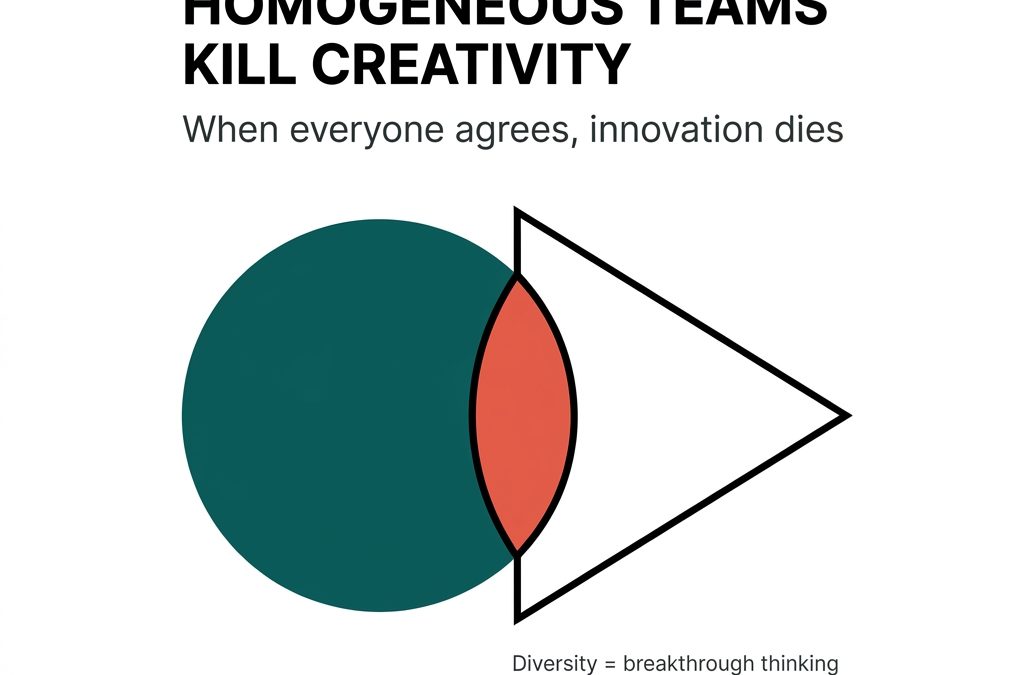
TL;DR: Homogeneous teams kill creativity by eliminating cognitive friction. Diversity isn’t a moral stance, it’s a creative technology. When different worldviews collide, they generate solutions that uniform thinking cannot access. The discomfort you feel when perspectives clash? That’s where breakthrough thinking lives.
Core Answer:
-
Cognitive diversity (different ways of thinking) matters more than traditional diversity metrics for creative outcomes
-
Homogeneous teams mistake agreement for truth and become structurally incapable of breakthrough thinking
-
Creative friction between different perspectives reveals invisible assumptions and unlocks new solutions
-
Leaders must build internal capacity to handle discomfort before diversity initiatives become genuine
-
The question shifts from “how do we accommodate differences?” to “what perspectives are we missing?”
What I’ve Learned From Film Sets
I’ve been in the film-industry for over a decade. The pattern I keep seeing: the best creative breakthroughs come from collision, not brilliance.
Cinematography sees light and shadow. Sound design hears texture and silence. Costume reads character through fabric. These perspectives clash. Something unexpected emerges from that friction. No single brilliant mind generates what their collision creates.
This isn’t about traditional diversity metrics. I’m talking about cognitive diversity. Different ways of thinking about the same problem.
Homogeneity doesn’t limit creativity. It kills it.
Key insight: Creative breakthroughs emerge from cognitive friction between different worldviews, not from individual genius.
Why Sameness Feels Safe
Every organization I work with has the same invisible problem.
They normalize. Create shared values. Standardize processes. Build governance structures. They call it alignment. Culture. Team cohesion.
They’re building walls.
I understand why. When everyone thinks similarly, meetings run smoother. Decisions happen faster. Less friction. Less disagreement. Less discomfort when someone challenges assumptions.
That comfort? That’s the signal creative growth has stopped.
Research confirms this. Homogeneous teams are more susceptible to groupthink, where the desire for harmony leads to irrational decisions. When people around you think like you, you stop encountering ideas that challenge your worldview.
You mistake agreement for truth.
Key insight: Comfort in decision-making signals the absence of cognitive diversity, not team effectiveness.
Diversity as Creative Technology
I need you to reframe diversity for a moment.
Not as a moral stance. Not as a checkbox. As creative technology. A structural requirement for innovation.
Genuine creativity requires divergent thinking. The ability to generate multiple solutions from different angles. Divergent thinking doesn’t happen when everyone in the room shares the same mental models, life experiences, and unconscious assumptions about how the world works.
The data is striking. Stanford research shows teams with differing perspectives generate 60% more creative solutions than homogeneous groups. They consider 48% more solutions to problems. Companies with diverse management teams earn 19% more revenue from innovation.
This isn’t about being nice. This is about accessing cognitive territory that uniform thinking cannot reach.
Key insight: Diversity functions as a mechanism for accessing solutions that homogeneous thinking structurally cannot generate.
How This Shows Up on Film Sets
Let me show you what this looks like in practice.
On a film set, departments operate from completely different worldviews. The production designer thinks spatial storytelling. The director of photography thinks emotional tone through color temperature. The sound mixer thinks about what silence communicates.
When these minds collaborate, they challenge each other’s invisible assumptions.
I’ve watched a costume designer’s choice completely shift how a cinematographer lights a scene. I’ve seen a sound designer’s perspective force a director to reconsider the entire emotional arc of a sequence. These aren’t conflicts. They’re creative friction generating solutions none of them could find alone.
The acting world demonstrates this principle visibly. When diverse creative teams develop films, directors, producers, writers who bring different lived experiences, they unlock stories homogeneous teams cannot access. Films like Black Panther and Soul captured nuances that made them resonate deeply because the creators shared their characters’ identities and experiences.
The authenticity you feel? That’s what happens when diverse perspectives shape the work from the beginning.
Key insight: Different departmental worldviews create productive friction that generates creative solutions no single perspective could produce.
The Fear Response as Diagnostic Tool
Here’s how you know if your team has built invisible walls.
Watch what happens when something unexpected enters the room. An idea that wasn’t calculated. A perspective that challenges consensus. A solution that doesn’t fit the established pattern.
If the response is fear, if people shut it down, if they get defensive, if they explain why it won’t work before considering it, you’re looking at a team that has normalized homogeneity.
If the response is curiosity, if people lean in, if they ask questions, if they explore implications even when uncomfortable, you’re looking at a team with creative capacity.
The leader sets this tone. I’ve seen it hundreds of times. If the person at the top encourages out-of-the-box thinking, stays calm when surprised, creates space for failure, the entire team relaxes into creative possibility. Everyone becomes solution-focused. Ideas flow.
If the leader tolerates diversity only on paper? If they promise openness but react with fear when assumptions get challenged? The team learns to keep divergent thinking to themselves.
Key insight: Team responses to unexpected ideas (fear versus curiosity) reveal whether diversity is genuine or performative.
The Culture Fit Trap
Most organizations don’t realize they’re building homogeneous teams.
They think they’re hiring for culture fit. They want people who share their values, who communicate in similar ways, who won’t disrupt the existing dynamic.
They’re hiring people who think like they already think.
I’ve experienced this pattern repeatedly. Leaders say they want diversity and innovation. They promise it on paper. When someone brings genuinely different thinking, when it creates the uncomfortable friction that precedes breakthrough, they cannot handle it.
They haven’t learned how to handle themselves. They’re afraid of losing control, of looking incompetent, of having their worldview challenged in front of others.
So they hire people who confirm existing assumptions. They call it culture fit. They mistake it for team cohesion. And they wonder why creativity has stagnated.
Key insight: “Culture fit” often functions as unconscious homogeneity that leaders mistake for team effectiveness.
The Inner Work Nobody Discusses
Here’s what I’ve learned from working with leaders who want to change this pattern.
The tools for handling diversity’s friction already exist. You have to do the internal work first.
In traditional yoga culture, there’s this principle: become the leader of yourself before you lead others. The Isha Yoga Center teaches specific practices for inner engineering. For controlling how you react from the inside so external circumstances don’t control you.
When leaders do this work, they build capacity to stay grounded when diversity brings the messy, unexpected stuff. They handle disagreement without feeling threatened. They sit with uncertainty without forcing premature closure.
Without that foundation, all the diversity initiatives in the world are performance.
I’ve noticed something else. People who’ve experienced genuine suffering, chronic illness, loss of loved ones, significant failure, tend to be more resilient and relaxed in creative environments. They’ve already met the unexpected and survived it. They’re not afraid of friction because they know it’s part of the process.
That lived experience becomes a form of diversity itself. The internal diversity of having wrestled with real hardship gives them access to perspectives and emotional ranges that someone who’s lived a comfortable, predictable life doesn’t have.
Key insight: Leaders need internal capacity (through practices like yoga or lived hardship) to handle the discomfort diversity creates before external initiatives become genuine.
What Diverse Teams Reveal
The real value of diversity isn’t adding new ideas to the mix.
Diverse perspectives reveal the limitations of your current thinking that you couldn’t see from inside it.
When someone with a genuinely different worldview looks at your problem, they see assumptions you didn’t know you were making. They spot patterns you’ve normalized. They ask questions that feel obvious to them but have never occurred to you.
This is why research shows creative diversity matters more than individual creativity. Teams with varied thinking styles outperform teams of individually brilliant people who all think the same way. You don’t need high collective creativity. You need creative diversity and collaboration.
The friction between different perspectives generates solutions uniform thinking cannot access. Different lived experiences collide and create new territory.
Key insight: Diverse teams don’t just add perspectives, they expose invisible assumptions in your current thinking you couldn’t see from within it.
Where Is Your Thinking Too Uniform?
Look at your own environment honestly.
Where have you surrounded yourself with people who think like you? Where have you normalized processes that feel comfortable because they confirm your existing worldview? Where are you mistaking agreement for innovation?
This isn’t about guilt. It’s about recognition.
Most of us build these invisible walls without realizing it. We hire people we connect with easily. We collaborate with people who understand us intuitively. We create systems that reward thinking aligned with ours.
Slowly, without noticing, we’ve created an echo chamber where breakthrough thinking becomes structurally impossible.
The question isn’t whether you value diversity in theory. The question is whether you’ve built the internal capacity to handle what diversity brings: discomfort, friction, challenges to assumptions, solutions that don’t fit your mental models.
Because that’s where creativity lives. Not in the comfort of sameness, but in the collision of genuinely different ways of seeing the world.
Key insight: Building capacity for discomfort matters more than intellectual commitment to diversity.
Frequently Asked Questions
What is cognitive diversity?
Cognitive diversity refers to differences in how people think, process information, and solve problems. It includes different mental models, life experiences, educational backgrounds, and approaches to creativity. This matters more for innovation than surface-level demographic diversity alone.
How do I know if my team lacks cognitive diversity?
Watch how your team responds to unexpected ideas. If the default response is fear, defensiveness, or immediate rejection, you’ve built homogeneity. If the response is curiosity and exploration, you have genuine diversity. Also look for: quick consensus without debate, comfort in all meetings, and hiring people who “fit in” easily.
Does diversity always create conflict?
Diversity creates friction, not necessarily conflict. Friction is the productive discomfort when different worldviews challenge each other’s assumptions. This feels uncomfortable but generates breakthrough thinking. Conflict happens when people lack the internal capacity to handle that friction constructively.
How do leaders build capacity to handle diverse perspectives?
Internal work comes first. Practices like yoga, meditation, or other forms of self-regulation help leaders stay grounded when challenged. Leaders who’ve experienced genuine hardship (illness, loss, failure) often have this capacity naturally because they’ve already survived the unexpected.
What’s wrong with hiring for culture fit?
Culture fit often becomes code for “thinks like we already think.” You end up hiring people who confirm your existing assumptions rather than challenge them. This creates the illusion of team cohesion while eliminating the cognitive friction necessary for innovation.
Can diversity work without individual creativity?
Yes. Research shows creative diversity (different thinking styles collaborating) matters more than individual creativity levels. A team of moderately creative people with diverse perspectives outperforms a team of brilliant people who all think the same way.
What perspectives am I missing in my environment?
Look at who you hire, who you listen to, whose ideas get implemented. If everyone shares similar backgrounds, education, life experiences, or ways of processing information, you’re missing perspectives. The real question: what solutions exist that you cannot see because of your current cognitive homogeneity?
Is this about demographic diversity or thought diversity?
Both matter, but they’re connected differently than most people realize. Different lived experiences (which often correlate with demographic differences) create genuinely different ways of thinking. The goal isn’t demographic diversity for its own sake, it’s accessing the cognitive diversity that different life experiences produce.
Key Takeaways
-
Cognitive diversity (different ways of thinking) is a creative technology, not a moral obligation. It generates solutions homogeneous teams structurally cannot access.
-
Homogeneous teams mistake agreement for truth and comfort for effectiveness. When meetings feel easy, creative growth has likely stopped.
-
Creative friction between different worldviews reveals invisible assumptions and unlocks breakthrough thinking. The discomfort is the signal, not the problem.
-
Leaders must build internal capacity to handle diversity’s friction before external initiatives become genuine. This comes through practices like yoga or lived experience with hardship.
-
“Culture fit” often creates unconscious homogeneity. You hire people who confirm existing assumptions rather than challenge them.
-
Teams reveal their true diversity through emotional responses to unexpected ideas. Fear signals performative diversity. Curiosity signals genuine capacity.
-
The reframe shifts from “how do we accommodate differences?” to “what perspectives are we missing that would unlock solutions we cannot see yet?”
When you cherish diversity as the mechanism for creative problem-solving rather than an obligation, everything changes about how you build teams, approach problems, and define creativity itself.
The rooms where creativity thrives don’t look the same. Don’t think the same. Don’t operate from the same assumptions.
That’s exactly why they work.
by Christian Kresmann, Founder - Beyond Creativity | 2026, Apr, 7 | creativity, leadership, mindset
TL;DR: Three weeks after my MS diagnosis, lying in bed, I learned something about how my mind works. Most people don’t need more creative techniques. They need to see when they’re sabotaging themselves. Self-awareness is the operating system. Everything else runs on top of it.
The core insight:
-
Teaching people to observe their own thinking beats teaching them creative methods
-
One person’s lack of self-regulation shuts down entire teams
-
Critical thinking without consciousness turns into sophisticated bias
-
Consciousness isn’t another skill. It’s the foundation all other skills need to work
How I Learned This Lying in Bed After My Diagnosis
Three weeks after my multiple sclerosis diagnosis, I was lying in bed.
My mind was racing. Horrifying visions of the future. Worst-case scenarios on loop. I worried myself into a bad mood, then worried about being in a bad mood.
Then something clicked.
I realized I was the one terrifying myself. Not the disease. Not the uncertainty. Me. My own attention, running on autopilot, dragging me down.
And if I was doing this to myself, I stopped.
I started paying attention to what was happening in the moment. I breathed. I felt my pulse. I heard sounds around me. I shifted my attention consciously to all those things instead of the mental horror show.
That moment changed how I see everything I do now. The coaching. The creativity training. The film work. All of it.
The pattern I keep seeing is this: people don’t lack creative techniques. They lack the consciousness to see when they’re blocking themselves.
Awareness of how you think matters more than what you think about.
Why a Screenwriter With Too Many Ideas Couldn’t Write
A screenwriter I worked with had the opposite problem people expect.
She generated ideas constantly. Dozens. Good ones.
But she couldn’t focus her attention on any specific part of what she was creating. She needed someone else to ask a question before she zoomed in on what mattered. Without the external prompt, she kept generating more ideas, never going deeper.
The problem wasn’t her creativity. It was her inability to consciously direct her own attention.
So I taught her to ask better questions. Not creative techniques. Not brainstorming methods. Questions.
Questions direct our attention toward answers. Once she learned to ask herself the right questions, she steered her own focus. She stopped needing me.
This is what I mean by consciousness being the missing piece.
Questions direct attention. Attention determines what you create.
What Research Shows About Metacognition and Creativity
This isn’t only my observation. The data backs this up.
A study on metacognitive training found something interesting: teaching people to think about their thinking improved creative problem-solving more than teaching them creative methods. Fifty minutes across eight sessions of metacognitive strategy training produced measurably better creative outcomes than no intervention.
Training people on how they think outperformed training them on what to think about.
Another study revealed something even more interesting. When people felt able to improve, self-evaluation didn’t hurt their creativity. But when they didn’t expect to improve, self-evaluation significantly reduced their creative performance.
Belief about capacity mattered more than the technique.
Research shows without self-awareness, people are incapable of creative accomplishments. People who self-monitor more frequently are significantly more innovative than those who self-monitor less.
Self-awareness is the gateway to accessing creativity. Not a nice-to-have. The gateway.
Metacognitive training beats creative technique training. Self-awareness determines creative capacity.
How One Person’s Lack of Self-Regulation Stopped an Entire Film Set
We were on a film set. Everything was moving. Then one person lashed out because something wasn’t going as planned.
Immediately, everyone else had to regulate their own systems. The whole crew stopped what they were doing to manage the emotional fallout. If the person had caught their reaction before it exploded outward, none of this would’ve happened. Everyone would’ve kept working.
But they didn’t. The lack of self-regulation in one person hijacked the attention and energy of the entire group.
This is collaboration breaking down at the consciousness level. One person’s inability to notice their own state created a systemic distraction for everyone else.
The best collaborators I know all have one thing in common. They’re aware of their own triggers, biases, and patterns in group settings. They notice when they’re dominating, withdrawing, or reacting instead of responding.
This awareness is what makes collaboration work. Without it, you’re firefighting emotional disruptions instead of creating together.
One person’s unconscious reaction hijacks the entire team’s attention.
Why Critical Thinking Without Consciousness Becomes Sophisticated Bias
I see this all the time. People use critical thinking skills to defend beliefs they’re already committed to, rather than examining their own reasoning.
They assume something as true, then make inferences from the assumption. But they never question the basis of their thinking.
They’re building an entire logical structure on a foundation of unexamined assumptions. The critical thinking is solid. The starting point is flawed.
The consciousness piece is being able to step back and ask: Wait, what am I assuming here? Is this true, or is this the starting point I accepted without questioning?
Without that meta-awareness, critical thinking becomes a tool for reinforcing what you already believe.
Solid logic built on unexamined assumptions still produces bad thinking.
Consciousness Is the Operating System, Not Another Skill
I thought composure would be the fifth C. Then I realized composure is what happens when you’re consciously directing your attention.
Composure is downstream. Consciousness is the source.
Unconscious creativity is ideas happening to you, floating in from external influences without direction. Conscious creativity is where you point your attention. You decide what problem to focus on, what area to explore, and you direct your thinking intentionally toward solutions.
It’s the difference between being passively influenced and actively steering your creative process.
The same applies to the other Cs. Communication. Collaboration. Critical Thinking. They all require the ability to consciously direct your attention.
Without consciousness, you’re running on autopilot. With consciousness, you’re choosing where to focus, what to question, and how to respond.
This is why I call consciousness the operating system. The other four Cs are applications. Consciousness is what runs them.
Consciousness is the OS. Communication, Collaboration, Critical Thinking, Creativity are the apps.
What Happens When I Build Capability in People
People come to me wanting to improve one skill. Usually communication or creativity.
Then they find consciousness work opens everything else.
Because once you consciously direct your attention, you:
-
Notice when you’re stuck in a mental loop and shift out of it
-
Catch yourself making assumptions and question them
-
Recognize when you’re reacting emotionally and choose a different response
-
Direct your focus to the specific aspect of a problem that needs attention
-
Ask yourself better questions instead of waiting for someone else to prompt you
This isn’t a technique. This is a different way of operating.
And this changes everything.
Consciousness work opens all other skills simultaneously.
Why Consciousness Matters More as Technology Evolves
Technology is evolving fast. AI is handling more tasks. The skills needed are shifting.
But here’s what I keep coming back to: people need to evolve their consciousness as technology evolves with them.
Because the more automated our external world becomes, the more critical our internal awareness becomes.
If you don’t consciously direct your attention, you’ll be pulled in whatever direction the loudest voice, the brightest screen, or the strongest emotion takes you.
If you do, you’ll be able to choose. To focus. To create. To collaborate. To think clearly.
This is the difference consciousness makes.
Consciousness isn’t another skill to add to the list. It’s the foundation the other skills need to work.
As automation increases, conscious attention becomes the differentiator.
Common Questions About Consciousness and Creativity
How is consciousness different from mindfulness?
Mindfulness is one form of conscious attention. Consciousness is broader. Noticing your thoughts, directing your focus intentionally, questioning your assumptions, choosing your responses. Mindfulness helps you observe. Consciousness lets you steer.
Do I need to learn meditation to develop consciousness?
No. Meditation helps some people, but it’s not required. You develop consciousness by practicing attention direction in your daily work. Ask yourself better questions. Notice when you’re reacting. Catch yourself making assumptions. This is consciousness training.
How long does it take to see results from consciousness work?
Some people notice shifts immediately, like I did lying in bed after my diagnosis. Others take weeks or months. The timeline matters less than the practice. Once you start directing your attention consciously, the change compounds.
If someone lacks self-awareness, how do they even start?
Start by noticing one pattern. When do you feel stuck? When do you react emotionally? When do you avoid something? Pick one pattern and watch for it. This is the entry point. Awareness of one pattern opens awareness of others.
Does consciousness training work for people with ADHD or other attention challenges?
Yes, but the approach shifts. People with ADHD often have strong awareness of where their attention goes. The work becomes learning to redirect it without judgment. The consciousness is there. The steering mechanism needs practice.
How do I know if I’m becoming more conscious or fooling myself?
You’ll notice you’re catching yourself mid-pattern instead of after the fact. You’ll ask yourself questions you didn’t think to ask before. You’ll recognize assumptions you used to treat as facts. Other people will notice you’re responding differently.
Does this apply to teams, or only individuals?
Both. Individual consciousness changes how you show up in teams. Team consciousness is when the group notices its own patterns. When someone dominates, when the team avoids conflict, when assumptions go unquestioned. The same principles apply at both levels.
What’s the relationship between consciousness and emotional intelligence?
Emotional intelligence requires consciousness. You need to notice your emotions before you regulate them. You need to observe others before you empathize. Consciousness is the foundation. Emotional intelligence is what you build on top.
Key Takeaways
-
Self-awareness unlocks creative capacity faster than learning more creative techniques
-
Metacognitive training (thinking about thinking) produces better problem-solving outcomes than method training
-
One person’s lack of self-regulation hijacks entire teams by forcing everyone else to manage the emotional fallout
-
Critical thinking without consciousness becomes a tool for defending existing beliefs with sophisticated logic
-
Consciousness isn’t another skill. It’s the operating system that runs all other capabilities
-
As technology automates more tasks, conscious attention becomes the primary differentiator
-
You develop consciousness through practice: asking better questions, catching assumptions, noticing reactions, directing focus intentionally