TL;DR: Three years studying 279 students revealed why creativity training fails. The method works for some people and tanks performance for others with identical training. Your cognitive style determines whether a creative process helps or hinders you. Matching methods to how your brain works produces better results than forcing everyone through the same approach.
Core Insights:
-
Same creativity training produces opposite results based on cognitive style (Explorer vs Developer, Internal vs External, Task vs Person-focused)
-
When methods mismatch your natural processing style, you work twice as hard for half the results
-
Creative achievement depends more on condition match than raw talent
-
The constraint is the condition, not your capacity
When Training Works for Some and Fails Others
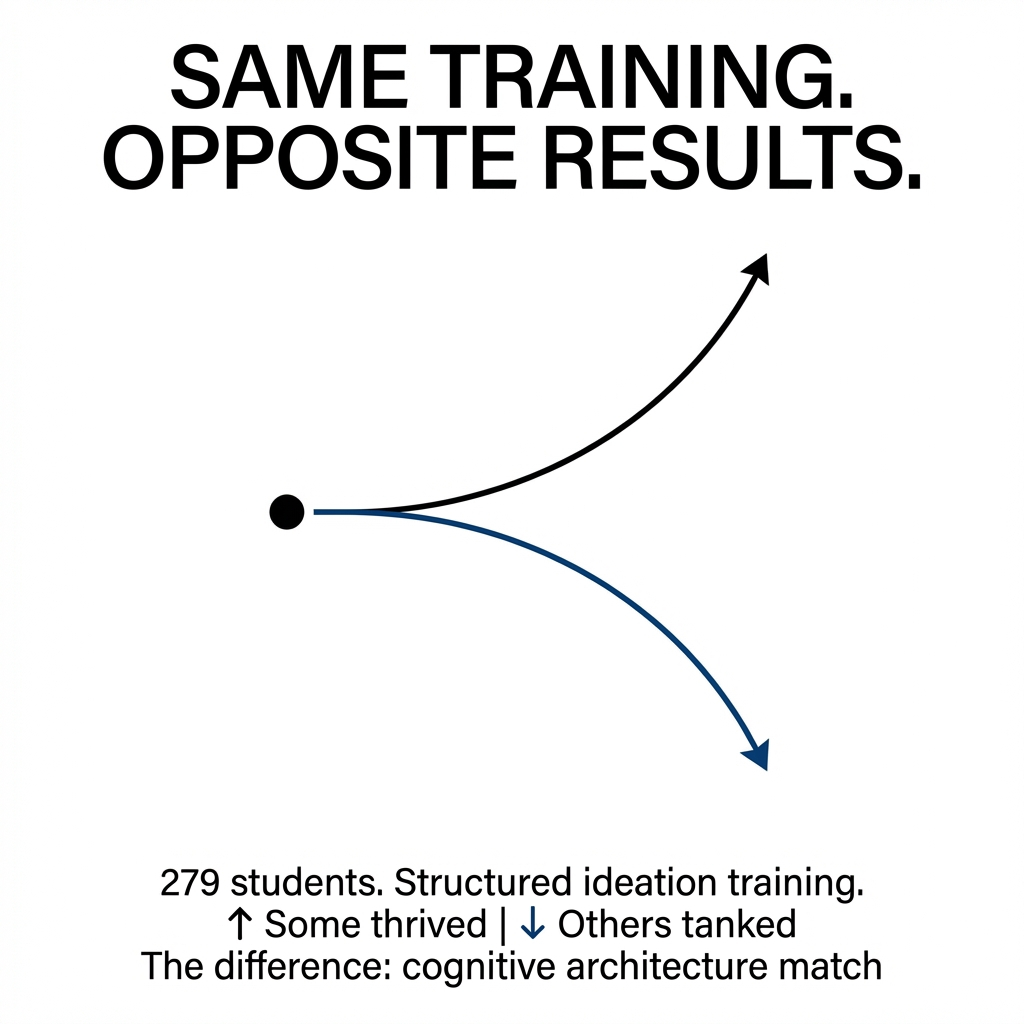
I spent three years measuring creative output in 279 students. Same training. Same tools. Same timeline.
The results were dramatically, statistically opposite.
Some students thrived with structured combinational ideation methods. Their creativity scores increased significantly from initial design to final output. Others tanked under the exact same conditions.
This was not about talent or effort. The pattern pointed to something the field consistently ignores: cognitive architecture mismatch.
What I Observed: Matching instructional methods to cognitive profiles increased performance. Mismatching them decreased creative output, sometimes significantly.
What Is Aptitude-Treatment-Interaction?
My PhD research, supported by decades of ATI studies, revealed a structural pattern. When instructional methods match someone’s cognitive profile, performance increases significantly. When they mismatch, the same training decreases creative output.
We have known this since the 1970s. We still design creativity training like everyone’s brain operates identically.
The research shows Aptitude-Treatment-Interaction examines how outcomes depend on the match between individual characteristics and the intervention they receive. When treatment and aptitude align, effects are optimal. When they mismatch, you get what I measured: intuitive thinkers showing decreased creativity after structured ideation training, while analytical thinkers showed significant improvement from the same method.
Same input. Opposite results.
Key Point: Your cognitive style determines whether a creative method helps or hinders you. The method is not universal.
How Does Problem-Solving Style Work?
The VIEW assessment measures something most organizations miss: how people prefer to engage in problem-solving and creative work.
Three dimensions. Six specific styles.
Orientation to Change: Explorer versus Developer
Explorers chase the big picture and the why. Developers want detail and the how.
Manner of Processing: External versus Internal
Some people need to talk through ideas, hear them, move with them. Others need to read, reflect, process alone.
Ways of Deciding: Person-focused versus Task-focused
Some prioritize relationship and human impact. Others prioritize logic and objective outcome.
You do not choose your style. But you do choose your behavior.
When you operate in your preferred style, performance feels automatic. Easy. Natural. Little effort, maximum output.
When you are forced into a mismatched style, everything takes more energy. Feels awkward. Produces results you perceive as inferior.
I watched this play out in real time during my research.
Key Point: Your cognitive style is not a preference you change at will. You work with your operating system, not against it.
Why a CMO and His Team Kept Miscommunicating
I worked with a Chief Marketing Officer who felt frustrated. Smart team. Good people. But every meeting felt like miscommunication.
He would present the vision, the big strategic why. They would immediately jump to execution details he had not considered yet. He would get irritated. They would get confused.
The VIEW assessment revealed the structural mismatch.
He scored as a strong Explorer. Big picture. Strategic. Why-focused.
Every single person on his team scored as a strong Developer. Detail-oriented. Execution-focused. How-focused.
This was not a communication problem. This was a cognitive architecture mismatch where no amount of “communicate better” advice would help.
Once he understood this, everything shifted. He started translating his Explorer thinking into Developer language. They started recognizing when they needed his big-picture framing before diving into details.
Same people. Same work. Completely different dynamic.
Key Point: Miscommunication often reflects cognitive style mismatch, not lack of effort or clarity.
What Does the Research Show?
My PhD study was not the first to find this pattern. Students with higher knowledge management and self-regulation ability benefited significantly more from creativity training than their peers. Identical training, dramatically different outcomes based on cognitive starting points.
Another study found intuitive individuals showed highest creativity in initial design phases, but their creativity decreased in final design after structured combinational ideation. Meanwhile, adaptive and analytical processors showed increased creativity after the same structured method.
The implication is uncomfortable. We have been measuring creative potential when we should measure creative conditions.
You hold all the raw creative capacity in the world. If the method does not match your cognitive architecture, you will underperform someone with less capacity but better alignment.
Key Point: Creative achievement depends more on condition match than trait possession.
Why Does One-Size-Fits-All Keep Failing?
I see this pattern everywhere now. Organizations invest in innovation training. Bring in experts. Run workshops. Implement new processes.
Six months later, creative output has not improved. Sometimes it declined.
The problem is not the training quality. The problem is the assumption where what works for one cognitive style works for all.
When your profile of thinking styles matches an environment, you thrive. When the profile mismatches, you struggle. This is not about effort or talent. This is about structural fit.
I watched students in my research struggle not because they lacked creativity, but because the instructional approach contradicted their natural processing style. They worked twice as hard to produce half the results.
This is not a training problem. This is an architecture problem.
Key Point: Uniform training methods produce inconsistent results because brains operate differently.
When People Misinterpret Style Mismatch as Personal Limitation
Here is what makes this particularly tricky. Most people experiencing this mismatch do not recognize the style issue. They interpret the struggle as a personal limitation.
“I am not creative.”
“I do not think strategically.”
“I am terrible at brainstorming.”
These are not truths. These are symptoms of operating in a mismatched environment.
I had students who believed they were not creative because every brainstorming session felt forced and unproductive. Turns out they were strong Internal processors being asked to think out loud in group settings. Their creativity showed up beautifully when given time to reflect and process alone first.
The constraint was not their capacity. The constraint was the condition.
Key Point: Perceived creative limitations often reflect environmental mismatch, not inherent incapacity.
What Changes Performance?
In my work with organizations and individuals, I have seen the same pattern repeat. The moment people understand their cognitive architecture and get conditions where the architecture matches, performance shifts rapidly.
Not because they suddenly became more talented. Because the invisible constraint became visible and therefore modifiable.
A Developer-style thinker stops trying to force themselves into Explorer brainstorming sessions. Instead they contribute by refining and implementing ideas after initial generation.
An Internal processor stops believing they are bad at collaboration. Instead they ensure they get reflection time before group discussions.
A Task-focused decision maker stops apologizing for not being “people-oriented enough.” They recognize their logical analysis is exactly what the team needs.
Same person. Different condition. Completely different outcome.
Key Point: Making invisible constraints visible allows you to modify conditions instead of forcing behavior change.
What Research Keeps Telling Us
The goal of ATI research is clear: identify and develop interventions where different learners’ aptitudes match to maximize effectiveness.
We know learners with high spatial aptitude learn better through visual elaboration than text-only materials.
We know growth mindset promotes cognitive flexibility and creative capacity, while fixed mindset constrains them.
We know cognitive style is environmentally sensitive, formed by both individual predispositions and environmental requirements.
We have decades of validated research showing where matching method to cognitive architecture produces optimal results. We still design training, education, and organizational processes as if everyone’s brain works identically.
Key Point: The research exists. The application lags decades behind.
How to Apply This to Your Work
I am not suggesting you need a formal assessment to understand this. Start paying attention to when creative work feels easy versus forced.
Notice which conditions let you produce your best thinking with minimal effort.
Recognize when you are trying to force yourself into someone else’s creative process and the effort costs you energy without producing results.
The pattern I see most often: people experiencing execution blockage despite clear intention and understanding. They know what they want to create. They have the skills. But something invisible keeps preventing action.
Often, the invisible wall is a mismatch between their natural cognitive architecture and the conditions they are trying to work within.
You do not change your cognitive style. But you do change the conditions.
And when conditions match architecture, the constraint dissolves.
Key Point: Observe where your creative process flows naturally. Design conditions around those patterns.
The Question We Should Ask
We spend enormous energy trying to identify creative people. We should spend the energy creating conditions where different cognitive architectures produce creative work.
Because the research is clear: creative achievement depends more on condition match than trait possession.
Someone with moderate creative capacity in aligned conditions will outperform someone with high creative capacity in mismatched conditions. Every time.
This is not theory. This is what I measured across 279 students. This is what decades of ATI research confirms. This is what I see transform performance when organizations finally pay attention to the pattern.
The uncomfortable truth: your training is not failing because people lack creativity. The training fails because you are applying identical methods to different cognitive architectures and expecting uniform results.
Brains do not work like this.
And until we design for cognitive diversity instead of cognitive uniformity, we will keep getting the same disappointing outcomes from our creativity initiatives.
The architecture mismatch is not a bug in your people. The mismatch is a design flaw in your approach.
Frequently Asked Questions
How do I identify my cognitive style?
The VIEW assessment measures three dimensions: Orientation to Change (Explorer vs Developer), Manner of Processing (External vs Internal), and Ways of Deciding (Person-focused vs Task-focused). You also observe when creative work feels effortless versus forced. Where you naturally produce your best output with minimal energy indicates style alignment.
Does cognitive style change over time?
Your underlying style preference remains stable. Your behavior adapts to different situations. You learn to work in non-preferred styles when needed, but this requires more energy and effort than operating in your natural style.
What if my job requires a style opposite to mine?
You modify conditions within your role where possible. Internal processors negotiate reflection time before meetings. Developers request detailed briefs before big-picture strategy sessions. You are not changing your style, you are creating micro-conditions where your architecture functions better.
Why do organizations ignore this research?
Designing for cognitive diversity requires more complexity than one-size-fits-all training. The research exists but application demands customization. Many organizations choose efficiency over effectiveness, then wonder why training produces inconsistent results.
How does this relate to creativity training specifically?
Structured ideation methods work brilliantly for analytical, Developer-style thinkers. They tank performance for intuitive, Explorer-style thinkers. Same training, opposite results. Effective creativity development matches method to cognitive architecture instead of assuming universal applicability.
Will knowing my style immediately improve performance?
Awareness creates the possibility for change. Once you see the mismatch, you modify conditions. Performance shifts when you stop forcing behavior change and start designing environmental alignment. The shift happens rapidly once the constraint becomes visible.
How do teams with mixed cognitive styles work together?
The CMO example shows this. You translate between styles. Explorers learn to provide detail for Developers. Developers learn when big-picture framing helps before execution. You design processes where different styles contribute at optimal points instead of forcing everyone through identical steps.
Is this similar to learning styles or personality types?
No. Learning styles lack empirical support. Personality types measure different constructs. Cognitive style specifically addresses how you prefer to engage in problem-solving and creative work. The VIEW framework has validation through decades of ATI research showing measurable performance differences based on style-method alignment.
Key Takeaways
-
Identical creativity training produces opposite results based on cognitive style match or mismatch.
-
Your cognitive architecture (Explorer vs Developer, Internal vs External, Task vs Person-focused) determines which creative methods help versus hinder you.
-
Perceived creative limitations often reflect environmental mismatch, not inherent incapacity.
-
Creative achievement depends more on condition match than raw talent or trait possession.
-
Someone with moderate capacity in aligned conditions outperforms someone with high capacity in mismatched conditions.
-
Making invisible constraints visible allows you to modify conditions instead of forcing behavior change.
-
Organizations keep designing for cognitive uniformity while ignoring decades of research on cognitive diversity.