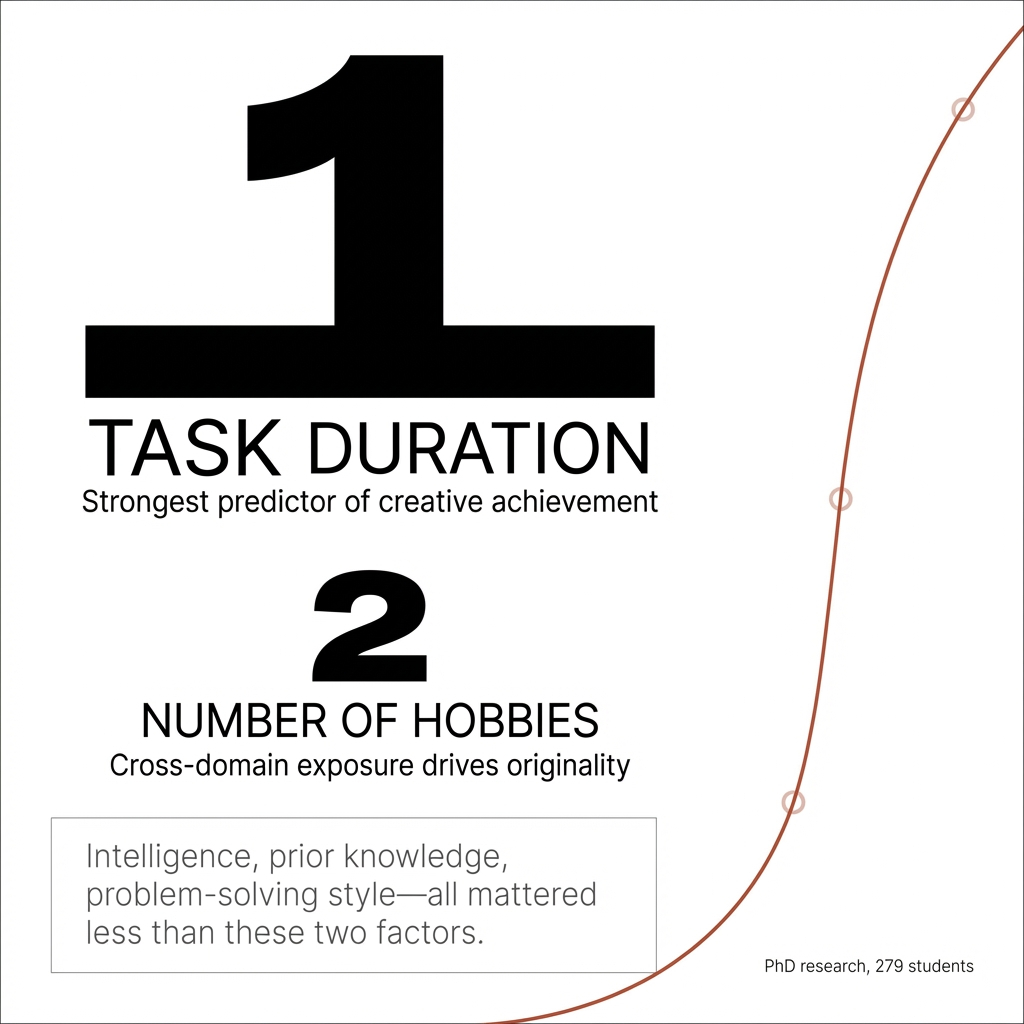
TL;DR: Research with 279 tenth-graders revealed that time spent on creative tasks predicts achievement more than intelligence, prior knowledge, or problem-solving style. The second strongest factor was variety of hobbies. These findings apply directly to teams and organizations struggling with creative output.
Core Findings:
-
Task duration was the strongest predictor of creative achievement among tenth-graders
-
Number of hobbies (not depth) was the second strongest predictor
-
Creative output depends more on conditions than on individual traits
-
Psychological safety and time to iterate matter more than brainstorming techniques
-
Cross-domain knowledge transfer drives creative recontextualization
I spent years researching creativity for my PhD. Tested 279 tenth-grade students. Measured their intelligence, prior knowledge, interest levels, problem-solving styles.
I expected the explorers to dominate. You know, the kids with the playful, experimental mindset who throw ideas around without attachment.
They didn’t.
The strongest predictor of creative achievement wasn’t intelligence. Wasn’t prior knowledge. Wasn’t even problem-solving style.
Task duration.
How long students spent on the work mattered more than how smart they were or what they already knew.
What the Data Showed Me About Time and Creativity
This finding contradicted everything I assumed. I thought explorers would breeze through tasks, playing with ideas without perfecting them. Less time needed because they weren’t obsessing over details.
Wrong.
The data showed a clear pattern. More time created more opportunities for ideas to emerge. Even among explorers, those who spent more time produced better creative work.
This wasn’t about grinding. It was about creating space for iteration.
Research with 208 fifth and sixth-grade students found student creativity varied in a positive and linear relationship with attentiveness in class. Attentive students were more likely to be creative in specific learning areas. Students with higher creative potential also controlled their attentiveness better.
Attention and time aren’t separate variables. They’re connected.
Key Point: Creative achievement increases with task duration because more time allows iteration and idea emergence. Even naturally exploratory thinkers need time to produce better work.
How to Architect for Creativity in Real Work
After this research, I realized something. We design for creativity.
Not by hoping inspiration strikes. By protecting time.
The problem? Outside constraints push back hard. On film sets, we want more takes, more rehearsal time, more iteration. Costs money. Everyone needs to get paid. For individual creative work, more iteration means more of your own time or budget.
Companies face the same tension. They need good work in a reasonable timeframe. Economic reality collides with creative needs.
I developed two practices:
First, present the choice clearly. When someone pushes for speed, I ask: do you want fast or do you want good? Perfect needs iteration. Make the trade-off visible.
Second, decide what’s good enough. Ask yourself: is this already good enough to move forward? You iterate later. Circle back when there’s time. Apply the lean principle. Ship a workable solution, knowing where you’ll improve it next.
Picasso created over 5,000 pieces of art in his lifetime. He spent time in his craft. He also shipped. Didn’t wait for perfect.
Key Point: Creativity needs protected time, but perfect doesn’t exist. Present the speed versus quality trade-off clearly, and ship workable solutions while knowing where to iterate next.
Why Variety of Hobbies Predicts Creative Achievement
Number of hobbies was the second strongest predictor of creative achievement in my research.
Not quality of hobbies. Not depth of expertise. Variety.
I’m not a hobbyist in the traditional sense. I transfer knowledge from one domain into another constantly. The underlying mechanism hobbies activate.
I use aikido techniques in leadership seminars. Train leaders with martial arts principles. Redirecting energy instead of resisting it. I pull from marginal gains theory in cycling and apply it to leadership development.
Creativity is recontextualization. Taking something from one domain and using it where others don’t see the connection.
Sometimes these metaphors surface naturally as I speak. Other times, I actively search for them. When I’m stuck on what to do next, I think: how would I describe this problem as a basketball player? As a chef? As a physicist? As a chess player?
Domain-specific imagery lets me argue on a structural level while making it visceral.
A study with 380 adolescents found both openness to experience and intrinsic motivation significantly predicted creativity. Together, they explained 34% of variance in creative performance.
Hobbies create openness. They force you to process information differently. They build cognitive diversity.
Key Point: Cross-domain knowledge transfer drives creativity. Variety of hobbies matters more than depth because different domains provide different thinking patterns you recontextualize for new problems.
Why Creative Output Declines Despite Better Tools
We’ve given people better tools. Faster processes. More data.
Creative output went down.
The problem isn’t resources. Mindset blocks.
People lack the mental space to tinker. They’re not allowed to brainstorm without immediately judging their ideas as not good enough. They’ve internalized the judgment before the idea even forms.
This is a climate issue. Does your company allow tinkering moments? Do people feel psychologically safe to explore?
Research shows traditional verbal face-to-face brainstorming groups tend not to be particularly effective. While waiting to share ideas, people forget what they meant to say or get distracted. Participation becomes uneven as some dominate discussions.
85% of employees want employers to prioritize creative development. Traditional brainstorming sessions improve problem-solving by only 45%.
We’re using broken tools and wondering why creativity suffers.
Key Point: Creative output declines when psychological safety is absent. Better tools don’t fix mindset blocks. People need permission to tinker without immediate judgment.
What Blocks Creativity at the Foundation Level
Working with organizations taught me something. The fundamental issue is human stability.
People don’t think creatively when they’re anxious about not being good enough. When they’re caught in the achievement pressure cycle. When their baseline state is stress.
I’ve taught specific breathing practices in seminars. Twelve minutes of alternate nostril breathing. People report immediate calm. Anxiety drops.
Every person is at a different point in their journey. Invisible walls limit their willingness or ability to practice these things. I know I need to practice more yoga to stay in a calm state consistently. I’m not there yet. Better than five years ago, though.
I meet people where they are. Sometimes teaching a simple breathing exercise. Sometimes suggesting they pause for coffee instead of hustling through the day.
Small interventions matter when people aren’t ready for big ones.
Key Point: Anxiety blocks creative thinking. Human stability matters more than brainstorming techniques. Meet people where they are with small, accessible interventions.
How Creativity Unlocks in Real Time
I’ve seen this shift happen in real time. When people finally get permission to play and tinker without judgment, you watch someone who was drowning finally take a breath.
Literally. They exhale. Inhale more deeply. Laugh. Their muscles relax.
Some people need explicit permission from authority to go there. They ask: is it okay to be this weird? I say yes. You’re allowed to be weird here.
Then I reframe what success looks like. I bring in stories from other domains. The Japanese sushi chef who practices for seven years to cook rice perfectly. Those reference points shift what people think is legitimate.
Research with 350 middle school students found creative metacognition (knowing your own creative strengths and limitations, plus knowing when and how to be creative) significantly moderates the relationship between risk-taking and creative performance.
High creative metacognition benefits performance. Low creative metacognition degrades it, especially when people take risks without understanding their own creative process.
You don’t tell people to be more creative. You help them understand how they create.
Key Point: Permission to explore without judgment creates visible physical and emotional shifts. People need to understand their own creative process, not receive generic creativity advice.
Why Conditions Matter More Than Individual Traits
We spend enormous energy trying to identify creative people.
The research shows achievement depends more on conditions than traits.
Task duration. Psychological safety. Permission to tinker. Time to iterate. Cross-domain exposure.
Conditions you build. You don’t need to hire different people. You need to change the environment.
A systematic review of 65 studies on adolescent creativity found 94% didn’t consider social contextual factors. We’re measuring individual traits while ignoring the environment that enables or blocks creative work.
For young adolescents, the intense pressure to conform and not stand out is one key factor for continued loss of creativity. Teens are known for being impulsive risk-takers, but within academic circles they tend to be the opposite.
The same pattern shows up in organizations. People have the capacity. The environment kills it.
Key Point: Focus on building conditions (time, safety, permission to tinker) instead of searching for creative individuals. The environment matters more than traits.
How This Research Changed My Practice
This research changed my entire creative approach.
I consciously protect time for iteration. Spending more time increases the chances something creative emerges. I don’t wait for inspiration. I create conditions where it shows up.
I actively pull from multiple domains. When I’m stuck, I shift contexts. Think about the problem as if I were in a different field. Cross-domain translation generates new approaches.
I build psychological safety first. Before any creative work happens, I make sure people know they explore without judgment. The exhale has to happen before ideas flow.
I’ve stopped measuring creativity as a fixed trait. I measure conditions. Did we protect enough time? Did we create safety? Did we allow tinkering? Did we pull from diverse domains?
Those are the levers moving creative output.
Key Point: Apply the research by protecting time for iteration, pulling from diverse domains when stuck, building psychological safety first, and measuring conditions rather than traits.
What the Pattern Reveals Across Contexts
Tenth-graders in my PhD research. Executives in leadership seminars. The same factors predict creative achievement.
Time matters more than talent.
Diverse exposure matters more than deep expertise in one area.
Psychological safety matters more than brainstorming techniques.
We keep looking for creative people when we should be building creative conditions.
Students who spent more time on tasks produced better creative work. Students with more hobbies showed higher creative achievement. Students who felt safe to explore generated more original ideas.
Your team probably has the creative capacity already. The question is whether you’ve built the conditions letting it emerge.
Frequently Asked Questions
What was the strongest predictor of creative achievement in the research?
Task duration. How long students spent on creative work mattered more than intelligence, prior knowledge, or problem-solving style. More time creates more opportunities for ideas to emerge and iterate.
Why do hobbies matter for creativity?
Variety of hobbies (not depth) was the second strongest predictor because hobbies activate cross-domain knowledge transfer. Different domains provide different thinking patterns you recontextualize for new problems.
How do you balance creative time with business constraints?
Present the trade-off clearly. Ask: do you want fast or good? Perfect needs iteration. When time is limited, decide what’s good enough to ship now and where you’ll iterate next. Apply lean principles.
What is creative metacognition?
Knowing your own creative strengths and limitations, plus knowing when and how to be creative. Research shows high creative metacognition benefits performance, while low creative metacognition degrades it, especially when taking risks.
Why don’t traditional brainstorming sessions work?
Traditional verbal face-to-face brainstorming tends not to be particularly effective. While waiting to share ideas, people forget what they meant to say or get distracted. Participation becomes uneven as some dominate discussions. They improve problem-solving by only 45%.
How do you create psychological safety for creativity?
Give explicit permission to explore without judgment. Some people need authority figures to say it’s okay to be weird or experimental. Address the foundation of human stability first. Anxiety blocks creative thinking.
What conditions should organizations measure instead of traits?
Task duration. Psychological safety. Permission to tinker. Time to iterate. Cross-domain exposure. These are conditions you build by changing the environment, not by hiring different people.
How quickly do creative interventions work?
Small interventions create immediate shifts. Twelve minutes of alternate nostril breathing produces immediate calm and drops anxiety. Permission to explore creates visible physical relaxation. Meet people where they are.
Key Takeaways
-
Task duration predicts creative achievement more than intelligence, prior knowledge, or problem-solving style. More time allows iteration and idea emergence.
-
Variety of hobbies matters more than depth because cross-domain knowledge transfer drives creative recontextualization.
-
Creative output depends on conditions (time, psychological safety, permission to tinker) more than individual traits.
-
Traditional brainstorming techniques are broken. Psychological safety and time matter more than structured sessions.
-
Anxiety blocks creativity at the foundation level. Address human stability before expecting creative output.
-
Organizations should stop searching for creative people and start building creative environments.
-
Measure conditions, not traits. Ask: Did we protect time? Create safety? Allow tinkering? Pull from diverse domains?