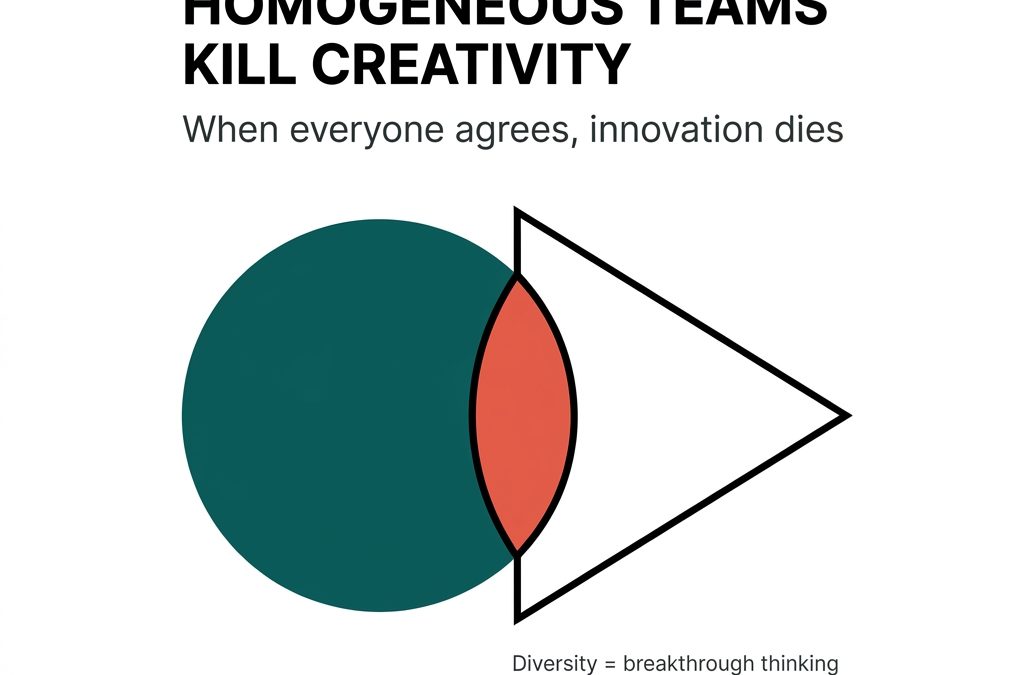
TL;DR: Homogeneous teams kill creativity by eliminating cognitive friction. Diversity isn’t a moral stance, it’s a creative technology. When different worldviews collide, they generate solutions that uniform thinking cannot access. The discomfort you feel when perspectives clash? That’s where breakthrough thinking lives.
Core Answer:
-
Cognitive diversity (different ways of thinking) matters more than traditional diversity metrics for creative outcomes
-
Homogeneous teams mistake agreement for truth and become structurally incapable of breakthrough thinking
-
Creative friction between different perspectives reveals invisible assumptions and unlocks new solutions
-
Leaders must build internal capacity to handle discomfort before diversity initiatives become genuine
-
The question shifts from “how do we accommodate differences?” to “what perspectives are we missing?”
What I’ve Learned From Film Sets
I’ve been in the film-industry for over a decade. The pattern I keep seeing: the best creative breakthroughs come from collision, not brilliance.
Cinematography sees light and shadow. Sound design hears texture and silence. Costume reads character through fabric. These perspectives clash. Something unexpected emerges from that friction. No single brilliant mind generates what their collision creates.
This isn’t about traditional diversity metrics. I’m talking about cognitive diversity. Different ways of thinking about the same problem.
Homogeneity doesn’t limit creativity. It kills it.
Key insight: Creative breakthroughs emerge from cognitive friction between different worldviews, not from individual genius.
Why Sameness Feels Safe
Every organization I work with has the same invisible problem.
They normalize. Create shared values. Standardize processes. Build governance structures. They call it alignment. Culture. Team cohesion.
They’re building walls.
I understand why. When everyone thinks similarly, meetings run smoother. Decisions happen faster. Less friction. Less disagreement. Less discomfort when someone challenges assumptions.
That comfort? That’s the signal creative growth has stopped.
Research confirms this. Homogeneous teams are more susceptible to groupthink, where the desire for harmony leads to irrational decisions. When people around you think like you, you stop encountering ideas that challenge your worldview.
You mistake agreement for truth.
Key insight: Comfort in decision-making signals the absence of cognitive diversity, not team effectiveness.
Diversity as Creative Technology
I need you to reframe diversity for a moment.
Not as a moral stance. Not as a checkbox. As creative technology. A structural requirement for innovation.
Genuine creativity requires divergent thinking. The ability to generate multiple solutions from different angles. Divergent thinking doesn’t happen when everyone in the room shares the same mental models, life experiences, and unconscious assumptions about how the world works.
The data is striking. Stanford research shows teams with differing perspectives generate 60% more creative solutions than homogeneous groups. They consider 48% more solutions to problems. Companies with diverse management teams earn 19% more revenue from innovation.
This isn’t about being nice. This is about accessing cognitive territory that uniform thinking cannot reach.
Key insight: Diversity functions as a mechanism for accessing solutions that homogeneous thinking structurally cannot generate.
How This Shows Up on Film Sets
Let me show you what this looks like in practice.
On a film set, departments operate from completely different worldviews. The production designer thinks spatial storytelling. The director of photography thinks emotional tone through color temperature. The sound mixer thinks about what silence communicates.
When these minds collaborate, they challenge each other’s invisible assumptions.
I’ve watched a costume designer’s choice completely shift how a cinematographer lights a scene. I’ve seen a sound designer’s perspective force a director to reconsider the entire emotional arc of a sequence. These aren’t conflicts. They’re creative friction generating solutions none of them could find alone.
The acting world demonstrates this principle visibly. When diverse creative teams develop films, directors, producers, writers who bring different lived experiences, they unlock stories homogeneous teams cannot access. Films like Black Panther and Soul captured nuances that made them resonate deeply because the creators shared their characters’ identities and experiences.
The authenticity you feel? That’s what happens when diverse perspectives shape the work from the beginning.
Key insight: Different departmental worldviews create productive friction that generates creative solutions no single perspective could produce.
The Fear Response as Diagnostic Tool
Here’s how you know if your team has built invisible walls.
Watch what happens when something unexpected enters the room. An idea that wasn’t calculated. A perspective that challenges consensus. A solution that doesn’t fit the established pattern.
If the response is fear, if people shut it down, if they get defensive, if they explain why it won’t work before considering it, you’re looking at a team that has normalized homogeneity.
If the response is curiosity, if people lean in, if they ask questions, if they explore implications even when uncomfortable, you’re looking at a team with creative capacity.
The leader sets this tone. I’ve seen it hundreds of times. If the person at the top encourages out-of-the-box thinking, stays calm when surprised, creates space for failure, the entire team relaxes into creative possibility. Everyone becomes solution-focused. Ideas flow.
If the leader tolerates diversity only on paper? If they promise openness but react with fear when assumptions get challenged? The team learns to keep divergent thinking to themselves.
Key insight: Team responses to unexpected ideas (fear versus curiosity) reveal whether diversity is genuine or performative.
The Culture Fit Trap
Most organizations don’t realize they’re building homogeneous teams.
They think they’re hiring for culture fit. They want people who share their values, who communicate in similar ways, who won’t disrupt the existing dynamic.
They’re hiring people who think like they already think.
I’ve experienced this pattern repeatedly. Leaders say they want diversity and innovation. They promise it on paper. When someone brings genuinely different thinking, when it creates the uncomfortable friction that precedes breakthrough, they cannot handle it.
They haven’t learned how to handle themselves. They’re afraid of losing control, of looking incompetent, of having their worldview challenged in front of others.
So they hire people who confirm existing assumptions. They call it culture fit. They mistake it for team cohesion. And they wonder why creativity has stagnated.
Key insight: “Culture fit” often functions as unconscious homogeneity that leaders mistake for team effectiveness.
The Inner Work Nobody Discusses
Here’s what I’ve learned from working with leaders who want to change this pattern.
The tools for handling diversity’s friction already exist. You have to do the internal work first.
In traditional yoga culture, there’s this principle: become the leader of yourself before you lead others. The Isha Yoga Center teaches specific practices for inner engineering. For controlling how you react from the inside so external circumstances don’t control you.
When leaders do this work, they build capacity to stay grounded when diversity brings the messy, unexpected stuff. They handle disagreement without feeling threatened. They sit with uncertainty without forcing premature closure.
Without that foundation, all the diversity initiatives in the world are performance.
I’ve noticed something else. People who’ve experienced genuine suffering, chronic illness, loss of loved ones, significant failure, tend to be more resilient and relaxed in creative environments. They’ve already met the unexpected and survived it. They’re not afraid of friction because they know it’s part of the process.
That lived experience becomes a form of diversity itself. The internal diversity of having wrestled with real hardship gives them access to perspectives and emotional ranges that someone who’s lived a comfortable, predictable life doesn’t have.
Key insight: Leaders need internal capacity (through practices like yoga or lived hardship) to handle the discomfort diversity creates before external initiatives become genuine.
What Diverse Teams Reveal
The real value of diversity isn’t adding new ideas to the mix.
Diverse perspectives reveal the limitations of your current thinking that you couldn’t see from inside it.
When someone with a genuinely different worldview looks at your problem, they see assumptions you didn’t know you were making. They spot patterns you’ve normalized. They ask questions that feel obvious to them but have never occurred to you.
This is why research shows creative diversity matters more than individual creativity. Teams with varied thinking styles outperform teams of individually brilliant people who all think the same way. You don’t need high collective creativity. You need creative diversity and collaboration.
The friction between different perspectives generates solutions uniform thinking cannot access. Different lived experiences collide and create new territory.
Key insight: Diverse teams don’t just add perspectives, they expose invisible assumptions in your current thinking you couldn’t see from within it.
Where Is Your Thinking Too Uniform?
Look at your own environment honestly.
Where have you surrounded yourself with people who think like you? Where have you normalized processes that feel comfortable because they confirm your existing worldview? Where are you mistaking agreement for innovation?
This isn’t about guilt. It’s about recognition.
Most of us build these invisible walls without realizing it. We hire people we connect with easily. We collaborate with people who understand us intuitively. We create systems that reward thinking aligned with ours.
Slowly, without noticing, we’ve created an echo chamber where breakthrough thinking becomes structurally impossible.
The question isn’t whether you value diversity in theory. The question is whether you’ve built the internal capacity to handle what diversity brings: discomfort, friction, challenges to assumptions, solutions that don’t fit your mental models.
Because that’s where creativity lives. Not in the comfort of sameness, but in the collision of genuinely different ways of seeing the world.
Key insight: Building capacity for discomfort matters more than intellectual commitment to diversity.
Frequently Asked Questions
What is cognitive diversity?
Cognitive diversity refers to differences in how people think, process information, and solve problems. It includes different mental models, life experiences, educational backgrounds, and approaches to creativity. This matters more for innovation than surface-level demographic diversity alone.
How do I know if my team lacks cognitive diversity?
Watch how your team responds to unexpected ideas. If the default response is fear, defensiveness, or immediate rejection, you’ve built homogeneity. If the response is curiosity and exploration, you have genuine diversity. Also look for: quick consensus without debate, comfort in all meetings, and hiring people who “fit in” easily.
Does diversity always create conflict?
Diversity creates friction, not necessarily conflict. Friction is the productive discomfort when different worldviews challenge each other’s assumptions. This feels uncomfortable but generates breakthrough thinking. Conflict happens when people lack the internal capacity to handle that friction constructively.
How do leaders build capacity to handle diverse perspectives?
Internal work comes first. Practices like yoga, meditation, or other forms of self-regulation help leaders stay grounded when challenged. Leaders who’ve experienced genuine hardship (illness, loss, failure) often have this capacity naturally because they’ve already survived the unexpected.
What’s wrong with hiring for culture fit?
Culture fit often becomes code for “thinks like we already think.” You end up hiring people who confirm your existing assumptions rather than challenge them. This creates the illusion of team cohesion while eliminating the cognitive friction necessary for innovation.
Can diversity work without individual creativity?
Yes. Research shows creative diversity (different thinking styles collaborating) matters more than individual creativity levels. A team of moderately creative people with diverse perspectives outperforms a team of brilliant people who all think the same way.
What perspectives am I missing in my environment?
Look at who you hire, who you listen to, whose ideas get implemented. If everyone shares similar backgrounds, education, life experiences, or ways of processing information, you’re missing perspectives. The real question: what solutions exist that you cannot see because of your current cognitive homogeneity?
Is this about demographic diversity or thought diversity?
Both matter, but they’re connected differently than most people realize. Different lived experiences (which often correlate with demographic differences) create genuinely different ways of thinking. The goal isn’t demographic diversity for its own sake, it’s accessing the cognitive diversity that different life experiences produce.
Key Takeaways
-
Cognitive diversity (different ways of thinking) is a creative technology, not a moral obligation. It generates solutions homogeneous teams structurally cannot access.
-
Homogeneous teams mistake agreement for truth and comfort for effectiveness. When meetings feel easy, creative growth has likely stopped.
-
Creative friction between different worldviews reveals invisible assumptions and unlocks breakthrough thinking. The discomfort is the signal, not the problem.
-
Leaders must build internal capacity to handle diversity’s friction before external initiatives become genuine. This comes through practices like yoga or lived experience with hardship.
-
“Culture fit” often creates unconscious homogeneity. You hire people who confirm existing assumptions rather than challenge them.
-
Teams reveal their true diversity through emotional responses to unexpected ideas. Fear signals performative diversity. Curiosity signals genuine capacity.
-
The reframe shifts from “how do we accommodate differences?” to “what perspectives are we missing that would unlock solutions we cannot see yet?”
When you cherish diversity as the mechanism for creative problem-solving rather than an obligation, everything changes about how you build teams, approach problems, and define creativity itself.
The rooms where creativity thrives don’t look the same. Don’t think the same. Don’t operate from the same assumptions.
That’s exactly why they work.