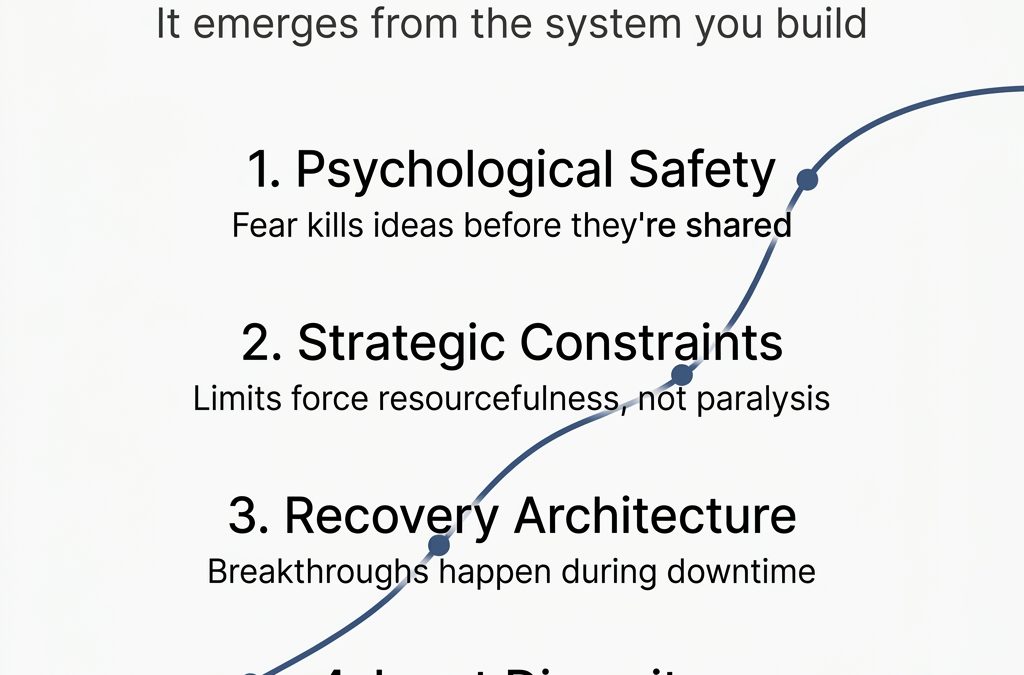
TL;DR: Creativity isn’t a trait you hire for. It’s what happens when you remove the barriers blocking it. Most organizations sit on unrealized creative potential because they focus on finding the right people instead of building the right conditions. Four structural elements determine whether creativity emerges: psychological safety, strategic constraints, recovery architecture, and input diversity.
The Core Problem:
-
Brilliant people go silent in unsafe environments
-
Unlimited freedom creates paralysis, not innovation
-
Relentless execution without recovery kills creative thinking
-
Homogeneous teams produce predictable solutions
-
The fix isn’t better hiring. It’s better systems.
Years back, I thought the problem was finding the right people.
Hire the creative ones. The divergent thinkers. People with unusual backgrounds who see things differently. Put them in a room and watch innovation happen.
That’s not how it works.
I watched brilliant people go silent in the wrong environment. I saw average teams produce extraordinary work when the conditions shifted. The pattern became impossible to ignore: creativity isn’t a personality trait you hire for. It’s an emergent property of the system you build.
That’s not how it works.
I’ve watched brilliant people go silent in the wrong environment. I’ve seen average teams produce extraordinary work when the conditions shifted. The pattern became impossible to ignore: creativity isn’t a personality trait you hire for—it’s an emergent property of the system you build.
Most leaders focus on inputs when they should be designing conditions. You don’t force creativity into existence. You remove what’s blocking it. You architect an environment where it becomes the natural response instead of the exception.
Here’s what I learned about the four structural elements that determine whether creativity emerges or dies.
Here’s what I’ve learned about the four structural elements that determine whether creativity emerges or dies in your organization.
What Is Psychological Safety and Why Does It Matter?
People won’t share ideas when they’re afraid.
This sounds obvious until you realize how organizations treat psychological safety as a nice-to-have cultural add-on instead of the load-bearing structure it actually is.
This sounds obvious until you realize how many organizations treat psychological safety as a nice-to-have cultural add-on instead of the load-bearing structure it actually is.
Research shows psychological safety accounts for 47% of the variance in workplace creativity. That’s not a marginal factor. That’s nearly half of what determines whether your team generates new solutions or retreats into safe, predictable patterns.
The correlation is strong (r = 0.68), meaning as psychological safety increases, creative output follows in near lockstep.
The correlation is strong—r = 0.68—meaning as psychological safety increases, creative output follows in near lockstep.
Here’s what I find interesting: safety doesn’t directly produce creativity. It creates conditions for happiness at work, which then unlocks creative involvement. You can’t skip steps. Surface interventions fail because they don’t touch the root structure.
Psychological safety isn’t about being nice.
It’s about building an environment where people say “I don’t know” without losing status. Where admitting mistakes becomes information instead of ammunition. Where challenging the established approach doesn’t require career-level courage.
When I work with teams stuck in creative paralysis, the first thing I look for isn’t their ideation process. It’s whether anyone feels safe saying the current approach isn’t working.
If they don’t, no brainstorming technique helps.
Key Point: Psychological safety isn’t a cultural perk. It’s the structural foundation that determines whether your team’s creativity surfaces or stays buried. Without it, you’re asking people to take risks they’ve been trained to avoid.
If they don’t, no brainstorming technique will help.
How Do Constraints Enable Creativity?
Freedom doesn’t fuel creativity the way most people think.
I used to believe removing constraints would unlock potential. Give people unlimited resources, infinite time, complete autonomy, and watch them soar. What I observed instead was paralysis dressed up as exploration.
I used to believe removing constraints would unlock potential. Give people unlimited resources, infinite time, complete autonomy, and watch them soar. What I observed instead was paralysis dressed up as exploration.
A meta-analysis reviewing 145 empirical studies dismantles the myth that eradicating rules and boundaries makes creativity thrive. The research shows individuals, teams, and organizations benefit from a healthy dose of constraints. It’s only when constraints become excessive that they stifle innovation.
Cognitive scientist Margaret Boden puts it plainly: “Constraints, far from being opposed to creativity, make creativity possible.”
Constraints shift your mindset from abundance to resourcefulness.
When you have everything available, your brain doesn’t engage problem-solving mode. It scans options. When you have clear limits, your brain activates a different system, one that focuses on what’s available and finds novel combinations within those boundaries.
I’ve seen this play out repeatedly. The team with a tight budget often produces more elegant solutions than the team with unlimited resources. The writer facing a strict word count finds sharper language than the one with infinite space.
The most valuable constraint is the human one. When designers embrace real limits (limited dexterity or low lighting), products become exceptionally useful under normal conditions. Designing for the edge forces you to solve for higher friction, and once solved, the benefit cascades outward.
This is why accessible innovations become mainstream. The curb cut was designed for wheelchairs and now serves everyone with rolling luggage, strollers, and bicycles.
Key Point: Constraints aren’t limitations. They’re focusing mechanisms. The question isn’t whether to impose them, but which constraints activate resourcefulness without crushing possibility.
The question isn’t whether to impose constraints. It’s which constraints activate resourcefulness without crushing possibility.
Why Does Recovery Matter for Creative Performance?
Your best ideas don’t happen at your desk.
Neuroscience research reveals short breaks between tasks boost problem-solving abilities by up to 40%. The brain’s default mode network (active during rest, not focus) is where creative insight happens. Problems often get solved when we stop consciously working on them.
Memory consolidation requires downtime. Emotional integration requires downtime. Some of your most valuable cognitive work happens off-task.
Yet most organizations treat recovery as a luxury instead of a performance architecture.
Yet most organizations treat recovery as a luxury instead of a performance architecture.
I watched leaders push teams into back-to-back meetings, celebrate those who skip lunch, and reward people who respond to emails at midnight. Then they wonder why innovation stalls.
Breaks aren’t distractions from productivity. They’re the foundation of it.
A 2021 study found two out of three US executives expect vacations increase creativity, yet scientific evidence was scarce until recently. Research now shows employees’ cognitive flexibility increased after vacation, with recovery experiences during time off directly predicting creative performance.
Recovery isn’t a single action. It’s an architecture. The quality of recovery matters more than quantity. Movement, nature, mindfulness, and naps outperform passive scrolling or fragmented breaks.
When I restructured my own work rhythm to include deliberate recovery periods, the shift wasn’t subtle. Ideas that used to take days of forced effort started arriving during walks. Solutions emerged in the shower. Connections formed while I was doing nothing related to the problem.
The insight: your brain is still working when you’re not.
The insight: your brain is still working when you’re not.
Building recovery into your team’s architecture means protecting white space in calendars. It means normalizing walks between meetings. It means recognizing that the person who leaves at 5pm might be more creative than the one who stays until 8pm.
Key Point: Recovery isn’t a reward for productivity. It’s the mechanism that enables it. Your brain needs downtime to process, consolidate, and connect. Without it, you’re running a system at capacity with no room for insight.
How Does Input Diversity Drive Innovation?
Creativity happens at intersections.
Steve Jobs said it in a 1994 interview: the key to creativity is exposing yourself to the best things humans have done and bringing those things into what you’re doing. What made the original Macintosh special was that the people working on it were musicians, poets, artists, zoologists, and historians who also happened to be the best computer scientists in the world.
You can’t cross-pollinate anything with itself.
When everyone on your team has the same background, reads the same books, attends the same conferences, and thinks through the same frameworks, you’re not building diversity. You’re building an echo chamber with good intentions.
Research on cross-pollination confirms it’s a powerful tool for generating new ideas and promoting innovation. When individuals with different perspectives and experiences come together, they generate more creative solutions. The automotive industry learned from aviation to create more fuel-efficient cars. The diversity of ideas requires actual differences.
Communities at crossroads benefit from increased creativity because diverse perspectives collide. Ancient Alexandria. Modern Hong Kong. These weren’t accidents. They were intersections where different fields and cultures met.
The practical application is simpler than most leaders realize: set aside some portion of a weekly meeting to ask each person what they read, saw, or came across. If one idea cross-pollinates to others, the time becomes valuable.
Here’s the challenge most organizations face: when teams are busy doing routine things, they’re not going to make time for innovation. Teams rely on their typical ways of doing things, creating echo chambers and blind spots.
Cross-pollination can’t be forced. Employees need psychological safety to share new ideas and ask questions. Leaders must nurture trust and give teams permission to not pass, but try.
I noticed the most innovative teams I worked with share a common pattern: they deliberately bring in outside perspectives. They invite people from unrelated fields to review their work. They study industries that have nothing to do with their own. They treat input diversity as a strategic advantage, not a cultural checkbox.
Key Point: Creativity emerges at the intersection of different fields, perspectives, and experiences. Homogeneous teams produce predictable solutions. Diverse inputs create the friction where new ideas form.
What Are the Key Takeaways?
You can’t hire your way to creativity.
You hire talented people and watch them go silent in a psychologically unsafe environment. You assemble brilliant minds and watch them drown in unlimited options. You build diverse teams and watch them burn out from relentless execution without recovery. You bring in outside perspectives and watch them bounce off a culture that doesn’t have space for new ideas.
The environment determines what emerges.
When I assess why creativity has stalled in an organization, I don’t start by evaluating people. I look at the conditions: Do people speak without fear? Do they have clear constraints that focus their thinking? Is recovery built into the rhythm or treated as weakness? Are diverse inputs welcomed or collected for appearances?
These aren’t soft factors. They’re structural elements that determine whether the creativity already present in your people has any chance of surfacing.
Most organizations are sitting on unrealized creative potential.
The problem isn’t the people. It’s the invisible walls the system has built around them. Remove those walls and you don’t need to hire different people. You need to stop blocking the ones you already have.
Start with one element. Build psychological safety by modeling vulnerability yourself. Introduce one meaningful constraint that forces resourcefulness. Protect recovery time in your team’s calendar. Ask what people are reading outside your industry.
Creativity isn’t something you inject into a team by hiring the right person. It’s something you allow by building the right conditions.
The question isn’t whether your people are creative enough.
The question is whether your environment lets them be.
Frequently Asked Questions
What is the biggest barrier to workplace creativity?
Lack of psychological safety. When people fear judgment, status loss, or negative consequences for speaking up, they retreat into safe, predictable patterns. Research shows psychological safety accounts for 47% of variance in creative output.
Do constraints help or hurt creative thinking?
Constraints help when they’re strategic. A meta-analysis of 145 studies shows that healthy constraints boost creativity by forcing resourcefulness. The brain shifts from scanning endless options to finding novel combinations within boundaries. Excessive constraints stifle innovation, but complete freedom creates paralysis.
How do breaks improve problem-solving?
Neuroscience shows short breaks boost problem-solving by up to 40%. The brain’s default mode network (active during rest) is where creative connections form. Memory consolidation, emotional processing, and insight generation all happen during downtime, not focused work.
What makes input diversity effective for innovation?
Real diversity of perspectives, not surface demographics. When people from different fields, backgrounds, and experiences collide, they generate solutions homogeneous teams miss. Cross-pollination requires actual differences in thinking, not people who think alike from different departments.
How do I know if my environment blocks creativity?
Ask four questions: Do people speak up without fear? Do they have clear constraints that focus thinking? Is recovery built into the rhythm? Are outside perspectives welcomed? If any answer is no, you’re blocking the creativity already present in your team.
Where should I start if creativity has stalled?
Pick one structural element. Model vulnerability to build psychological safety. Introduce one meaningful constraint. Protect recovery time in calendars. Ask what people are learning outside your industry. Small shifts in conditions create large shifts in creative output.
What’s the difference between hiring creative people and building creative environments?
Hiring focuses on inputs (the people). Environment focuses on conditions (the system). Brilliant people go silent in unsafe, constrained, exhausting, homogeneous environments. Average teams produce extraordinary work when conditions shift. The environment determines what emerges.
Final Takeaways
-
Creativity isn’t a personality trait. It’s an emergent property of the system you build.
-
Psychological safety is the foundation. Without it, people won’t share ideas, admit mistakes, or challenge assumptions.
-
Strategic constraints focus thinking and activate resourcefulness. Complete freedom creates paralysis.
-
Recovery isn’t a luxury. It’s where memory consolidation, insight generation, and creative connections happen.
-
Input diversity requires actual differences in perspective, not surface-level variety.
-
Most organizations sit on unrealized creative potential because the environment blocks what’s already there.
-
The fix isn’t better hiring. It’s removing the invisible walls your system built around your people.
The question is whether your environment lets them be.