by Christian Kresmann, Founder - Beyond Creativity | 2026, Apr, 5 | creativity, leadership, mindset, spirituality
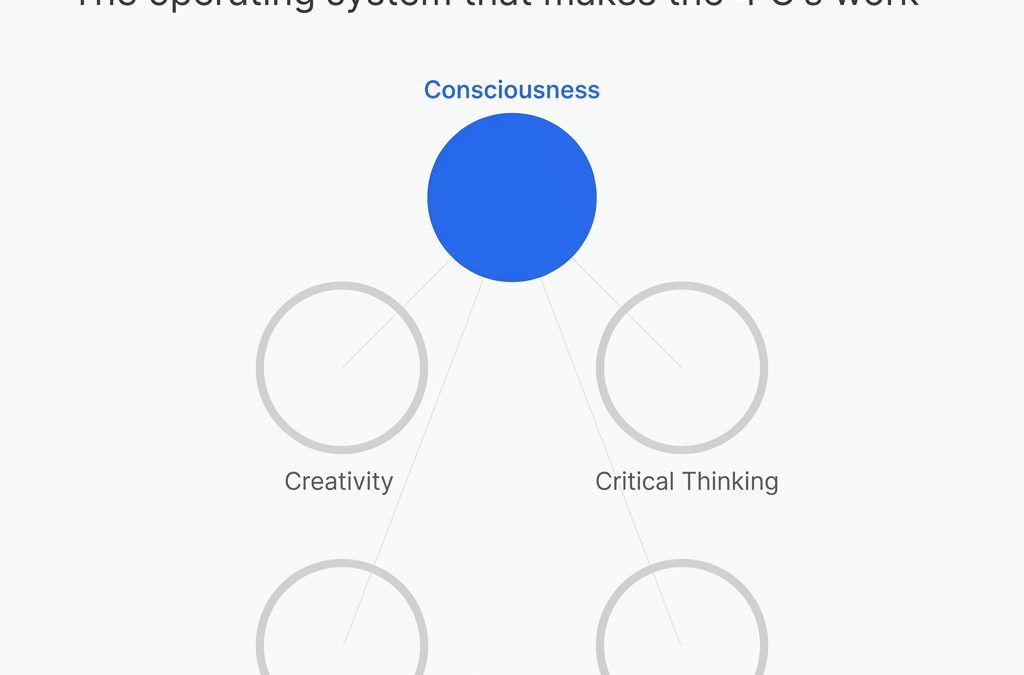
TL;DR: The widely-taught 4 C’s of 21st century skills (Creativity, Critical Thinking, Collaboration, Communication) operate at half capacity without a fifth element: Consciousness. This is the meta-skill that lets you direct attention, notice your own patterns, and choose how to deploy your other abilities. Research shows metacognitive ability explains 33.8% of performance variance, and AI productivity gains only materialize for employees with high self-awareness. Without consciousness, you have skills you can’t access when you need them most.
Core Answer:
-
The 4 C’s (Creativity, Critical Thinking, Collaboration, Communication) are incomplete without Consciousness as the fifth C
-
Consciousness is the operating system that makes the other four skills work when you need them
-
Metacognitive ability (thinking about your thinking) explains 33.8% of performance variance across teams
-
AI productivity gains only appear in workers with high metacognitive skill
-
Without consciousness, critical thinking becomes sophisticated bias and collaboration collapses under emotional reactivity
What I Learned Lying in Bed After My MS Diagnosis
Three weeks after my multiple sclerosis diagnosis, I was lying in bed building horrifying visions of the future. My mind raced. I terrified myself into a state I couldn’t escape.
Then I noticed something.
I was the one doing the terrifying.
I could feel my pulse. I could hear sounds in the room. I could breathe. All those chemical reactions happening in my body were real, happening right now. I could shift my attention to them. Consciously.
That moment rewired how I see everything we teach about 21st century skills.
Key Point: Consciousness is the ability to direct your own attention. Most people never learn this exists, let alone how to train it.
The Framework Everyone Teaches (And Why It Falls Short)
You know the 4 C’s: Creativity, Critical Thinking, Collaboration, Communication.
Schools teach them. Companies train them. Consultants sell them.
They’re incomplete.
I’ve trained hundreds of people in creativity over the past 11 years. Most don’t lack creative techniques. They lack the consciousness to recognize when they’re blocking themselves.
I worked with a screenwriter who generated ideas constantly. Brilliant ones. But she couldn’t direct her attention to specific parts of those ideas without an external prompt. Someone had to ask her a question before she could focus.
She had the creativity skill. She lacked the meta-awareness to self-regulate her focus.
I taught her to ask better questions. Questions direct attention. They force you to search for answers. Once she learned to ask herself the right questions, she didn’t need me anymore.
That’s consciousness at work.
Key Point: You need more than skills. You need the meta-awareness to know when and how to deploy them.
Why the 4 C’s Operate at Half Capacity Without Consciousness
Research backs this up in ways most people miss.
Metacognitive ability explains 33.8% of performance variance across work teams. Not creativity. Not communication skills. The ability to think about your own thinking.
What This Looks Like in Practice
Two people have identical critical thinking training. Same frameworks. Same analytical tools. One outperforms the other by a significant margin.
Why?
The high performer notices when they’re building an argument on an unexamined assumption. They catch themselves. They question the foundation before constructing the logic.
The other person uses critical thinking to defend beliefs they already committed to. They never turn that analytical lens on their own starting point.
Critical thinking without consciousness is sophisticated bias.
How This Shows Up in Collaboration
The same pattern appears everywhere.
I’ve seen it on film sets. One person lashes out because something didn’t go as planned. Immediately, everyone else has to regulate their own systems. They stop working. They manage the emotional fallout.
That person lacked the consciousness to notice their reaction before it exploded outward. One person’s inability to self-regulate hijacked the attention and energy of the entire group.
Collaboration collapsed because consciousness was missing.
Key Point: Skills without self-awareness become tools you can’t access under pressure.
The AI Productivity Paradox: Why Consciousness Matters More Now
The data on AI makes this even clearer.
A field experiment published in the Journal of Applied Psychology found something unexpected. AI productivity gains only materialized for employees with high metacognitive skill.
AI didn’t make everyone smarter. It made self-aware thinkers more effective.
The people who could monitor their own thinking, recognize their blind spots, and adjust their approach got massive gains. Everyone else saw minimal improvement.
Technology evolves. If consciousness doesn’t evolve with it, the gap widens.
Employees with high metacognitive abilities are 35% more likely to navigate organizational changes and maintain productivity during uncertainty.
That’s not a small edge. That’s the difference between thriving and surviving.
Key Point: AI amplifies what you already do. If you lack self-awareness, AI won’t fix that.
What Consciousness Actually Does (And Why It’s Different)
Consciousness isn’t another skill on the list. It’s the operating system that makes the other four work.
Unconscious vs. Conscious Creativity
Unconscious creativity happens to you. Ideas float in from external influences. You react to what’s around you.
Conscious creativity is different. You point your attention at a specific problem. You decide what area to explore. You direct your thinking toward solutions.
How This Applies to Communication and Collaboration
Same with communication. You have perfect technique and still fail if you don’t notice when you’re dominating a conversation, withdrawing from conflict, or reacting instead of responding.
The best collaborators I know all share one thing. They’re aware of their own triggers, biases, and patterns in group settings. They catch themselves before the pattern takes over.
Research on soft skills metacognition showed that when knowledge about these skills moves from tacit to conscious, performance improves. Training people to think about their soft skills led to increases in self-efficacy and adaptive performance.
You can’t optimize what you can’t see.
Key Point: Consciousness transforms passive skills into active choices you make in real time.
The Gap Between What We Teach and What Employers Actually Need
Here’s the uncomfortable part.
There are subtle and sometimes glaring differences in what an employer thinks “critical thinking” means versus how a university defines it.
We struggle to locate these trans-disciplinary skills and match them to what employers seek.
Research on instructional materials revealed that teachers’ integration of the 4 C’s competencies was classified as “Not yet reached competency,” with means ranging from 1.57 to 1.92 on a 4-point scale.
Even educators struggle to operationalize these abstract skills.
Maybe that’s because we’re teaching the outputs without teaching the operating system.
Key Point: We’re teaching people what to do, not how to know when to do it.
How Decision-Making and Attention Actually Work
Neuroscience research understands attention as a distinct form of decision based on the utility of information.
You’re not focusing. You’re deciding what deserves your cognitive resources.
Self-awareness of your goals, together with the capacity to predict possible obstacles, drives every step of the decision-making process. From problem identification to outcome evaluation.
Each step is marked by different levels of self-awareness.
Research on perceptual decision mechanisms highlights the role of top-down attentional control and conscious awareness in selecting a decision strategy to optimize detection performance.
Consciousness isn’t passive awareness. It’s active selection.
Key Point: Every moment of focus is a decision about where to allocate your mental resources.
What This Means for How We Build Skills That Actually Work
People come to me wanting to improve one skill. Communication or creativity, mostly.
Then they find out that consciousness work opens everything else.
I don’t teach creativity techniques in isolation. I teach people to notice when they’re stuck in a pattern. I teach them to ask different questions. I teach them to direct their attention consciously toward what they need to create.
The techniques matter. But without the meta-layer of consciousness, they’re tools you can’t access when you need them most.
The Fifth C: Consciousness
The 4 C’s aren’t wrong. They’re incomplete.
Consciousness is the fifth C.
It’s the ability to direct your attention. To notice your own patterns. To question your assumptions before you build arguments on top of them. To catch yourself before you hijack a team’s energy with an unregulated reaction.
Technology will keep evolving. The 4 C’s will keep getting taught.
But if we don’t evolve consciousness alongside them, we’re building skills on a foundation that can’t hold the weight.
I learned that lying in bed after my diagnosis. My mind was the one thing the disease couldn’t touch.
But only if I learned to direct it consciously.
That’s what we need to teach.
Key Point: Without consciousness, you have skills you can’t deploy when pressure hits.
Questions People Ask About the Fifth C
What’s the difference between consciousness and self-awareness?
Self-awareness is knowing your patterns exist. Consciousness is the active ability to direct your attention away from those patterns or toward different choices in real time. You notice the reaction before it runs you.
How do you train consciousness if schools don’t teach it?
Start with questions that redirect attention. When you’re stuck, ask yourself: What am I paying attention to right now? What am I assuming without checking? What would I notice if I looked at this differently? Questions force your brain to search, which breaks automatic patterns.
Does this mean the 4 C’s are useless without consciousness?
No. They’re necessary. But they operate at half capacity without “the meta-skill” of consciousness directing when and how to use them. You need both the tools and the awareness to deploy them.
Why don’t employers just test for metacognitive ability?
Most don’t know how. Metacognition is harder to measure than technical skills or even creativity. Plus, we’ve built hiring systems around what’s easy to test, not what predicts performance. That’s changing, slowly.
Is consciousness the same thing as mindfulness?
There’s overlap, but consciousness is broader. Mindfulness teaches present-moment awareness. Consciousness includes that, plus the ability to direct attention strategically, question your assumptions, and choose responses instead of reacting. It’s awareness with agency.
What happens when someone has high skills but low consciousness?
They become unpredictable under pressure. Their skills disappear when stress hits, emotions spike, or patterns get triggered. They know what to do in theory but can’t access it when the stakes are high.
How long does it take to develop consciousness as a skill?
There’s no fixed timeline. Some people have breakthrough moments in weeks. Others build it gradually over months or years. The difference is whether you’re practicing attention direction daily or waiting for it to happen by accident.
Does AI make consciousness more important or less?
More. AI handles information processing. Consciousness handles decision-making about what information matters, when to question your own thinking, and how to deploy AI as a tool instead of a crutch. Research shows AI productivity gains only show up in people with high metacognitive ability.
Key Takeaways
-
The 4 C’s (Creativity, Critical Thinking, Collaboration, Communication) are incomplete without Consciousness as the fifth C
-
Consciousness is the operating system that makes the other four skills accessible under pressure
-
Metacognitive ability explains 33.8% of performance variance across teams, more than creativity or communication skills alone
-
AI productivity gains only materialize for workers with high metacognitive skill, not everyone who uses AI
-
Critical thinking without consciousness becomes sophisticated bias. Collaboration without consciousness collapses under emotional reactivity.
-
Training consciousness means learning to direct attention, question assumptions, and notice patterns before they run you
-
Employees with high metacognitive abilities are 35% more likely to navigate change and maintain productivity during uncertainty
by Christian Kresmann, Founder - Beyond Creativity | 2026, Apr, 3 | acting, business, creativity, leadership, mindset, spirituality

TL;DR: We ask meaningful questions but fail to listen to the answers, turning genuine inquiry into performance. This creates emotional harm equivalent to physical pain and erodes trust in relationships. The fix is simple: if you ask, wait for the answer.
Core insights:
-
Asking questions without listening communicates “you don’t matter” and activates the same brain regions as physical pain
-
Only 2% of people are skilled at active listening, yet 60% of workplace failures stem from poor listening
-
Real listening creates inter-brain synchrony, a neurological bond that technology can’t replicate
-
The solution: if you’re not interested in the answer, don’t ask the question
What Performative Curiosity Looks Like
Someone asks how your new job is going.
You start to answer. Mid-sentence, their eyes drift. They check their phone. Or they interrupt with their own story about their career transition three years ago.
The question wasn’t a question. It was theater.
I’ve watched this pattern repeat across family dinners, professional meetings, coffee with friends. The setting changes. The behavior stays the same.
Someone poses a meaningful question, then vanishes before the answer arrives.
Why Deeper Questions Get Less Attention
Here’s what I notice: the deeper the question, the faster people disappear.
“How are you handling your father’s illness?”
“What does this career change mean for you?”
“How did that conversation with your partner go?”
These aren’t small talk. These are invitations into someone’s inner world. And the person asking often treats them like they’re discussing the weather.
Research shows only 2% of people are skilled at active listening. Meanwhile, 69% of leaders say it’s essential. That gap tells you everything.
We value something we refuse to practice.
The result? 65% of employees feel misunderstood due to poor listening skills. And 60% of workplace failures stem from inadequate listening, not lack of knowledge or skill.
We’re failing at the one thing that matters.
Key point: We ask vulnerable questions but treat them like small talk, creating a gap between what we say matters and what we practice.
What Being Unheard Does to Your Brain
When someone asks you a question but doesn’t listen to your answer, something specific happens in your body.
It feels like a slap in the face.
That’s not metaphor. Research shows social rejection and being ignored activate the same brain regions as physical pain. Your brain processes being unheard like a scraped knee or kicked shin.
It’s neurological violence.
I feel it as layers. First comes the sense of being unimportant. Then the realization that I’m not seen or heard. Finally, the understanding that what I think and how I go about life doesn’t matter to this person.
Each layer compounds.
And here’s what makes it worse: the person asking the question is often doing it because they don’t feel seen and heard either. They’re using you as an outlet for their own thoughts and opinions. They want to feel smart, to show they understand how the world works.
The question becomes a way of showing off.
Key point: Being ignored triggers the same neural pathways as physical pain. When we ask questions we don’t listen to, we’re inflicting neurological harm.
How We Lost Our Attention Span
Our attention spans have collapsed. Dr. Gloria Mark’s research tracked them declining from 150 seconds in 2004, to 75 seconds in 2012, to 47 seconds in 2024.
We’re losing the capacity to stay present long enough to hear a full answer.
People check their phones up to 80 times per day while believing they only check 25 times. Half of us admit we don’t stop checking our smartphones even when we should be focusing.
The mental garbage we carry interrupts our capacity for human connection. The vacation we’re planning. The meeting we’re worried about. The argument we had this morning.
We think these preoccupations are important. They’re not. They’re noise masquerading as meaning.
And here’s the paradox: we think we’re too busy for the kind of attention real listening requires. But the chance to relax, to be present, to connect is already available in the moment with the person in front of us.
We’re too distracted to notice.
Key point: Our attention spans have dropped to 47 seconds. We’re physically losing the ability to listen, treating connection as less important than the noise in our heads.
What Genuine Listening Feels Like
I notice when someone is genuinely listening through an invisible bond between us. There’s a magnetism that either strengthens or fades.
When it’s there, time stops. It also feels like eternity. Our life energies tie together. There is no other human being in the world for me. Only the person in front of me.
Yale research discovered that face-to-face conversations create coordinated neural activity between two brains. A literal synchronization that’s suppressed during Zoom or digital interactions. Real listening creates what scientists term “inter-brain synchrony” that technology doesn’t replicate.
This isn’t poetry. It’s neuroscience.
When two people genuinely connect through eye contact and deep listening, their brainwaves sync up. This synchrony enhances empathy, trust, and emotional regulation.
But it only happens with authentic presence. Performative questioning kills it.
Key point: Real listening creates inter-brain synchrony, a neurological bond where two people’s brainwaves align. Performative questions destroy this connection.
The One Rule That Changes Everything
If you’re not interested in the answer, don’t ask the question.
That’s it. That’s the whole thing.
Don’t prompt someone to share if their words will be met with distraction or indifference. Don’t request vulnerability you have no intention of honoring.
There’s a distinction worth noting: casual exchanges about weather or commutes don’t carry the same weight. Those surface-level pleasantries serve a different function. They’re social lubricant.
The issue arises with questions that matter. Questions that touch on things of substance.
Those require space, patience, and listening.
Key point: The rule is simple. If you ask a meaningful question, wait for the answer. Anything less is performative cruelty.
What Fake Listening Communicates
When we ask a question but don’t wait for the answer, we communicate something specific: you don’t matter. Your feelings don’t matter. All I care about is my own well-being.
And here’s the part we miss: my well-being would be far greater by including you.
We think too much of ourselves. We think we’re the most important person in the world. We ignore that we’re a tiny speck in the whole cosmos. We’re unimportant even in the city we live in, even more unimportant in our country, and especially insignificant among the 8 billion people on this planet.
Underneath that is a basic thought pattern: we divide and exclude rather than recognizing that every life on earth is part of ourselves.
If we understood that every life is part of ourselves, we would slow down. We would taste every answer given. We would have compassion about the story between the words spoken out loud.
Because we would be listening to ourselves.
Key point: Not listening tells someone they don’t matter. We miss that our well-being depends on including others, not prioritizing ourselves.
Why Real Engagement Is So Rare
True engagement requires more than surface-level inquiries. It demands follow-up questions, sustained attention, and genuine curiosity about the response.
Leaders especially should master this: asking “How’s the new job?” then absorbing the answer instead of rushing to the next topic or pivoting the conversation back to themselves.
The frustration intensifies when someone prompts a response, then talks over the answer with their own thoughts, redirecting everything back to their experience.
The conversation becomes a monologue disguised as dialogue.
Research shows 74% of employees say being heard at work boosts engagement and motivation. Yet more than half of managers fail to listen effectively to their teams.
We’ve normalized asking questions as performance rather than genuine inquiry.
Key point: 74% of employees say being heard boosts engagement, but most managers fail to listen. We’ve turned questioning into performance art.
How I Know When I’m Failing at This
I catch myself sometimes starting to do the thing I hate when others do it to me.
I notice the other person drifting away with their thinking. It’s in their eye movement. They get restless. The invisible bond between us slowly fades. The magnetism loses its power.
I also notice it when I start to articulate worse. When I ramble. When I lose my focus and presence. When I get lost in my thoughts.
That’s the signal. That’s when I shift focus back to the other person.
I like to listen 80% of the time and only speak 20% of the time. Unless I’m asked to speak. Then I go all in as a coach or trainer or actor or speaker on stage.
But in regular conversations, I like to give space.
Because real questions deserve real attention.
Key point: The signal that I’m not listening: the other person gets restless, I start to ramble, the bond fades. That’s when I shift back to them.
The Long-Term Damage of Not Being Heard
Prolonged experiences of not being heard lead to increased stress hormones, diminished self-worth, emotional isolation, trust breakdown, and learned helplessness where people stop trying to be heard even when opportunities arise.
The psychological cost compounds over time.
From the day we’re born, being seen and heard by others are fundamental human needs. Going unheard for extended periods leads to erosion of self-worth, emotional suppression, chronic stress, and physical health consequences.
This isn’t rudeness. It’s a form of violence we’ve normalized.
And here’s what makes it tragic: the solution is simple.
Wait for the answer.
If the answer matters enough to ask about, it matters enough to wait for. Real questions deserve real attention.
Anything less is noise masquerading as conversation.
Key point: Chronic experiences of being unheard cause stress, diminished self-worth, and learned helplessness. The damage compounds over time.
What Shifts When We Actually Listen
If someone understood that every life on earth is part of themselves, what would change about how they ask questions?
They would slow down.
They would taste every answer given.
They would have compassion about the story between the words spoken out loud.
Because they would be listening to themselves.
The invisible bond would strengthen instead of fade. The magnetism would grow. Time would stop in the best possible way.
And both people would walk away having experienced something rare: genuine human connection.
That’s what’s available when we stop performing curiosity and start practicing it.
The question is whether we’re willing to slow down long enough to find out.
Common Questions About Active Listening
How do I know if someone is genuinely listening to me?
You’ll feel an invisible bond, a magnetism between you. Their eye contact stays consistent. They ask follow-up questions. Time seems to slow down. You feel seen, not judged.
What’s the difference between small talk and questions that require real listening?
Small talk serves as social lubricant (weather, commutes). Real questions invite vulnerability (“How are you handling your father’s illness?”). The latter requires patience, space, and genuine attention.
Why do people ask questions they don’t want answered?
Often because they don’t feel seen and heard themselves. They use questions as a way to show off their thinking, to feel smart, to get their opinions out. It’s performance, not curiosity.
What happens in my brain when someone ignores me after asking a question?
Social rejection and being ignored activate the same brain regions as physical pain. Your brain processes being unheard like a scraped knee. It’s neurological violence, not just rudeness.
How do I catch myself when I’m not listening?
Watch for these signals: the other person gets restless, their eyes drift, you start rambling, you lose focus. The invisible bond between you fades. When you notice that, shift your attention back to them.
What’s inter-brain synchrony?
When two people genuinely connect through eye contact and deep listening, their brainwaves sync up. This neurological alignment enhances empathy, trust, and emotional regulation. It only happens with authentic presence.
How long should I wait before responding to someone’s answer?
Long enough to taste every word. Long enough to hear the story between the words spoken out loud. If you’re already formulating your response while they’re talking, you’re not listening.
What’s the long-term cost of not being heard?
Increased stress hormones, diminished self-worth, emotional isolation, trust breakdown, and learned helplessness. People eventually stop trying to be heard even when opportunities arise. The damage compounds over time.
Key Takeaways
-
Asking questions without listening activates the same brain regions as physical pain. It’s neurological violence we’ve normalized.
-
Only 2% of people are skilled at active listening, yet 60% of workplace failures stem from poor listening, not lack of knowledge.
-
Real listening creates inter-brain synchrony where two people’s brainwaves align, enhancing empathy and trust. Performative questions destroy this bond.
-
Our attention spans have collapsed from 150 seconds in 2004 to 47 seconds in 2024. We’re physically losing the ability to listen.
-
The simple rule: if you’re not interested in the answer, don’t ask the question. Anything less is performative cruelty.
-
When we ask but don’t listen, we communicate “you don’t matter.” We miss that our well-being depends on including others.
-
The solution is simple: slow down, taste every answer, have compassion for the story between the words. Real questions deserve real attention.
by Christian Kresmann, Founder - Beyond Creativity | 2026, Mar, 18 | creativity, leadership, mindset
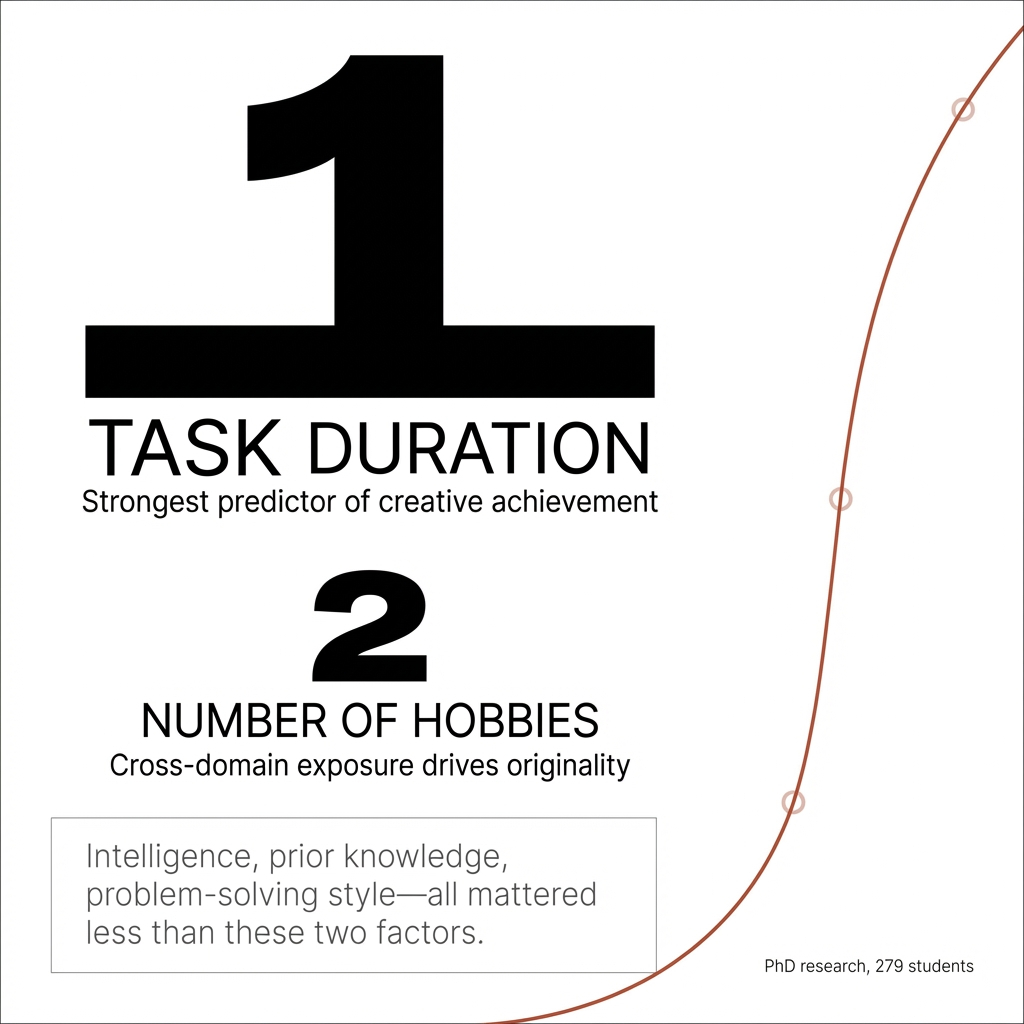
TL;DR: Research with 279 tenth-graders revealed that time spent on creative tasks predicts achievement more than intelligence, prior knowledge, or problem-solving style. The second strongest factor was variety of hobbies. These findings apply directly to teams and organizations struggling with creative output.
Core Findings:
-
Task duration was the strongest predictor of creative achievement among tenth-graders
-
Number of hobbies (not depth) was the second strongest predictor
-
Creative output depends more on conditions than on individual traits
-
Psychological safety and time to iterate matter more than brainstorming techniques
-
Cross-domain knowledge transfer drives creative recontextualization
I spent years researching creativity for my PhD. Tested 279 tenth-grade students. Measured their intelligence, prior knowledge, interest levels, problem-solving styles.
I expected the explorers to dominate. You know, the kids with the playful, experimental mindset who throw ideas around without attachment.
They didn’t.
The strongest predictor of creative achievement wasn’t intelligence. Wasn’t prior knowledge. Wasn’t even problem-solving style.
Task duration.
How long students spent on the work mattered more than how smart they were or what they already knew.
What the Data Showed Me About Time and Creativity
This finding contradicted everything I assumed. I thought explorers would breeze through tasks, playing with ideas without perfecting them. Less time needed because they weren’t obsessing over details.
Wrong.
The data showed a clear pattern. More time created more opportunities for ideas to emerge. Even among explorers, those who spent more time produced better creative work.
This wasn’t about grinding. It was about creating space for iteration.
Research with 208 fifth and sixth-grade students found student creativity varied in a positive and linear relationship with attentiveness in class. Attentive students were more likely to be creative in specific learning areas. Students with higher creative potential also controlled their attentiveness better.
Attention and time aren’t separate variables. They’re connected.
Key Point: Creative achievement increases with task duration because more time allows iteration and idea emergence. Even naturally exploratory thinkers need time to produce better work.
How to Architect for Creativity in Real Work
After this research, I realized something. We design for creativity.
Not by hoping inspiration strikes. By protecting time.
The problem? Outside constraints push back hard. On film sets, we want more takes, more rehearsal time, more iteration. Costs money. Everyone needs to get paid. For individual creative work, more iteration means more of your own time or budget.
Companies face the same tension. They need good work in a reasonable timeframe. Economic reality collides with creative needs.
I developed two practices:
First, present the choice clearly. When someone pushes for speed, I ask: do you want fast or do you want good? Perfect needs iteration. Make the trade-off visible.
Second, decide what’s good enough. Ask yourself: is this already good enough to move forward? You iterate later. Circle back when there’s time. Apply the lean principle. Ship a workable solution, knowing where you’ll improve it next.
Picasso created over 5,000 pieces of art in his lifetime. He spent time in his craft. He also shipped. Didn’t wait for perfect.
Key Point: Creativity needs protected time, but perfect doesn’t exist. Present the speed versus quality trade-off clearly, and ship workable solutions while knowing where to iterate next.
Why Variety of Hobbies Predicts Creative Achievement
Number of hobbies was the second strongest predictor of creative achievement in my research.
Not quality of hobbies. Not depth of expertise. Variety.
I’m not a hobbyist in the traditional sense. I transfer knowledge from one domain into another constantly. The underlying mechanism hobbies activate.
I use aikido techniques in leadership seminars. Train leaders with martial arts principles. Redirecting energy instead of resisting it. I pull from marginal gains theory in cycling and apply it to leadership development.
Creativity is recontextualization. Taking something from one domain and using it where others don’t see the connection.
Sometimes these metaphors surface naturally as I speak. Other times, I actively search for them. When I’m stuck on what to do next, I think: how would I describe this problem as a basketball player? As a chef? As a physicist? As a chess player?
Domain-specific imagery lets me argue on a structural level while making it visceral.
A study with 380 adolescents found both openness to experience and intrinsic motivation significantly predicted creativity. Together, they explained 34% of variance in creative performance.
Hobbies create openness. They force you to process information differently. They build cognitive diversity.
Key Point: Cross-domain knowledge transfer drives creativity. Variety of hobbies matters more than depth because different domains provide different thinking patterns you recontextualize for new problems.
Why Creative Output Declines Despite Better Tools
We’ve given people better tools. Faster processes. More data.
Creative output went down.
The problem isn’t resources. Mindset blocks.
People lack the mental space to tinker. They’re not allowed to brainstorm without immediately judging their ideas as not good enough. They’ve internalized the judgment before the idea even forms.
This is a climate issue. Does your company allow tinkering moments? Do people feel psychologically safe to explore?
Research shows traditional verbal face-to-face brainstorming groups tend not to be particularly effective. While waiting to share ideas, people forget what they meant to say or get distracted. Participation becomes uneven as some dominate discussions.
85% of employees want employers to prioritize creative development. Traditional brainstorming sessions improve problem-solving by only 45%.
We’re using broken tools and wondering why creativity suffers.
Key Point: Creative output declines when psychological safety is absent. Better tools don’t fix mindset blocks. People need permission to tinker without immediate judgment.
What Blocks Creativity at the Foundation Level
Working with organizations taught me something. The fundamental issue is human stability.
People don’t think creatively when they’re anxious about not being good enough. When they’re caught in the achievement pressure cycle. When their baseline state is stress.
I’ve taught specific breathing practices in seminars. Twelve minutes of alternate nostril breathing. People report immediate calm. Anxiety drops.
Every person is at a different point in their journey. Invisible walls limit their willingness or ability to practice these things. I know I need to practice more yoga to stay in a calm state consistently. I’m not there yet. Better than five years ago, though.
I meet people where they are. Sometimes teaching a simple breathing exercise. Sometimes suggesting they pause for coffee instead of hustling through the day.
Small interventions matter when people aren’t ready for big ones.
Key Point: Anxiety blocks creative thinking. Human stability matters more than brainstorming techniques. Meet people where they are with small, accessible interventions.
How Creativity Unlocks in Real Time
I’ve seen this shift happen in real time. When people finally get permission to play and tinker without judgment, you watch someone who was drowning finally take a breath.
Literally. They exhale. Inhale more deeply. Laugh. Their muscles relax.
Some people need explicit permission from authority to go there. They ask: is it okay to be this weird? I say yes. You’re allowed to be weird here.
Then I reframe what success looks like. I bring in stories from other domains. The Japanese sushi chef who practices for seven years to cook rice perfectly. Those reference points shift what people think is legitimate.
Research with 350 middle school students found creative metacognition (knowing your own creative strengths and limitations, plus knowing when and how to be creative) significantly moderates the relationship between risk-taking and creative performance.
High creative metacognition benefits performance. Low creative metacognition degrades it, especially when people take risks without understanding their own creative process.
You don’t tell people to be more creative. You help them understand how they create.
Key Point: Permission to explore without judgment creates visible physical and emotional shifts. People need to understand their own creative process, not receive generic creativity advice.
Why Conditions Matter More Than Individual Traits
We spend enormous energy trying to identify creative people.
The research shows achievement depends more on conditions than traits.
Task duration. Psychological safety. Permission to tinker. Time to iterate. Cross-domain exposure.
Conditions you build. You don’t need to hire different people. You need to change the environment.
A systematic review of 65 studies on adolescent creativity found 94% didn’t consider social contextual factors. We’re measuring individual traits while ignoring the environment that enables or blocks creative work.
For young adolescents, the intense pressure to conform and not stand out is one key factor for continued loss of creativity. Teens are known for being impulsive risk-takers, but within academic circles they tend to be the opposite.
The same pattern shows up in organizations. People have the capacity. The environment kills it.
Key Point: Focus on building conditions (time, safety, permission to tinker) instead of searching for creative individuals. The environment matters more than traits.
How This Research Changed My Practice
This research changed my entire creative approach.
I consciously protect time for iteration. Spending more time increases the chances something creative emerges. I don’t wait for inspiration. I create conditions where it shows up.
I actively pull from multiple domains. When I’m stuck, I shift contexts. Think about the problem as if I were in a different field. Cross-domain translation generates new approaches.
I build psychological safety first. Before any creative work happens, I make sure people know they explore without judgment. The exhale has to happen before ideas flow.
I’ve stopped measuring creativity as a fixed trait. I measure conditions. Did we protect enough time? Did we create safety? Did we allow tinkering? Did we pull from diverse domains?
Those are the levers moving creative output.
Key Point: Apply the research by protecting time for iteration, pulling from diverse domains when stuck, building psychological safety first, and measuring conditions rather than traits.
What the Pattern Reveals Across Contexts
Tenth-graders in my PhD research. Executives in leadership seminars. The same factors predict creative achievement.
Time matters more than talent.
Diverse exposure matters more than deep expertise in one area.
Psychological safety matters more than brainstorming techniques.
We keep looking for creative people when we should be building creative conditions.
Students who spent more time on tasks produced better creative work. Students with more hobbies showed higher creative achievement. Students who felt safe to explore generated more original ideas.
Your team probably has the creative capacity already. The question is whether you’ve built the conditions letting it emerge.
Frequently Asked Questions
What was the strongest predictor of creative achievement in the research?
Task duration. How long students spent on creative work mattered more than intelligence, prior knowledge, or problem-solving style. More time creates more opportunities for ideas to emerge and iterate.
Why do hobbies matter for creativity?
Variety of hobbies (not depth) was the second strongest predictor because hobbies activate cross-domain knowledge transfer. Different domains provide different thinking patterns you recontextualize for new problems.
How do you balance creative time with business constraints?
Present the trade-off clearly. Ask: do you want fast or good? Perfect needs iteration. When time is limited, decide what’s good enough to ship now and where you’ll iterate next. Apply lean principles.
What is creative metacognition?
Knowing your own creative strengths and limitations, plus knowing when and how to be creative. Research shows high creative metacognition benefits performance, while low creative metacognition degrades it, especially when taking risks.
Why don’t traditional brainstorming sessions work?
Traditional verbal face-to-face brainstorming tends not to be particularly effective. While waiting to share ideas, people forget what they meant to say or get distracted. Participation becomes uneven as some dominate discussions. They improve problem-solving by only 45%.
How do you create psychological safety for creativity?
Give explicit permission to explore without judgment. Some people need authority figures to say it’s okay to be weird or experimental. Address the foundation of human stability first. Anxiety blocks creative thinking.
What conditions should organizations measure instead of traits?
Task duration. Psychological safety. Permission to tinker. Time to iterate. Cross-domain exposure. These are conditions you build by changing the environment, not by hiring different people.
How quickly do creative interventions work?
Small interventions create immediate shifts. Twelve minutes of alternate nostril breathing produces immediate calm and drops anxiety. Permission to explore creates visible physical relaxation. Meet people where they are.
Key Takeaways
-
Task duration predicts creative achievement more than intelligence, prior knowledge, or problem-solving style. More time allows iteration and idea emergence.
-
Variety of hobbies matters more than depth because cross-domain knowledge transfer drives creative recontextualization.
-
Creative output depends on conditions (time, psychological safety, permission to tinker) more than individual traits.
-
Traditional brainstorming techniques are broken. Psychological safety and time matter more than structured sessions.
-
Anxiety blocks creativity at the foundation level. Address human stability before expecting creative output.
-
Organizations should stop searching for creative people and start building creative environments.
-
Measure conditions, not traits. Ask: Did we protect time? Create safety? Allow tinkering? Pull from diverse domains?
The Creative Mismatch: Why Identical Training Produces Wildly Different Results
by Christian Kresmann, Founder - Beyond Creativity | 2026, Mar, 16 | creativity, mindset
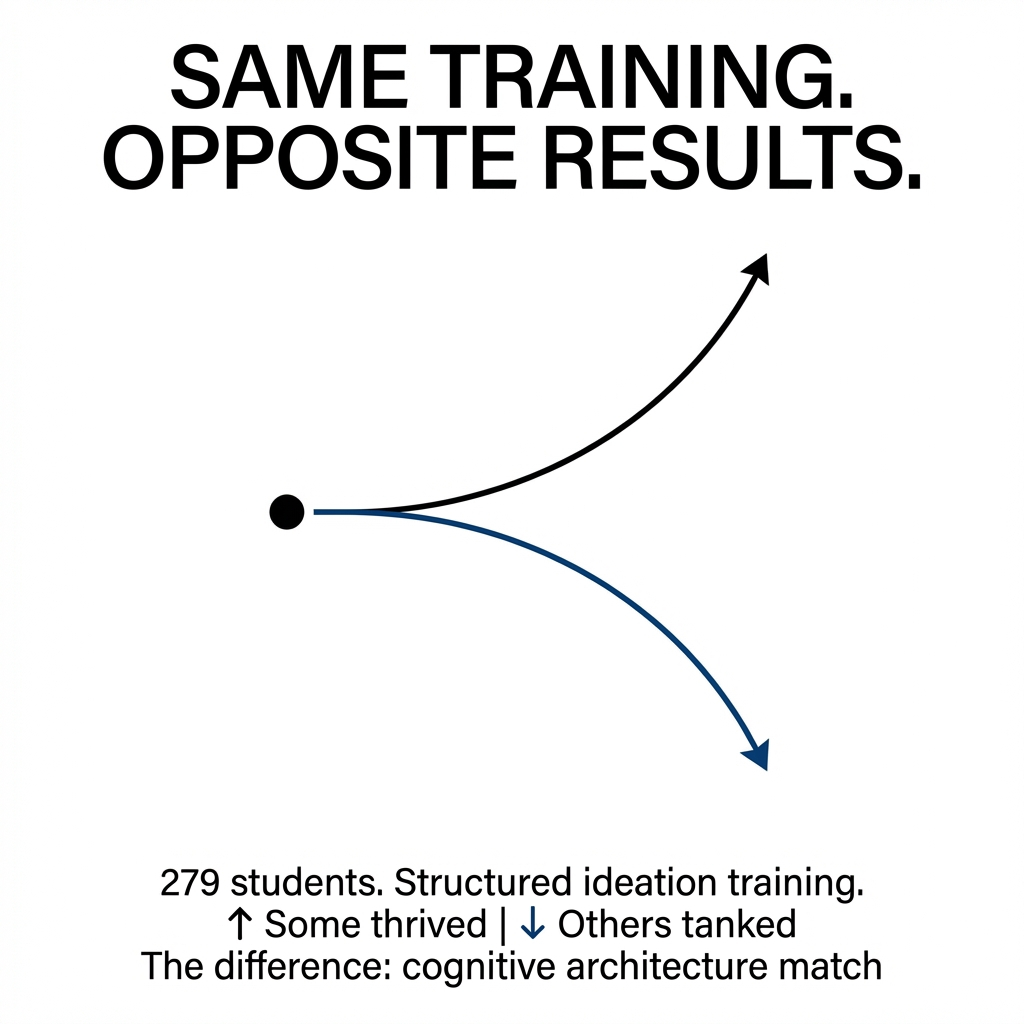
TL;DR: Three years studying 279 students revealed why creativity training fails. The method works for some people and tanks performance for others with identical training. Your cognitive style determines whether a creative process helps or hinders you. Matching methods to how your brain works produces better results than forcing everyone through the same approach.
Core Insights:
-
Same creativity training produces opposite results based on cognitive style (Explorer vs Developer, Internal vs External, Task vs Person-focused)
-
When methods mismatch your natural processing style, you work twice as hard for half the results
-
Creative achievement depends more on condition match than raw talent
-
The constraint is the condition, not your capacity
When Training Works for Some and Fails Others
I spent three years measuring creative output in 279 students. Same training. Same tools. Same timeline.
The results were dramatically, statistically opposite.
Some students thrived with structured combinational ideation methods. Their creativity scores increased significantly from initial design to final output. Others tanked under the exact same conditions.
This was not about talent or effort. The pattern pointed to something the field consistently ignores: cognitive architecture mismatch.
What I Observed: Matching instructional methods to cognitive profiles increased performance. Mismatching them decreased creative output, sometimes significantly.
What Is Aptitude-Treatment-Interaction?
My PhD research, supported by decades of ATI studies, revealed a structural pattern. When instructional methods match someone’s cognitive profile, performance increases significantly. When they mismatch, the same training decreases creative output.
We have known this since the 1970s. We still design creativity training like everyone’s brain operates identically.
The research shows Aptitude-Treatment-Interaction examines how outcomes depend on the match between individual characteristics and the intervention they receive. When treatment and aptitude align, effects are optimal. When they mismatch, you get what I measured: intuitive thinkers showing decreased creativity after structured ideation training, while analytical thinkers showed significant improvement from the same method.
Same input. Opposite results.
Key Point: Your cognitive style determines whether a creative method helps or hinders you. The method is not universal.
How Does Problem-Solving Style Work?
The VIEW assessment measures something most organizations miss: how people prefer to engage in problem-solving and creative work.
Three dimensions. Six specific styles.
Orientation to Change: Explorer versus Developer
Explorers chase the big picture and the why. Developers want detail and the how.
Manner of Processing: External versus Internal
Some people need to talk through ideas, hear them, move with them. Others need to read, reflect, process alone.
Ways of Deciding: Person-focused versus Task-focused
Some prioritize relationship and human impact. Others prioritize logic and objective outcome.
You do not choose your style. But you do choose your behavior.
When you operate in your preferred style, performance feels automatic. Easy. Natural. Little effort, maximum output.
When you are forced into a mismatched style, everything takes more energy. Feels awkward. Produces results you perceive as inferior.
I watched this play out in real time during my research.
Key Point: Your cognitive style is not a preference you change at will. You work with your operating system, not against it.
Why a CMO and His Team Kept Miscommunicating
I worked with a Chief Marketing Officer who felt frustrated. Smart team. Good people. But every meeting felt like miscommunication.
He would present the vision, the big strategic why. They would immediately jump to execution details he had not considered yet. He would get irritated. They would get confused.
The VIEW assessment revealed the structural mismatch.
He scored as a strong Explorer. Big picture. Strategic. Why-focused.
Every single person on his team scored as a strong Developer. Detail-oriented. Execution-focused. How-focused.
This was not a communication problem. This was a cognitive architecture mismatch where no amount of “communicate better” advice would help.
Once he understood this, everything shifted. He started translating his Explorer thinking into Developer language. They started recognizing when they needed his big-picture framing before diving into details.
Same people. Same work. Completely different dynamic.
Key Point: Miscommunication often reflects cognitive style mismatch, not lack of effort or clarity.
What Does the Research Show?
My PhD study was not the first to find this pattern. Students with higher knowledge management and self-regulation ability benefited significantly more from creativity training than their peers. Identical training, dramatically different outcomes based on cognitive starting points.
Another study found intuitive individuals showed highest creativity in initial design phases, but their creativity decreased in final design after structured combinational ideation. Meanwhile, adaptive and analytical processors showed increased creativity after the same structured method.
The implication is uncomfortable. We have been measuring creative potential when we should measure creative conditions.
You hold all the raw creative capacity in the world. If the method does not match your cognitive architecture, you will underperform someone with less capacity but better alignment.
Key Point: Creative achievement depends more on condition match than trait possession.
Why Does One-Size-Fits-All Keep Failing?
I see this pattern everywhere now. Organizations invest in innovation training. Bring in experts. Run workshops. Implement new processes.
Six months later, creative output has not improved. Sometimes it declined.
The problem is not the training quality. The problem is the assumption where what works for one cognitive style works for all.
When your profile of thinking styles matches an environment, you thrive. When the profile mismatches, you struggle. This is not about effort or talent. This is about structural fit.
I watched students in my research struggle not because they lacked creativity, but because the instructional approach contradicted their natural processing style. They worked twice as hard to produce half the results.
This is not a training problem. This is an architecture problem.
Key Point: Uniform training methods produce inconsistent results because brains operate differently.
When People Misinterpret Style Mismatch as Personal Limitation
Here is what makes this particularly tricky. Most people experiencing this mismatch do not recognize the style issue. They interpret the struggle as a personal limitation.
“I am not creative.”
“I do not think strategically.”
“I am terrible at brainstorming.”
These are not truths. These are symptoms of operating in a mismatched environment.
I had students who believed they were not creative because every brainstorming session felt forced and unproductive. Turns out they were strong Internal processors being asked to think out loud in group settings. Their creativity showed up beautifully when given time to reflect and process alone first.
The constraint was not their capacity. The constraint was the condition.
Key Point: Perceived creative limitations often reflect environmental mismatch, not inherent incapacity.
What Changes Performance?
In my work with organizations and individuals, I have seen the same pattern repeat. The moment people understand their cognitive architecture and get conditions where the architecture matches, performance shifts rapidly.
Not because they suddenly became more talented. Because the invisible constraint became visible and therefore modifiable.
A Developer-style thinker stops trying to force themselves into Explorer brainstorming sessions. Instead they contribute by refining and implementing ideas after initial generation.
An Internal processor stops believing they are bad at collaboration. Instead they ensure they get reflection time before group discussions.
A Task-focused decision maker stops apologizing for not being “people-oriented enough.” They recognize their logical analysis is exactly what the team needs.
Same person. Different condition. Completely different outcome.
Key Point: Making invisible constraints visible allows you to modify conditions instead of forcing behavior change.
What Research Keeps Telling Us
The goal of ATI research is clear: identify and develop interventions where different learners’ aptitudes match to maximize effectiveness.
We know learners with high spatial aptitude learn better through visual elaboration than text-only materials.
We know growth mindset promotes cognitive flexibility and creative capacity, while fixed mindset constrains them.
We know cognitive style is environmentally sensitive, formed by both individual predispositions and environmental requirements.
We have decades of validated research showing where matching method to cognitive architecture produces optimal results. We still design training, education, and organizational processes as if everyone’s brain works identically.
Key Point: The research exists. The application lags decades behind.
How to Apply This to Your Work
I am not suggesting you need a formal assessment to understand this. Start paying attention to when creative work feels easy versus forced.
Notice which conditions let you produce your best thinking with minimal effort.
Recognize when you are trying to force yourself into someone else’s creative process and the effort costs you energy without producing results.
The pattern I see most often: people experiencing execution blockage despite clear intention and understanding. They know what they want to create. They have the skills. But something invisible keeps preventing action.
Often, the invisible wall is a mismatch between their natural cognitive architecture and the conditions they are trying to work within.
You do not change your cognitive style. But you do change the conditions.
And when conditions match architecture, the constraint dissolves.
Key Point: Observe where your creative process flows naturally. Design conditions around those patterns.
The Question We Should Ask
We spend enormous energy trying to identify creative people. We should spend the energy creating conditions where different cognitive architectures produce creative work.
Because the research is clear: creative achievement depends more on condition match than trait possession.
Someone with moderate creative capacity in aligned conditions will outperform someone with high creative capacity in mismatched conditions. Every time.
This is not theory. This is what I measured across 279 students. This is what decades of ATI research confirms. This is what I see transform performance when organizations finally pay attention to the pattern.
The uncomfortable truth: your training is not failing because people lack creativity. The training fails because you are applying identical methods to different cognitive architectures and expecting uniform results.
Brains do not work like this.
And until we design for cognitive diversity instead of cognitive uniformity, we will keep getting the same disappointing outcomes from our creativity initiatives.
The architecture mismatch is not a bug in your people. The mismatch is a design flaw in your approach.
Frequently Asked Questions
How do I identify my cognitive style?
The VIEW assessment measures three dimensions: Orientation to Change (Explorer vs Developer), Manner of Processing (External vs Internal), and Ways of Deciding (Person-focused vs Task-focused). You also observe when creative work feels effortless versus forced. Where you naturally produce your best output with minimal energy indicates style alignment.
Does cognitive style change over time?
Your underlying style preference remains stable. Your behavior adapts to different situations. You learn to work in non-preferred styles when needed, but this requires more energy and effort than operating in your natural style.
What if my job requires a style opposite to mine?
You modify conditions within your role where possible. Internal processors negotiate reflection time before meetings. Developers request detailed briefs before big-picture strategy sessions. You are not changing your style, you are creating micro-conditions where your architecture functions better.
Why do organizations ignore this research?
Designing for cognitive diversity requires more complexity than one-size-fits-all training. The research exists but application demands customization. Many organizations choose efficiency over effectiveness, then wonder why training produces inconsistent results.
How does this relate to creativity training specifically?
Structured ideation methods work brilliantly for analytical, Developer-style thinkers. They tank performance for intuitive, Explorer-style thinkers. Same training, opposite results. Effective creativity development matches method to cognitive architecture instead of assuming universal applicability.
Will knowing my style immediately improve performance?
Awareness creates the possibility for change. Once you see the mismatch, you modify conditions. Performance shifts when you stop forcing behavior change and start designing environmental alignment. The shift happens rapidly once the constraint becomes visible.
How do teams with mixed cognitive styles work together?
The CMO example shows this. You translate between styles. Explorers learn to provide detail for Developers. Developers learn when big-picture framing helps before execution. You design processes where different styles contribute at optimal points instead of forcing everyone through identical steps.
Is this similar to learning styles or personality types?
No. Learning styles lack empirical support. Personality types measure different constructs. Cognitive style specifically addresses how you prefer to engage in problem-solving and creative work. The VIEW framework has validation through decades of ATI research showing measurable performance differences based on style-method alignment.
Key Takeaways
-
Identical creativity training produces opposite results based on cognitive style match or mismatch.
-
Your cognitive architecture (Explorer vs Developer, Internal vs External, Task vs Person-focused) determines which creative methods help versus hinder you.
-
Perceived creative limitations often reflect environmental mismatch, not inherent incapacity.
-
Creative achievement depends more on condition match than raw talent or trait possession.
-
Someone with moderate capacity in aligned conditions outperforms someone with high capacity in mismatched conditions.
-
Making invisible constraints visible allows you to modify conditions instead of forcing behavior change.
-
Organizations keep designing for cognitive uniformity while ignoring decades of research on cognitive diversity.
How Metaphors Actually Create Breakthroughs
by Christian Kresmann, Founder - Beyond Creativity | 2026, Mar, 13 | creativity, leadership, mindset
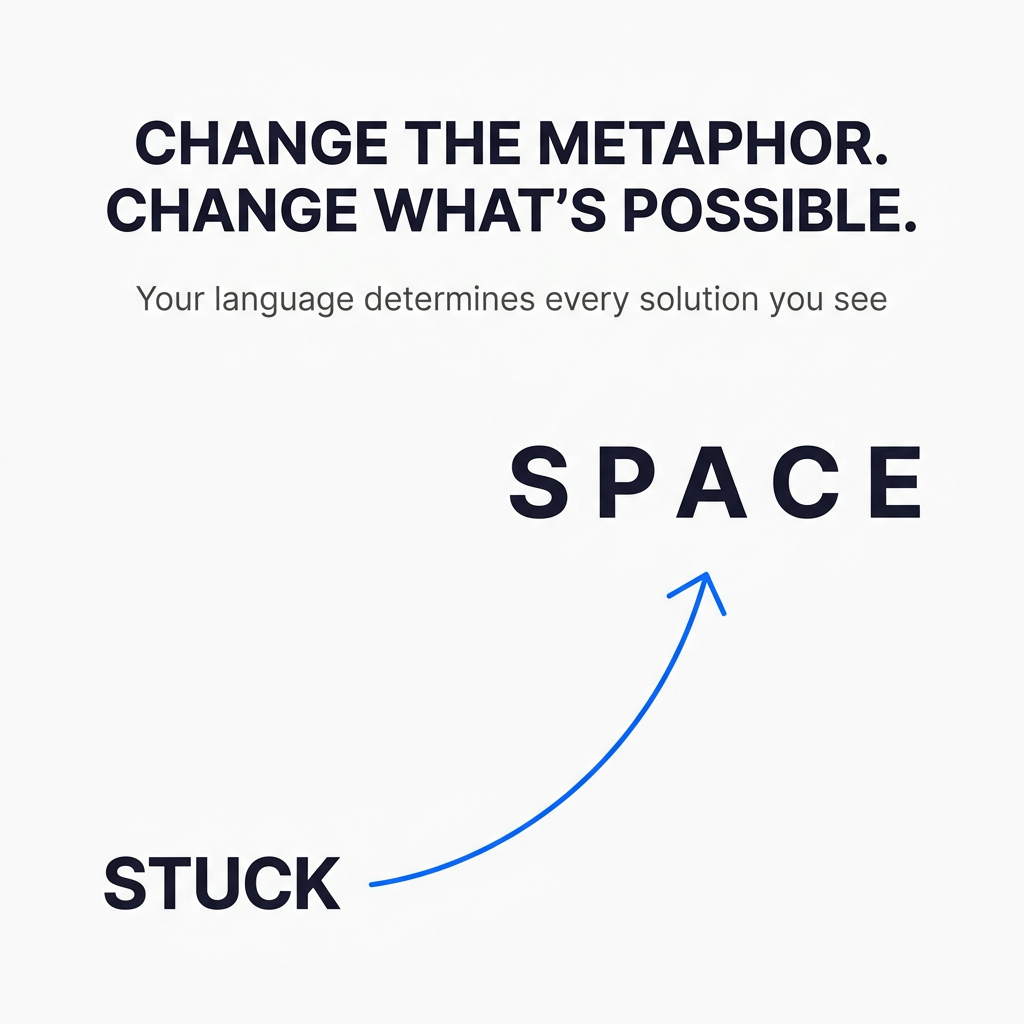
TL;DR: Metaphors are not decorative language. They’re the cognitive mechanism your brain uses to solve problems. When you make unconscious metaphors conscious through NLP chunking (up for abstraction, down for specifics, sideways for new domains), you unlock solution spaces you couldn’t see before. This is practical problem-solving infrastructure, not artistic flourish.
Core Insights:
-
Your brain treats metaphors as embodied reality. When you say “I’m stuck,” your sensory-motor cortex activates within 200 milliseconds as if facing physical immobility.
-
Unconscious metaphors shape what solutions seem possible. “Pushing a boulder” leads to force strategies, while “lost in fog” leads to visibility strategies.
-
NLP chunking provides a systematic method: chunk up for broader patterns, down for specifics, sideways for parallel structures in different domains.
-
Chunking sideways generates breakthroughs because concepts at the same abstraction level share transferable properties across contexts.
-
Organizations amplify this through shared metaphors. Describing a challenge as “battle” versus “garden” produces fundamentally different behaviors.
What Are Metaphors Really Doing?
I’ve spent years watching people get stuck on problems they could solve if they looked at them differently. The issue isn’t intelligence or effort.
It’s perspective.
When someone tells me they can’t see the forest for the trees, or something feels too high to grasp, or everything’s blurry, they think they’re describing their situation. They’re not. They’re revealing how their brain organizes the problem.
These aren’t casual word choices. They’re cognitive maps. Visual, auditory, kinesthetic expressions showing you exactly how someone’s mind has structured a challenge.
When you make those unconscious metaphors conscious, you change them.
Research from the University of Arizona shows that when you process metaphors, your brain’s sensory-motor region activates within 200 milliseconds. This isn’t abstract thinking. It’s embodied experience.
Your brain treats “I’m stuck” like actual physical immobility. Shift the metaphor, and you shift the perceived reality of the problem itself.
Reality Check: Metaphors are not descriptions of your situation. They’re the cognitive architecture creating your experience of that situation.
How Metaphors Shape Solution Spaces
When I work with clients who are stuck, I don’t start by analyzing their problem directly. I let them describe it in whatever language comes naturally.
Then I listen for the metaphors.
Someone might say their project feels like pushing a boulder uphill. Another person describes their team as lost in fog. A third tells me they’re drowning in details.
Each metaphor isn’t a description. It’s a complete framework determining what solutions even seem possible.
If you’re pushing a boulder, you think about leverage and force. If you’re lost in fog, you think about visibility and navigation. If you’re drowning, you think about surfacing and breathing room.
Same issue. Entirely different solution spaces.
What I do is make the metaphor conscious. I ask: Is it really a boulder? Is it really fog?
When someone realizes they chose that framework unconsciously, something shifts. They relax.
Because suddenly they have a choice.
Pattern I’ve Noticed: The moment people see their metaphor as a choice rather than reality, the problem loses its fixed quality. New possibilities appear.
What Is the NLP Chunking Framework?
I use a simple tool from neuro-linguistic programming. It works on three axes: up, down, and sideways.
Chunking up means moving toward abstraction.
If you start with “steering wheel,” you chunk up to “car part,” then to “vehicle,” then to “transportation.” You’re climbing toward broader categories and universal principles.
Chunking down means moving toward specificity.
From “steering wheel,” you go to “wooden steering wheel” or “leather-wrapped steering wheel” or “this steering wheel in my car.” You’re descending into details and components.
Chunking sideways is where the magic happens.
This is lateral movement at the same level of abstraction.
From “steering wheel,” you chunk up one level to “car parts,” then look sideways to find other examples: wheels, pedals, seats, mirrors. They’re all at the same chunk level because they share the same overarching category.
This sideways movement is how you generate fresh metaphors. According to NLP training research, when you get skilled at this, you notice an exponential increase in your ability to think around problems.

What This Means: Chunking gives you conscious control over abstraction levels. You’re no longer stuck with your first metaphor.
How to Use This in Practice
Let me walk you through what this looks like. Say someone tells me they can’t see the forest for the trees.
I don’t immediately try to solve their problem. I tinker with their metaphor.
First, I check if the metaphor fits. I ask questions. Is it really a forest you’re looking at? Does that feel accurate?
I’m watching for congruence. That moment when their verbal description matches their nonverbal response. When they nod and their whole body says “yes, that’s exactly it.”
Then we start playing with the metaphor itself.
What if we took a helicopter ride over the forest instead of walking through it? What if we zoomed in on one single tree instead of trying to see them all? What if we examined the details of individual trees so we could distinguish between them?
I’m not solving the real-world problem yet. I’m exploring solutions within their metaphorical framework.
And here’s what happens: they start generating their own ideas.
“Oh, if I had a helicopter view, I’d see the patterns I’m missing.”
“If I focused on one tree, I could make progress instead of feeling overwhelmed.”
When they come up with the solution themselves, even in metaphor, it’s already accepted.
Then I ask: How would this solution look in the real world? And they translate it back.
The metaphor was scaffolding. A container where they could explore freely without the weight of the actual problem crushing their thinking.
Why This Works: The metaphor creates psychological distance from the problem, allowing pattern recognition without emotional overwhelm.
Why Chunking Sideways Creates Breakthroughs
The reason lateral chunking generates such insights is structural.
Concepts at the same abstraction level share transferable properties even when they look completely different on the surface.
A journey and a project both have starting points, obstacles, progress markers, and destinations.
A garden and a business both involve cultivation, pruning, seasonal cycles, and growth patterns.
A symphony and a team both require coordination, timing, individual excellence, and collective harmony.
When you recognize these parallel structures, wisdom from one domain informs another. This isn’t wordplay. Studies in the International Journal of Design show that metaphors play a role in design creativity, with synthesis of design solutions being the strongest factor in metaphor use.
Innovation comes from seeing the same pattern in a different context.
Core Principle: Breakthrough insights occur when you recognize structural similarity across apparently unrelated domains.
How to Build Metaphorical Fluency
You develop this skill deliberately. Here’s how I teach it.
Start with any concept. Let’s use “deadline.”
Chunk up: What’s the category above deadline?
Time constraint. What’s above that? Project management. What’s above that? Resource allocation.
Chunk down: What’s a specific example of a deadline?
The report due Friday. What’s more specific? The financial report due Friday at 5pm to the CFO.
Chunk sideways: Go up one level to “time constraint,” then look for other examples at that same level.
Budget limits. Team capacity. Regulatory requirements. They’re all constraints in different domains.
Now you ask: How do people handle budget limits creatively? How do teams work around capacity constraints? What do I learn from how industries manage regulatory requirements?
You’ve opened up three new solution spaces for your deadline problem.
The practice is simple. Pick random objects throughout your day and chunk them up, down, and sideways. Train your mind to move consciously through abstraction levels.
When you get fluent at this, you stop being trapped by the first metaphor that comes to mind.
Practice Method: Spend five minutes daily chunking everyday objects. Your coffee cup. Your desk. Your commute. The skill transfers to complex problems automatically.
What Changes When People Learn This
I’ve watched the same pattern play out dozens of times.
Someone comes to me stuck. We work through their metaphors. And then something fundamental shifts.
It’s not that they suddenly have all the answers. It’s that they realize their thinking isn’t fixed. The way they’ve been perceiving their situation was one choice among many. An unconscious choice, but a choice nonetheless.
That realization brings relief. Real, visible relief.
Because if you chose this interpretation unconsciously, you choose another one consciously. You’re not stuck with your first frame. You’re not trapped by how you initially saw things.
This goes deeper than problem-solving technique.
People walk around carrying metaphors they inherited without questioning. “Life is a competition.” “Success is climbing the ladder.” “Relationships are work.”
These aren’t truths. They’re frameworks.
And frameworks determine what actions seem possible.
When someone realizes this, really realizes it, they stop over-identifying with their beliefs. They get humble about what they know versus what they’re assuming.
That humility creates space for new thinking.
Observation from Practice: The relief people experience when they recognize thinking as choice rather than reality is profound. Fear decreases. Creativity increases.
How This Scales to Teams and Organizations
The same principles apply when you’re working with teams and organizations.
The difference is that you’re dealing with shared metaphors.
I’ve seen this play out in real time. When immigration gets described as “a flood” or “a virus,” entire organizations align around that metaphor. It shapes policy, behavior, resource allocation.
Everyone following that description acts accordingly.
If your team sees a challenge as a battle, you get defensive strategies and competitive thinking. If they see it as a garden, you get cultivation and patient growth.
Same challenge. Completely different organizational responses.
What I do with organizations is help them identify their limiting metaphors and create more solution-focused ones. I’m transparent about the mechanism. I explain that language shapes the solutions you allow yourself to consider.
Then I back it up with research.
Studies show that cross-domain innovation outperforms specialization. The most impactful scientific papers come from teams that combine disparate specialties, and that impact increases exponentially with disciplinary distance.
When you train teams to think metaphorically across domains, you’re not teaching soft skills. You’re installing cognitive infrastructure for innovation.
Organizational Reality: Shared metaphors create shared reality. Change the collective metaphor, and you change collective behavior without force.
The Biggest Misconception About Metaphorical Thinking
When people first encounter this work, they think it’s playful. Artistic. Something without practical implications.
They’re completely unaware of how many times a day they use metaphors and unconsciously accept those metaphors as reality.
When I say “metaphor,” they think poetry. Literary devices. Decorative language for creative writing.
They don’t realize it’s happening to them constantly. In every meeting. Every strategy session. Every time they describe a problem.
The metaphors you use aren’t describing reality.
They’re creating it.
And here’s what makes this tricky: there’s an invisible barrier between what people assume to be truth and what they recognize as a way of looking at things.
Everyone collectively agrees not to know the absolute truth so we function in society. But then we over-identify with our assumed beliefs.
We defend them. Build our identities around them. Forget they were ever interpretations.
That over-identification causes problems. Real problems.
Because when your core metaphors get questioned, it feels existential. Like you might disappear if the organizing story falls apart.
I’ve found that people are scared. Really scared. Of losing themselves. Of uncertainty. Of what happens if their identity-defining beliefs turn out to be metaphors they inherited.
What I’ve Learned: The resistance to examining metaphors isn’t intellectual. It’s existential. People fear that questioning their framework means losing themselves.
How to Hold Space for Metaphor Exploration
When I work with someone at that edge, where their foundational metaphors are being questioned, I approach it with lightheartedness.
I show them I don’t know the truth either. That it’s okay to sit in ambiguity. That there are so many moments in life where we can’t know what’s true and what’s false, and that’s fine.
I maintain a calm posture. Use humor. Make it warm.
I’m pacing their uncertainty with care, addressing their fears the same way you’d care for a child with anxiety. With love. With the understanding that those fears are real and valid.
That vibe, that presence of “we’re in this together and it’s safe to not know,” creates the container where exploration becomes possible.
Because transformation doesn’t happen through force. It happens through safety and choice.
My Approach: Humility, warmth, and humor create psychological safety. People explore new metaphors when they feel held, not pushed.
Frequently Asked Questions
How do I know if I’m using a limiting metaphor?
Listen to your language when describing problems. If your metaphor suggests only one type of solution (force, escape, defense), it’s probably limiting. Good metaphors open multiple pathways.
What if my metaphor feels true, not chosen?
That’s the sign of an unconscious metaphor. The feeling of “truth” is your brain’s familiarity with the pattern, not objective reality. Try chunking sideways to find alternative metaphors at the same abstraction level.
How long does it take to build metaphorical fluency?
With daily practice chunking everyday objects, most people notice shifts within two weeks. Full fluency, where you automatically recognize and shift metaphors, develops over months.
Do I need NLP training to use this?
No. The chunking framework is simple enough to self-teach. Start with physical objects, practice the three directions (up, down, sideways), then apply to problems.
How do I get my team to adopt a new shared metaphor?
Transparency works best. Explain how metaphors shape behavior, show research backing it up, then collaboratively explore what metaphor better serves your collective goals.
What if someone resists changing their metaphor?
Resistance usually signals identity attachment. Approach with lightness and curiosity, not force. Show you’re exploring together, not correcting them. Create safety first.
Are some metaphors objectively better than others?
No. Metaphors are tools. The best metaphor is the one that opens solution spaces appropriate to your context and values. A “battle” metaphor might serve in true crisis but limits during collaboration.
How is this different from positive thinking?
Positive thinking tries to change emotional valence. Metaphorical thinking changes structural framework. You’re not making problems “positive,” you’re revealing hidden solution architectures through pattern recognition.
Key Takeaways
-
Metaphors are cognitive infrastructure, not decorative language. Your brain processes them as embodied reality within 200 milliseconds.
-
Unconscious metaphors limit solution spaces. “Pushing a boulder” triggers different strategies than “tending a garden” for the same problem.
-
NLP chunking provides systematic metaphor exploration: up for abstraction, down for specifics, sideways for parallel domains.
-
Chunking sideways creates breakthroughs because concepts at the same abstraction level share transferable properties across contexts.
-
Making unconscious metaphors conscious gives you choice. That choice creates relief and opens new possibilities.
-
Organizations operate through shared metaphors. Change collective language, and you change collective behavior.
-
Resistance to examining metaphors is existential, not intellectual. Approach with humility, warmth, and safety, not force.