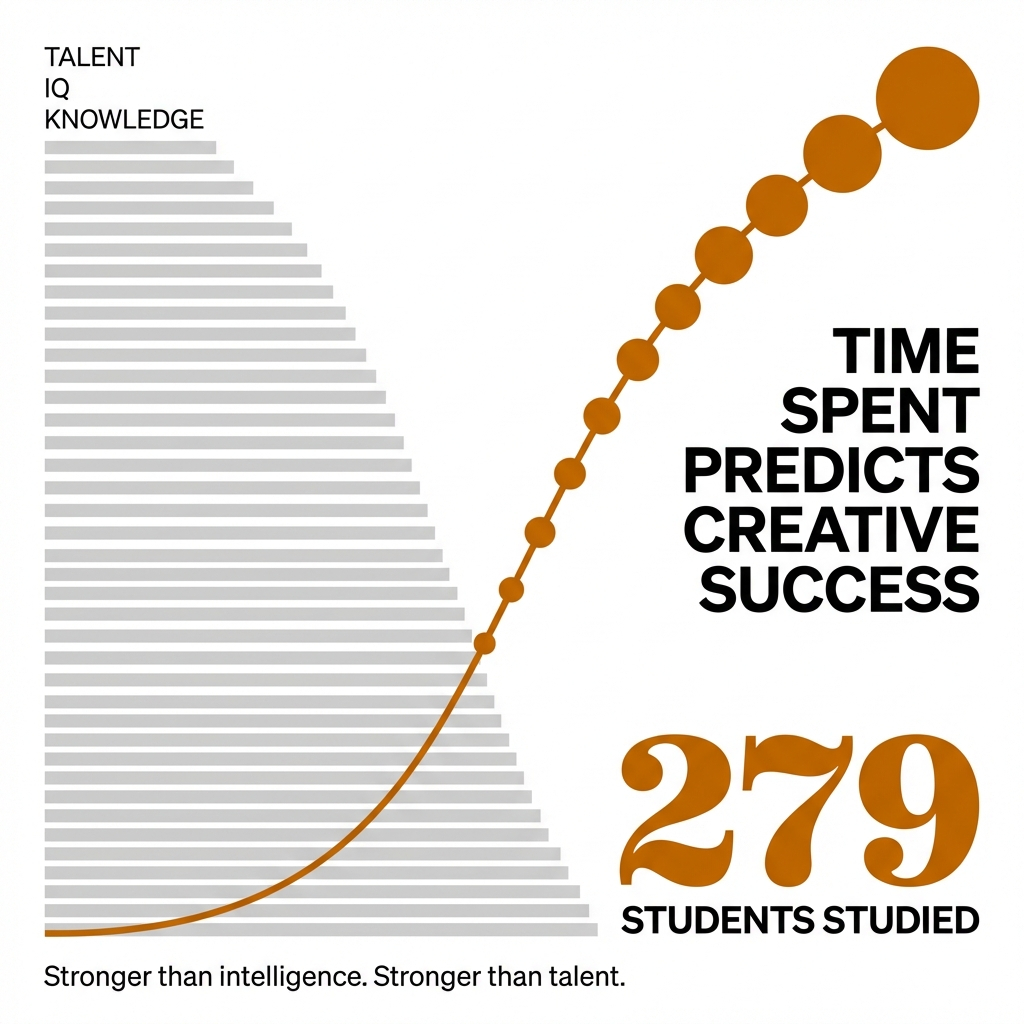
TL;DR: Three years studying 279 students revealed that task duration predicts creative achievement more than intelligence or natural talent. One-size-fits-all creativity training fails because different cognitive styles need different conditions. The solution isn’t finding creative people. It’s protecting time and matching instruction to how people actually think.
Time spent working predicts creative success more than intelligence, prior knowledge, or natural problem-solving style.
Different cognitive architectures need different instruction formats. Audio prompts work better for some people; written instructions work better for others.
Domain diversity matters more than domain mastery. Number of hobbies was the second-strongest predictor of creative achievement.
Psychological safety and internal stability are prerequisites. Anxiety blocks access to creative capacity regardless of tools or training.
Match instruction to cognitive style using frameworks like VIEW assessment. Developers need structure; Explorers need strategic context.
What I Got Wrong About Creativity
I spent three years studying 279 students to understand what predicts creative achievement. The results contradicted almost everything I believed.
I expected the explorers to dominate. The people who naturally play with ideas, who resist perfecting every detail. I thought they would breeze through creative tasks without needing much time because they were experimenting with concepts, not polishing them endlessly.
Wrong.
Task duration was the strongest predictor of creative achievement. Stronger than intelligence. Stronger than prior knowledge. Stronger than natural problem-solving style.
This finding changed how I approach creative work. It revealed something uncomfortable that most creativity training programs ignore: we can architect for creativity by protecting time, not by identifying creative people.
The research also revealed that how you deliver creative training matters as much as the content itself.
Key insight: Creative achievement depends more on conditions than traits. Protecting time for creative work outweighs all other interventions.
Why One-Size-Fits-All Training Fails: The Aptitude-Treatment-Interaction Problem
Most organizations approach creativity training the same way. Develop one program, roll it out to everyone, measure results.
Then they wonder why half the team thrives while the other half stagnates.
The problem is the assumption that identical input produces identical output across different cognitive architectures.
Aptitude-Treatment-Interaction research examines how outcomes depend on the match between cognitive style and instruction format. When you match treatment to aptitude, the effect is optimal. When there’s a mismatch, people learn in what feels like a foreign language.
I saw this clearly in my research.
We took the same creative exercise and presented the prompt differently based on problem-solving styles measured by the VIEW assessment. For people who process information internally, we gave written instructions they could read multiple times. For those who process externally or auditorily, we recorded spoken prompts.
The results were striking.
Some students excelled with audio prompts while struggling with written ones, even though they tested well on cognitive ability and reading comprehension. Intelligence was irrelevant. Cognitive architecture was everything.
One pattern surprised me: cognitive load. When people could only listen to a task instead of rereading a written prompt, their working memory capacity became a limiting factor we had underestimated. Some handled it beautifully. Others hit a wall.
This is what organizations miss when they deploy one-size-fits-all creativity training.
Bottom line: Matching instruction format to cognitive style produces better outcomes than generic training, regardless of content quality.
How the VIEW Framework Reveals Cognitive Architecture
What VIEW Measures
VIEW assesses three dimensions of creative problem-solving style:
Orientation to Change: Explorer versus Developer
Manner of Processing: External versus Internal
Ways of Deciding: Person-focused versus Task-focused
These measure preference, not ability. They show how you naturally approach problems when nobody tells you what to do.
Style vs. Behavior: The Critical Distinction
You cannot change your style. You can change your behavior.
When you use your preferred style, everything feels easy, automatic, natural. You’re not burning mental resources to engage with the task. When you operate outside your preference, everything takes more effort and produces results you perceive as inferior.
I learned this working with a marketing team.
The CMO had a strong Explorer preference: big picture, strategic, focused on why things matter. His entire team had strong Developer preferences: detail-oriented, execution-focused, concerned with how to implement.
They were speaking different cognitive languages.
Once we redesigned their creative process with the Developer preference in mind (providing more structure, clearer implementation steps, detailed frameworks), their retention improved and ROI increased by 28%.
The content stayed the same. The delivery architecture changed.
Practical takeaway: Assess your team’s cognitive preferences before designing training. Developers need structure. Explorers need strategic context. Mismatches waste everyone’s time.
Why Domain Diversity Beats Domain Mastery for Creative Work
The second strongest predictor of creative achievement in my research was surprising.
Number of hobbies.
This aligns with what I’ve observed in my practice. I transfer knowledge from one domain into another constantly. I use aikido techniques in leadership seminars. I apply marginal gains principles from cycling to organizational development. I translate mathematical concepts into cooking metaphors when explaining complex ideas.
Creativity operates at the structural level. You recognize patterns in one context and apply them where others miss the connection.
When I’m stuck on a problem, I deliberately shift domains. How would I describe this as a basketball metaphor? As a cooking process? As a physics problem? As a chess position?
The domain-specific imagery makes abstract constraints concrete. Then I translate that visceral understanding back into the original problem space.
Research backs this up. Individual differences in creativity reflect variations in the efficiency of cognitive processes. Those processes get more efficient when you have more raw material to work with.
Hobbies provide the architecture that makes creative synthesis possible.
What this means: Stop treating hobbies as distractions. Encourage cross-domain exploration. Creative synthesis requires diverse input, not deeper specialization.
The Psychological Safety Prerequisite Nobody Wants to Address
You give people better tools, faster processes, more data. Creative output declines anyway.
The missing piece is almost always psychological safety.
People cannot tinker or explore if they’re anxious about judgment. They cannot generate raw material if their internal critic shuts down ideas before they form. They cannot spend time on creative tasks when the culture punishes anything that does not immediately produce measurable results.
I’ve watched people literally exhale when given permission to play.
Muscle relaxation happens. Laughter emerges. The whole body language shifts.
Some people need explicit permission from authority to go there. They’ll ask: Is it okay to be this weird? And sometimes you say yes, you’re allowed to be weird here.
Permission alone is not enough.
The deeper issue (one most organizations avoid addressing) is that people need internal stability to access creative capacity. If you’re running on anxiety, if your baseline state is “not good enough,” if you’re constantly worried about achievement and success, you lack the mental resources to explore.
I’ve found that specific practices like Kriya yoga establish an internal chemistry of stability. Not general relaxation, rather a fundamental shift in baseline state. Being stable and in a good mood for no reason.
I’ve taught simple breathing exercises in twelve-minute sessions and watched people’s anxiety drop immediately. Every person is at a different point in their readiness to adopt these practices. Sometimes the intervention is: pause and drink your coffee instead of hustling through the day.
You meet people where they are. You show them what’s possible. You give them the next smallest step they take.
The reality: Creativity requires mental resources. Anxiety depletes those resources. Address internal state before optimizing processes.
What This Means: How to Develop Creative Capacity in Your Team
Stop measuring creative potential. Start measuring creative conditions.
The research is clear: achievement depends more on conditions than traits.
Five Actions That Work
If you want to increase creative output in your team, here’s what the research supports:
1. Protect time. Not meeting-free afternoons. Not innovation sprints squeezed between deliverables. Actual, protected, guilt-free time to explore without immediate productivity pressure.
2. Match instruction to cognitive architecture. Use the VIEW assessment or similar tools to understand how people naturally process information. Then deliver training in formats that align with those preferences.
3. Encourage domain diversity. Stop treating hobbies as distractions. Recognize that cross-domain knowledge transfer is the engine of creative synthesis.
4. Build psychological safety first. Before you optimize processes or deploy new frameworks, create space where people tinker without fear of judgment.
5. Address internal state. Creativity requires mental resources. If people are running on anxiety and achievement pressure, they lack those resources.
Most creativity training fails because it ignores these conditions. It treats creativity as a skill you teach through content delivery, when the research shows it’s an outcome that emerges when the right conditions exist.
You cannot force creativity. You can remove the invisible walls that prevent it.
Frequently Asked Questions
Q: What is the VIEW assessment and how does it work?
VIEW measures three dimensions of creative problem-solving style: Orientation to Change (Explorer vs. Developer), Manner of Processing (External vs. Internal), and Ways of Deciding (Person-focused vs. Task-focused). It reveals cognitive preferences, not abilities.
Q: Does more time always equal better creative output?
Task duration was the strongest predictor in my research, but time alone is not sufficient. You need psychological safety, matched instruction formats, and freedom from anxiety. Time without the right conditions produces busywork, not creativity.
Q: How do I know if my team needs different instruction formats?
If half your team thrives with your current training while the other half stagnates, you have a format mismatch problem. Assess cognitive preferences using VIEW or similar tools, then provide instruction in multiple formats (written, audio, visual, hands-on).
Q: What if my organization cannot protect time for creative work?
Then you cannot expect creative output. The research is unambiguous: task duration predicts creative achievement more than intelligence or talent. If time is not protected, you’re optimizing for efficiency, not creativity. Choose which outcome you want.
Q: How many hobbies should someone have for optimal creative performance?
The research measured number of hobbies as a predictor, not an optimal count. The principle matters more than the number: domain diversity provides raw material for creative synthesis. One person with three hobbies who actively transfers knowledge across domains will outperform someone with five hobbies kept separate.
Q: What is psychological safety and how do I create it?
Psychological safety means people can tinker, experiment, and fail without fear of judgment or punishment. You create it by explicitly permitting exploration, protecting time for non-productive play, modeling vulnerability, and addressing the cultural signals that punish anything without immediate measurable results.
Q: Can Developers learn to think like Explorers, or vice versa?
No. You cannot change your cognitive style. You can change your behavior and learn to operate outside your preference, though it requires more effort and feels less natural. The better approach: design processes that accommodate both styles rather than forcing one group to adapt.
Q: What are the warning signs that anxiety is blocking creative capacity?
Watch for: people asking for permission to explore, muscle tension during brainstorming, immediate self-criticism of ideas, inability to engage in play, constant focus on measurable outcomes, and baseline mood of “not good enough.” If these patterns exist, address internal state before adding more tools or training.
Key Takeaways
Task duration predicts creative achievement more powerfully than intelligence, prior knowledge, or natural problem-solving style. Protect time for creative work before optimizing anything else.
Different cognitive architectures require different instruction formats. One-size-fits-all training fails because it ignores how people actually process information. Use VIEW or similar assessments to match delivery to preference.
Domain diversity drives creative synthesis. Number of hobbies was the second-strongest predictor of creative achievement. Cross-domain knowledge transfer provides the raw material for recognizing patterns others miss.
Psychological safety and internal stability are prerequisites, not nice-to-haves. Anxiety blocks access to creative capacity regardless of tools, training, or talent. Address internal state before deploying new processes.
You cannot force creativity, but you can architect conditions that allow it to emerge. Stop measuring creative potential. Start measuring creative conditions: protected time, matched instruction, domain diversity, psychological safety, and internal stability.
Invisible constraints are the real blockers. Most people cannot see the walls preventing their creative work because they’re standing too close. When constraints become visible, they become modifiable.
The Question Worth Asking
I used to think my job was helping people become more creative.
Now I realize it’s helping them see the constraints they cannot perceive.
When those invisible walls become visible, they become modifiable. When they become modifiable, people do not need me anymore. They architect their own conditions for creative work.
What invisible constraint is operating in your creative process right now that you cannot see because you’re standing too close to it?
What would become possible if that wall disappeared?