TL;DR: The widely-taught 4 C’s of 21st century skills (Creativity, Critical Thinking, Collaboration, Communication) operate at half capacity without a fifth element: Consciousness. This is the meta-skill that lets you direct attention, notice your own patterns, and choose how to deploy your other abilities. Research shows metacognitive ability explains 33.8% of performance variance, and AI productivity gains only materialize for employees with high self-awareness. Without consciousness, you have skills you can’t access when you need them most.
Core Answer:
-
The 4 C’s (Creativity, Critical Thinking, Collaboration, Communication) are incomplete without Consciousness as the fifth C
-
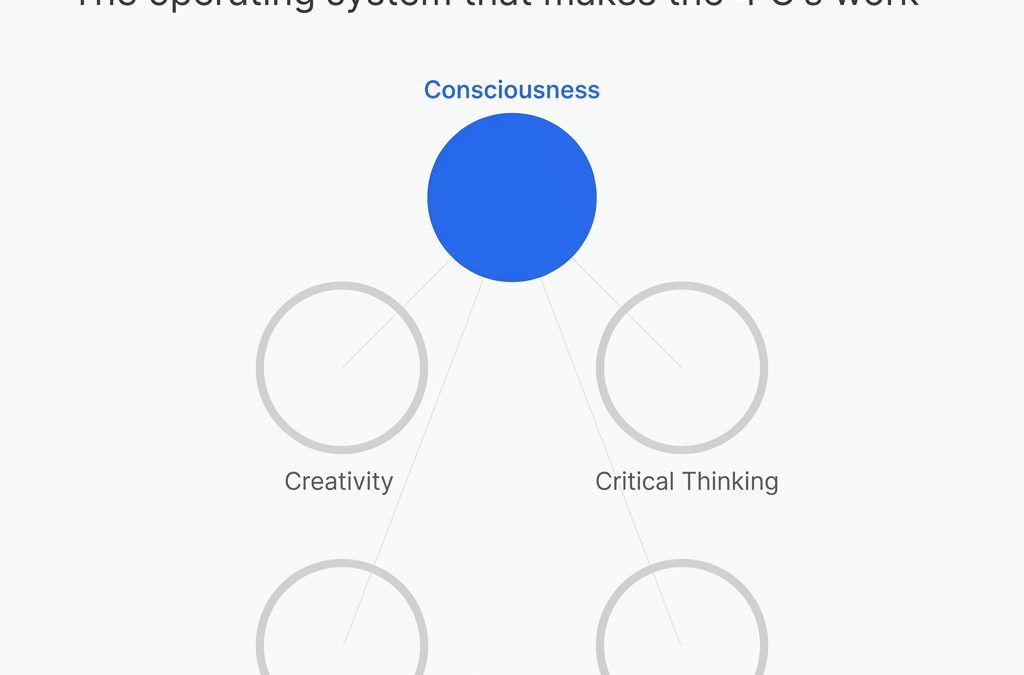
Consciousness is the operating system that makes the other four skills work when you need them
-
Metacognitive ability (thinking about your thinking) explains 33.8% of performance variance across teams
-
AI productivity gains only appear in workers with high metacognitive skill
-
Without consciousness, critical thinking becomes sophisticated bias and collaboration collapses under emotional reactivity
What I Learned Lying in Bed After My MS Diagnosis
Three weeks after my multiple sclerosis diagnosis, I was lying in bed building horrifying visions of the future. My mind raced. I terrified myself into a state I couldn’t escape.
Then I noticed something.
I was the one doing the terrifying.
I could feel my pulse. I could hear sounds in the room. I could breathe. All those chemical reactions happening in my body were real, happening right now. I could shift my attention to them. Consciously.
That moment rewired how I see everything we teach about 21st century skills.
Key Point: Consciousness is the ability to direct your own attention. Most people never learn this exists, let alone how to train it.
The Framework Everyone Teaches (And Why It Falls Short)
You know the 4 C’s: Creativity, Critical Thinking, Collaboration, Communication.
Schools teach them. Companies train them. Consultants sell them.
They’re incomplete.
I’ve trained hundreds of people in creativity over the past 11 years. Most don’t lack creative techniques. They lack the consciousness to recognize when they’re blocking themselves.
I worked with a screenwriter who generated ideas constantly. Brilliant ones. But she couldn’t direct her attention to specific parts of those ideas without an external prompt. Someone had to ask her a question before she could focus.
She had the creativity skill. She lacked the meta-awareness to self-regulate her focus.
I taught her to ask better questions. Questions direct attention. They force you to search for answers. Once she learned to ask herself the right questions, she didn’t need me anymore.
That’s consciousness at work.
Key Point: You need more than skills. You need the meta-awareness to know when and how to deploy them.
Why the 4 C’s Operate at Half Capacity Without Consciousness
Research backs this up in ways most people miss.
Metacognitive ability explains 33.8% of performance variance across work teams. Not creativity. Not communication skills. The ability to think about your own thinking.
What This Looks Like in Practice
Two people have identical critical thinking training. Same frameworks. Same analytical tools. One outperforms the other by a significant margin.
Why?
The high performer notices when they’re building an argument on an unexamined assumption. They catch themselves. They question the foundation before constructing the logic.
The other person uses critical thinking to defend beliefs they already committed to. They never turn that analytical lens on their own starting point.
Critical thinking without consciousness is sophisticated bias.
How This Shows Up in Collaboration
The same pattern appears everywhere.
I’ve seen it on film sets. One person lashes out because something didn’t go as planned. Immediately, everyone else has to regulate their own systems. They stop working. They manage the emotional fallout.
That person lacked the consciousness to notice their reaction before it exploded outward. One person’s inability to self-regulate hijacked the attention and energy of the entire group.
Collaboration collapsed because consciousness was missing.
Key Point: Skills without self-awareness become tools you can’t access under pressure.
The AI Productivity Paradox: Why Consciousness Matters More Now
The data on AI makes this even clearer.
A field experiment published in the Journal of Applied Psychology found something unexpected. AI productivity gains only materialized for employees with high metacognitive skill.
AI didn’t make everyone smarter. It made self-aware thinkers more effective.
The people who could monitor their own thinking, recognize their blind spots, and adjust their approach got massive gains. Everyone else saw minimal improvement.
Technology evolves. If consciousness doesn’t evolve with it, the gap widens.
Employees with high metacognitive abilities are 35% more likely to navigate organizational changes and maintain productivity during uncertainty.
That’s not a small edge. That’s the difference between thriving and surviving.
Key Point: AI amplifies what you already do. If you lack self-awareness, AI won’t fix that.
What Consciousness Actually Does (And Why It’s Different)
Consciousness isn’t another skill on the list. It’s the operating system that makes the other four work.
Unconscious vs. Conscious Creativity
Unconscious creativity happens to you. Ideas float in from external influences. You react to what’s around you.
Conscious creativity is different. You point your attention at a specific problem. You decide what area to explore. You direct your thinking toward solutions.
How This Applies to Communication and Collaboration
Same with communication. You have perfect technique and still fail if you don’t notice when you’re dominating a conversation, withdrawing from conflict, or reacting instead of responding.
The best collaborators I know all share one thing. They’re aware of their own triggers, biases, and patterns in group settings. They catch themselves before the pattern takes over.
Research on soft skills metacognition showed that when knowledge about these skills moves from tacit to conscious, performance improves. Training people to think about their soft skills led to increases in self-efficacy and adaptive performance.
You can’t optimize what you can’t see.
Key Point: Consciousness transforms passive skills into active choices you make in real time.
The Gap Between What We Teach and What Employers Actually Need
Here’s the uncomfortable part.
There are subtle and sometimes glaring differences in what an employer thinks “critical thinking” means versus how a university defines it.
We struggle to locate these trans-disciplinary skills and match them to what employers seek.
Research on instructional materials revealed that teachers’ integration of the 4 C’s competencies was classified as “Not yet reached competency,” with means ranging from 1.57 to 1.92 on a 4-point scale.
Even educators struggle to operationalize these abstract skills.
Maybe that’s because we’re teaching the outputs without teaching the operating system.
Key Point: We’re teaching people what to do, not how to know when to do it.
How Decision-Making and Attention Actually Work
Neuroscience research understands attention as a distinct form of decision based on the utility of information.
You’re not focusing. You’re deciding what deserves your cognitive resources.
Self-awareness of your goals, together with the capacity to predict possible obstacles, drives every step of the decision-making process. From problem identification to outcome evaluation.
Each step is marked by different levels of self-awareness.
Research on perceptual decision mechanisms highlights the role of top-down attentional control and conscious awareness in selecting a decision strategy to optimize detection performance.
Consciousness isn’t passive awareness. It’s active selection.
Key Point: Every moment of focus is a decision about where to allocate your mental resources.
What This Means for How We Build Skills That Actually Work
People come to me wanting to improve one skill. Communication or creativity, mostly.
Then they find out that consciousness work opens everything else.
I don’t teach creativity techniques in isolation. I teach people to notice when they’re stuck in a pattern. I teach them to ask different questions. I teach them to direct their attention consciously toward what they need to create.
The techniques matter. But without the meta-layer of consciousness, they’re tools you can’t access when you need them most.
The Fifth C: Consciousness
The 4 C’s aren’t wrong. They’re incomplete.
Consciousness is the fifth C.
It’s the ability to direct your attention. To notice your own patterns. To question your assumptions before you build arguments on top of them. To catch yourself before you hijack a team’s energy with an unregulated reaction.
Technology will keep evolving. The 4 C’s will keep getting taught.
But if we don’t evolve consciousness alongside them, we’re building skills on a foundation that can’t hold the weight.
I learned that lying in bed after my diagnosis. My mind was the one thing the disease couldn’t touch.
But only if I learned to direct it consciously.
That’s what we need to teach.
Key Point: Without consciousness, you have skills you can’t deploy when pressure hits.
Questions People Ask About the Fifth C
What’s the difference between consciousness and self-awareness?
Self-awareness is knowing your patterns exist. Consciousness is the active ability to direct your attention away from those patterns or toward different choices in real time. You notice the reaction before it runs you.
How do you train consciousness if schools don’t teach it?
Start with questions that redirect attention. When you’re stuck, ask yourself: What am I paying attention to right now? What am I assuming without checking? What would I notice if I looked at this differently? Questions force your brain to search, which breaks automatic patterns.
Does this mean the 4 C’s are useless without consciousness?
No. They’re necessary. But they operate at half capacity without “the meta-skill” of consciousness directing when and how to use them. You need both the tools and the awareness to deploy them.
Why don’t employers just test for metacognitive ability?
Most don’t know how. Metacognition is harder to measure than technical skills or even creativity. Plus, we’ve built hiring systems around what’s easy to test, not what predicts performance. That’s changing, slowly.
Is consciousness the same thing as mindfulness?
There’s overlap, but consciousness is broader. Mindfulness teaches present-moment awareness. Consciousness includes that, plus the ability to direct attention strategically, question your assumptions, and choose responses instead of reacting. It’s awareness with agency.
What happens when someone has high skills but low consciousness?
They become unpredictable under pressure. Their skills disappear when stress hits, emotions spike, or patterns get triggered. They know what to do in theory but can’t access it when the stakes are high.
How long does it take to develop consciousness as a skill?
There’s no fixed timeline. Some people have breakthrough moments in weeks. Others build it gradually over months or years. The difference is whether you’re practicing attention direction daily or waiting for it to happen by accident.
Does AI make consciousness more important or less?
More. AI handles information processing. Consciousness handles decision-making about what information matters, when to question your own thinking, and how to deploy AI as a tool instead of a crutch. Research shows AI productivity gains only show up in people with high metacognitive ability.
Key Takeaways
-
The 4 C’s (Creativity, Critical Thinking, Collaboration, Communication) are incomplete without Consciousness as the fifth C
-
Consciousness is the operating system that makes the other four skills accessible under pressure
-
Metacognitive ability explains 33.8% of performance variance across teams, more than creativity or communication skills alone
-
AI productivity gains only materialize for workers with high metacognitive skill, not everyone who uses AI
-
Critical thinking without consciousness becomes sophisticated bias. Collaboration without consciousness collapses under emotional reactivity.
-
Training consciousness means learning to direct attention, question assumptions, and notice patterns before they run you
-
Employees with high metacognitive abilities are 35% more likely to navigate change and maintain productivity during uncertainty