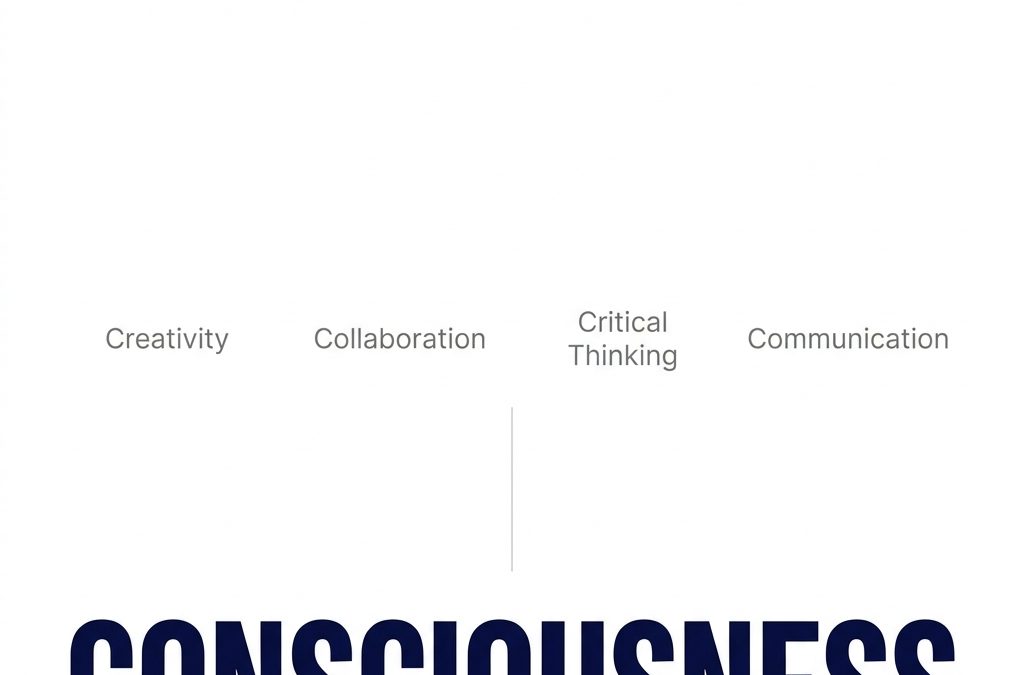
TL;DR: The 4 C’s (Creativity, Collaboration, Critical Thinking, Communication) are incomplete without Consciousness. Self-awareness is the operating system determining how well the other four skills work. Without the capacity to direct your attention and notice your own patterns, every other capability functions at half strength.
-
Consciousness means intentional redirection of attention
-
Collaboration fails when people cannot recognize their triggers and patterns in real time
-
Critical thinking without self-awareness becomes sophisticated rationalization
-
Communication breaks down at the attention level
-
Conscious creativity is directed; unconscious creativity is reactive
What Are the 4 C’s and Why Do They Fall Short?
The 4 C’s show up everywhere. Creativity, Collaboration, Critical Thinking, Communication. Every leadership program. Every future skills deck. Every corporate training.
They’re incomplete.
Here’s what I’ve seen working with hundreds of people over 11 years: most don’t lack creative techniques or communication skills.
They lack the consciousness to recognize when they’re blocking themselves.
A screenwriter I coached had ideas flooding in constantly. New angles. New scenes. New directions. She couldn’t focus attention on any single thread long enough to develop it.
She needed external prompts before she zeroed in on what mattered. Someone asking a question. Someone giving direction.
The problem was consciousness—the capacity to direct her own attention without needing someone else to steer.
I taught her to ask better questions. Questions direct attention toward finding answers.
The mechanism. Consciousness means intentional redirection.
The bottom line: Consciousness is the capacity to direct your own attention without external prompting. When people struggle with creativity or focus, the issue is whether they notice where their attention goes and choose to redirect it.
Why I Learned This Lying in Bed, Paralyzed by Fear
Three weeks after my multiple sclerosis diagnosis, I was lying in bed while my mind built catastrophes that hadn’t happened yet.
Racing. Catastrophizing. Spinning worst-case futures on repeat.
Three weeks straight. Same loop. Then something cracked open.
I realized I was the one terrifying myself.
Not the disease. Not the uncertainty. Me. My attention locked on disaster scenarios, feeding the loop with every thought.
The second I saw that pattern, I had a choice.
I redirected. Breathing. Pulse. Sounds in the room. Physical sensations anchored in now, not imagined wreckage three months out.
That’s when I understood what most frameworks miss.
Why Does Collaboration Fail Without Self-Awareness?
Last year on a film set, someone lost it.
Something went sideways. Happens constantly on sets. One crew member lashed out. Loud. Emotional. No filter.
Production stopped.
Not because the problem was unsolvable. Because 30 people now had to regulate their own systems in response to that outburst.
One person’s inability to manage their internal state hijacked the attention and energy of an entire crew.
Here’s the hidden cost of low consciousness in teams. If one person doesn’t self-regulate, the whole system pays for it.
Research backs this. A 2026 study analyzing the 4 C’s found collaboration is the most fragile competency. It stagnates or declines during scale-up more than any other skill.
It fails when people don’t notice their own triggers, biases, and patterns in group settings. When they don’t catch themselves dominating conversations, withdrawing when challenged, or reacting instead of responding.
The best collaborators I know share one trait: they see themselves in real time.
They notice when they’re about to interrupt. They catch the impulse to defend before listening. They recognize when ego drives the conversation instead of the work.
This is consciousness.
The bottom line: Collaboration breaks down when individuals lack real-time self-awareness. The ability to notice your own triggers, patterns, and impulses as they happen is what separates functional teams from dysfunctional ones. Training in collaboration techniques won’t fix what consciousness would.
How Does Critical Thinking Become Sophisticated Bias?
Here’s the uncomfortable truth: most people use critical thinking to defend beliefs they already hold.
They construct logical arguments. They cite evidence. They build airtight reasoning chains.
All of it resting on assumptions they never questioned.
I see this constantly. Someone presents a well-reasoned position. When you dig in, the entire structure sits on a foundation they accepted without examination.
They’re thinking from an unexamined starting point.
Real critical thinking requires stepping back and asking: What am I assuming here? Is that true, or is that where I started?
That’s a consciousness move. The ability to observe your own thinking process, not only the content of your thoughts.
Without that meta-layer, critical thinking becomes a tool for rationalization. You get good at justifying what you already believe.
The bottom line: Critical thinking without consciousness becomes rationalization dressed up as logic. Real critical thinking requires the meta-awareness to question your own assumptions and observe your thinking process, not only your conclusions.
Why Does Communication Break Down at the Attention Level?
I’ve watched brilliant people completely fail to communicate.
Their attention was somewhere else.
They were thinking about what to say next while the other person was still talking. They were defending against a perceived attack that hadn’t happened. They were running an internal narrative about what this conversation meant instead of listening.
Communication is an attention problem.
When your attention splits between what’s being said and what you’re preparing to say, you miss critical information. You respond to what you thought you heard, not what was communicated.
The fix: directing your full attention to what’s happening right now instead of rehearsing your response.
Consciousness in action.
The bottom line: Communication fails when attention is divided. The gap between good and great communicators is whether they direct full attention to what’s being said instead of what they’ll say next.
What Is the Difference Between Conscious and Unconscious Creativity?
Unconscious creativity is scrolling social media and getting influenced by whatever crosses your feed.
Ideas float in. You react. You generate something. You’re not steering the process.
Conscious creativity is different. You decide what problem to focus on. You direct your thinking toward specific constraints. You notice when you’re stuck in a familiar pattern and deliberately shift your approach.
Research on mindfulness and creativity found that five weeks of open awareness training significantly increased creative output. Not because people learned new techniques, but because they learned to see with fresh eyes instead of operating on autopilot.
Here’s the difference. Conscious creativity is directed. Unconscious creativity is reactive.
One lets you steer. The other leaves you waiting for lightning to strike.
The bottom line: Creativity means directing your attention to the right constraints and noticing when you’re stuck in autopilot. Conscious creativity means steering the process instead of reacting to whatever floats past.
Why Does Consciousness Matter More Now Than Ever?
Technology keeps evolving. AI handles more tasks. Automation takes over routine work.
The skills that matter are the ones machines don’t replicate: the ability to direct your own attention, regulate your own state, and choose your response instead of reacting.
Not a soft skill. The operating system.
A study on leadership effectiveness found that self-aware leaders consistently outperform their peers. They construct better teams, communicate more effectively, and get promoted more often.
Not because they’re smarter or more skilled. Because they see what they’re doing while they’re doing it.
The meta-skill. The one determining how well everything else functions.
The bottom line: As AI automates technical work, the irreplaceable skills are self-regulation and intentional attention. Consciousness is the operating system determining whether your other capabilities function when needed.
How Do the 5 C’s Work as a System?
Here’s what I’ve learned after 11 years building capability: you don’t fix communication without addressing consciousness.
You don’t strengthen collaboration without teaching people to notice their own patterns.
You don’t sharpen critical thinking if people don’t question their own assumptions.
You don’t free up creativity if attention stays scattered across a dozen distractions.
Consciousness is the foundation the other four rest on.
When someone comes to me wanting to improve communication, we start with attention. Where is it going? What’s pulling it away? Do you redirect it intentionally?
When someone wants to be more creative, we look at how they’re directing their thinking. Are they consciously exploring a problem space, or reacting to whatever pops up?
When collaboration breaks down, we ask: Does each person see their own contribution to the dysfunction?
The work: developing the capacity to direct the skills you already have.
The bottom line: The 5 C’s form an integrated system where Consciousness is the foundation. You won’t strengthen communication, collaboration, critical thinking, or creativity without first developing the capacity to notice and redirect your own attention and patterns.
What Does Developing Consciousness Look Like in Practice?
Not meditation retreats or spiritual practices.
Noticing when your mind is racing and choosing to redirect it.
Catching yourself mid-interruption and letting the other person finish.
Recognizing when you’re defending a position because your ego is attached, not because the logic holds.
Small moves. Repeated constantly.
Consciousness develops through thousands of micro-redirections becoming automatic.
The screenwriter I mentioned? She still generates ideas constantly. Now she focuses her attention on one thread long enough to develop it. She asks herself better questions. She steers her own thinking.
The film set example? That person learned to notice the physical sensation of frustration building before it exploded outward. They developed a gap between stimulus and response. Not perfect. Functional.
The goal: functional self-awareness where you choose your response instead of being hijacked by your reactions.
The bottom line: Consciousness develops through small, repeated micro-redirections. Notice when your mind races and choose to redirect it. Catch yourself mid-interruption. Recognize when ego drives your position. These tiny moves, repeated thousands of times, become automatic.
What Happens When You Train Skills Without Consciousness?
We keep training people in the 4 C’s and wondering why results plateau.
We teach communication frameworks, creativity techniques, collaboration models, and critical thinking methods.
Then we’re surprised when people still struggle.
The foundation is missing.
Without consciousness—the ability to direct your own attention and regulate your own state—every other skill operates at half capacity.
You have all the techniques in the world. If you don’t notice when you’re blocking yourself, they won’t help.
Consciousness isn’t optional.
The operating system determining whether the other four C’s function when you need them.
Right now, most people are running outdated software.
The bottom line: Training people in the 4 C’s without developing consciousness is why results plateau. Techniques don’t work if people lack the self-awareness to notice when they’re blocking themselves. Consciousness is the foundation.
Common Questions About the Fifth C
What is the fifth C in the 4 C’s framework?
The fifth C is Consciousness—the capacity to direct your own attention, notice your patterns, and regulate your internal state. While the traditional 4 C’s (Creativity, Collaboration, Critical Thinking, Communication) are important skills, Consciousness is the operating system that determines how effectively the other four function.
Why isn’t Consciousness included in most skills frameworks?
Most frameworks focus on observable outputs and teachable techniques. Consciousness is harder to measure and requires personal awareness work rather than step-by-step instruction. Organizations tend to train what’s easiest to standardize, not what’s most foundational.
How do you develop Consciousness as a skill?
Not sure if we actually develop “Consciousness” but lets go with this idea: Through repeated micro-redirections. Notice when your mind races and choose to redirect it. Catch yourself interrupting and stop. Recognize when ego drives your thinking. These small awareness moves, practiced thousands of times, become automatic. Start with one: noticing where your attention goes during conversations.
Does Consciousness require meditation or spiritual practice?
Of course. 🙂 And then again…No. While those practices are essential, we as human beeings already are conscious. However, Developing Consciousness means building functional self-awareness in daily situations as well. Noticing your triggers in meetings. Catching yourself before you react. Observing your thought patterns as they happen. The practice is embedded in your regular work and interactions.
How does Consciousness improve collaboration specifically?
Collaboration fails when people don’t notice their own patterns in real time. With Consciousness, you catch yourself dominating conversations, recognize when you’re withdrawing defensively, and see your contribution to team dysfunction. Self-aware team members regulate their own states instead of hijacking the group’s energy.
What’s the difference between critical thinking and critical thinking with Consciousness?
Critical thinking without Consciousness becomes sophisticated rationalization. You build logical arguments on unexamined assumptions. With Consciousness, you observe your own thinking process and question your starting points. You notice when you’re defending beliefs rather than examining truth.
How long does it take to develop functional Consciousness?
Functional improvement starts within weeks of consistent practice. Noticing one pattern and choosing to redirect it creates immediate change. Deeper capability develops over months and years as micro-redirections become automatic. The timeline varies by person, but small wins happen fast when you start paying attention.
Why do leaders with high Consciousness outperform their peers?
Self-aware leaders see what they’re doing while they’re doing it. They notice when their ego drives decisions. They catch themselves before reacting. They regulate their state instead of spreading dysfunction. This meta-awareness lets them access their other skills—communication, collaboration, creativity, critical thinking—when those skills are needed most.
Key Takeaways
-
Consciousness is the fifth C and the foundation for the other four—without self-awareness and intentional attention, Creativity, Collaboration, Critical Thinking, and Communication operate at half capacity
-
Consciousness is (in this framework) intentional redirection of attention, not passive awareness—it’s the ability to notice where your focus goes and choose to steer it differently
-
Collaboration breaks down when individuals lack real-time self-awareness of their triggers, patterns, and contributions to team dysfunction
-
Critical thinking without consciousness becomes sophisticated rationalization built on unexamined assumptions
-
Communication fails at the attention level—the gap between good and great communicators is whether they direct full attention to listening instead of rehearsing responses
-
Conscious creativity is directed and strategic while unconscious creativity is reactive—the difference is whether you steer the process or wait for inspiration to strike
-
Consciousness develops through thousands of small micro-redirections repeated until they become automatic—noticing when your mind races, catching yourself before interrupting, recognizing when ego drives your position