TL;DR: Three weeks after my MS diagnosis, lying in bed, I learned something about how my mind works. Most people don’t need more creative techniques. They need to see when they’re sabotaging themselves. Self-awareness is the operating system. Everything else runs on top of it.
The core insight:
-
Teaching people to observe their own thinking beats teaching them creative methods
-
One person’s lack of self-regulation shuts down entire teams
-
Critical thinking without consciousness turns into sophisticated bias
-
Consciousness isn’t another skill. It’s the foundation all other skills need to work
How I Learned This Lying in Bed After My Diagnosis
Three weeks after my multiple sclerosis diagnosis, I was lying in bed.
My mind was racing. Horrifying visions of the future. Worst-case scenarios on loop. I worried myself into a bad mood, then worried about being in a bad mood.
Then something clicked.
I realized I was the one terrifying myself. Not the disease. Not the uncertainty. Me. My own attention, running on autopilot, dragging me down.
And if I was doing this to myself, I stopped.
I started paying attention to what was happening in the moment. I breathed. I felt my pulse. I heard sounds around me. I shifted my attention consciously to all those things instead of the mental horror show.
That moment changed how I see everything I do now. The coaching. The creativity training. The film work. All of it.
The pattern I keep seeing is this: people don’t lack creative techniques. They lack the consciousness to see when they’re blocking themselves.
Awareness of how you think matters more than what you think about.
Why a Screenwriter With Too Many Ideas Couldn’t Write
A screenwriter I worked with had the opposite problem people expect.
She generated ideas constantly. Dozens. Good ones.
But she couldn’t focus her attention on any specific part of what she was creating. She needed someone else to ask a question before she zoomed in on what mattered. Without the external prompt, she kept generating more ideas, never going deeper.
The problem wasn’t her creativity. It was her inability to consciously direct her own attention.
So I taught her to ask better questions. Not creative techniques. Not brainstorming methods. Questions.
Questions direct our attention toward answers. Once she learned to ask herself the right questions, she steered her own focus. She stopped needing me.
This is what I mean by consciousness being the missing piece.
Questions direct attention. Attention determines what you create.
What Research Shows About Metacognition and Creativity
This isn’t only my observation. The data backs this up.
A study on metacognitive training found something interesting: teaching people to think about their thinking improved creative problem-solving more than teaching them creative methods. Fifty minutes across eight sessions of metacognitive strategy training produced measurably better creative outcomes than no intervention.
Training people on how they think outperformed training them on what to think about.
Another study revealed something even more interesting. When people felt able to improve, self-evaluation didn’t hurt their creativity. But when they didn’t expect to improve, self-evaluation significantly reduced their creative performance.
Belief about capacity mattered more than the technique.
Research shows without self-awareness, people are incapable of creative accomplishments. People who self-monitor more frequently are significantly more innovative than those who self-monitor less.
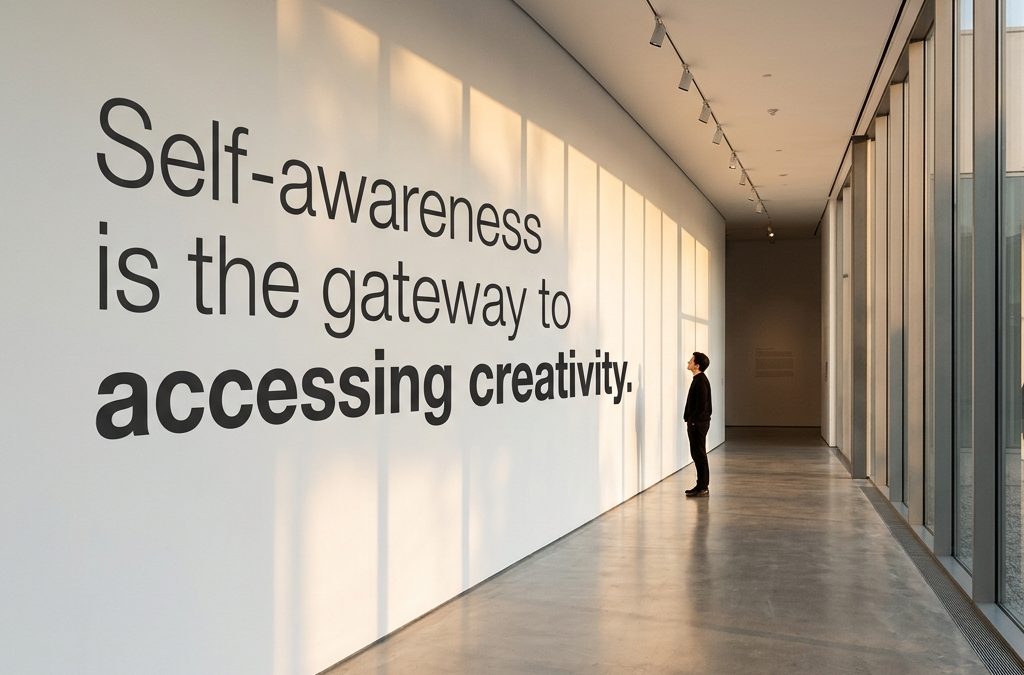
Self-awareness is the gateway to accessing creativity. Not a nice-to-have. The gateway.
Metacognitive training beats creative technique training. Self-awareness determines creative capacity.
How One Person’s Lack of Self-Regulation Stopped an Entire Film Set
We were on a film set. Everything was moving. Then one person lashed out because something wasn’t going as planned.
Immediately, everyone else had to regulate their own systems. The whole crew stopped what they were doing to manage the emotional fallout. If the person had caught their reaction before it exploded outward, none of this would’ve happened. Everyone would’ve kept working.
But they didn’t. The lack of self-regulation in one person hijacked the attention and energy of the entire group.
This is collaboration breaking down at the consciousness level. One person’s inability to notice their own state created a systemic distraction for everyone else.
The best collaborators I know all have one thing in common. They’re aware of their own triggers, biases, and patterns in group settings. They notice when they’re dominating, withdrawing, or reacting instead of responding.
This awareness is what makes collaboration work. Without it, you’re firefighting emotional disruptions instead of creating together.
One person’s unconscious reaction hijacks the entire team’s attention.
Why Critical Thinking Without Consciousness Becomes Sophisticated Bias
I see this all the time. People use critical thinking skills to defend beliefs they’re already committed to, rather than examining their own reasoning.
They assume something as true, then make inferences from the assumption. But they never question the basis of their thinking.
They’re building an entire logical structure on a foundation of unexamined assumptions. The critical thinking is solid. The starting point is flawed.
The consciousness piece is being able to step back and ask: Wait, what am I assuming here? Is this true, or is this the starting point I accepted without questioning?
Without that meta-awareness, critical thinking becomes a tool for reinforcing what you already believe.
Solid logic built on unexamined assumptions still produces bad thinking.
Consciousness Is the Operating System, Not Another Skill
I thought composure would be the fifth C. Then I realized composure is what happens when you’re consciously directing your attention.
Composure is downstream. Consciousness is the source.
Unconscious creativity is ideas happening to you, floating in from external influences without direction. Conscious creativity is where you point your attention. You decide what problem to focus on, what area to explore, and you direct your thinking intentionally toward solutions.
It’s the difference between being passively influenced and actively steering your creative process.
The same applies to the other Cs. Communication. Collaboration. Critical Thinking. They all require the ability to consciously direct your attention.
Without consciousness, you’re running on autopilot. With consciousness, you’re choosing where to focus, what to question, and how to respond.
This is why I call consciousness the operating system. The other four Cs are applications. Consciousness is what runs them.
Consciousness is the OS. Communication, Collaboration, Critical Thinking, Creativity are the apps.
What Happens When I Build Capability in People
People come to me wanting to improve one skill. Usually communication or creativity.
Then they find consciousness work opens everything else.
Because once you consciously direct your attention, you:
-
Notice when you’re stuck in a mental loop and shift out of it
-
Catch yourself making assumptions and question them
-
Recognize when you’re reacting emotionally and choose a different response
-
Direct your focus to the specific aspect of a problem that needs attention
-
Ask yourself better questions instead of waiting for someone else to prompt you
This isn’t a technique. This is a different way of operating.
And this changes everything.
Consciousness work opens all other skills simultaneously.
Why Consciousness Matters More as Technology Evolves
Technology is evolving fast. AI is handling more tasks. The skills needed are shifting.
But here’s what I keep coming back to: people need to evolve their consciousness as technology evolves with them.
Because the more automated our external world becomes, the more critical our internal awareness becomes.
If you don’t consciously direct your attention, you’ll be pulled in whatever direction the loudest voice, the brightest screen, or the strongest emotion takes you.
If you do, you’ll be able to choose. To focus. To create. To collaborate. To think clearly.
This is the difference consciousness makes.
Consciousness isn’t another skill to add to the list. It’s the foundation the other skills need to work.
As automation increases, conscious attention becomes the differentiator.
Common Questions About Consciousness and Creativity
How is consciousness different from mindfulness?
Mindfulness is one form of conscious attention. Consciousness is broader. Noticing your thoughts, directing your focus intentionally, questioning your assumptions, choosing your responses. Mindfulness helps you observe. Consciousness lets you steer.
Do I need to learn meditation to develop consciousness?
No. Meditation helps some people, but it’s not required. You develop consciousness by practicing attention direction in your daily work. Ask yourself better questions. Notice when you’re reacting. Catch yourself making assumptions. This is consciousness training.
How long does it take to see results from consciousness work?
Some people notice shifts immediately, like I did lying in bed after my diagnosis. Others take weeks or months. The timeline matters less than the practice. Once you start directing your attention consciously, the change compounds.
If someone lacks self-awareness, how do they even start?
Start by noticing one pattern. When do you feel stuck? When do you react emotionally? When do you avoid something? Pick one pattern and watch for it. This is the entry point. Awareness of one pattern opens awareness of others.
Does consciousness training work for people with ADHD or other attention challenges?
Yes, but the approach shifts. People with ADHD often have strong awareness of where their attention goes. The work becomes learning to redirect it without judgment. The consciousness is there. The steering mechanism needs practice.
How do I know if I’m becoming more conscious or fooling myself?
You’ll notice you’re catching yourself mid-pattern instead of after the fact. You’ll ask yourself questions you didn’t think to ask before. You’ll recognize assumptions you used to treat as facts. Other people will notice you’re responding differently.
Does this apply to teams, or only individuals?
Both. Individual consciousness changes how you show up in teams. Team consciousness is when the group notices its own patterns. When someone dominates, when the team avoids conflict, when assumptions go unquestioned. The same principles apply at both levels.
What’s the relationship between consciousness and emotional intelligence?
Emotional intelligence requires consciousness. You need to notice your emotions before you regulate them. You need to observe others before you empathize. Consciousness is the foundation. Emotional intelligence is what you build on top.
Key Takeaways
-
Self-awareness unlocks creative capacity faster than learning more creative techniques
-
Metacognitive training (thinking about thinking) produces better problem-solving outcomes than method training
-
One person’s lack of self-regulation hijacks entire teams by forcing everyone else to manage the emotional fallout
-
Critical thinking without consciousness becomes a tool for defending existing beliefs with sophisticated logic
-
Consciousness isn’t another skill. It’s the operating system that runs all other capabilities
-
As technology automates more tasks, conscious attention becomes the primary differentiator
-
You develop consciousness through practice: asking better questions, catching assumptions, noticing reactions, directing focus intentionally