TL;DR: A simple shift in how I framed a salad dressing problem revealed a pattern I’d seen before with multiple sclerosis. Most challenges aren’t unsolvable. They’re incorrectly framed. Your body tells you when you’re asking the wrong question through a physical sensation of expansion or contraction.
Core insight:
-
Wrong question: “Can’t find low-calorie dressings that taste good” (passive, limiting)
-
Right question: “How can I create low-calorie, delicious, vegan dressings?” (active, possibility-seeking)
-
The shift unlocked solutions that existed all along but stayed hidden behind the wrong frame
-
This same pattern applies to health challenges, relationships, projects, and creative blocks
-
Your physical response (expansion vs. contraction) is the diagnostic tool
The Salad Problem Nobody Talks About
Two years into a weight loss journey that started right after my PhD defense, I hit the same loop. Weight drops. Climbs back. Drops again.
Here’s where it got stupid though.
I love salad. Fresh, crunchy, satisfying. The dressing is what made it work. Those creamy, tangy sauces that turn raw vegetables into something you actually want to eat.
But most dressings pack enough calories to defeat the entire point of choosing salad.
I tried low-calorie versions. They tasted like disappointment mixed with vinegar. Switched back to high-calorie ones. Right back to square one. Eventually I just stopped eating salad altogether.
The logic seemed sound. Low-calorie options don’t taste good, why bother?
Case closed.
Key point: I’d accepted the constraint as fixed instead of questioning if the problem was even real.
What a Yoga Mat Taught Me About Questions
Then one morning during yoga, somewhere between downward dog and warrior pose, a memory surfaced.
Years back, at a yoga seminar, the instructor shared these incredible dressings. Low calorie. Delicious. Vegan. Nourishing. I’d completely forgotten about them. Or more accurately, I’d convinced myself I couldn’t recreate them on my own.
That’s when it hit me.
I’d never actually asked the right question.
The question I’d been asking was passive: “Can’t find low-calorie dressings that taste good.”
But what if I reframed it as an active search: “How can I create low-calorie, delicious, vegan, nourishing salad dressings?”
Such a subtle shift. But it opened a completely different door.
I contacted the yoga instructor. Asked for her recipes. Started googling that exact question. Asked ChatGPT the same thing. And surprise, surprise, answers came flooding in.
A whole world of possibilities emerged. Not because the solutions didn’t exist before, but because I’d boxed myself in with the wrong question.
Key point: The constraint wasn’t reality. The constraint was the question itself.
When I’d Seen This Pattern Before
This wasn’t the first time I’d seen this pattern.
Years ago, when I was diagnosed with multiple sclerosis, I spent three weeks in bed. Crying. Asking all the wrong questions.
“Why does this always happen to me?”
“What did I do to deserve this?”
Those questions led absolutely nowhere. They just spiraled inward, tighter and tighter, straight into helplessness.
Then I shifted the question: “How do I never have symptoms anymore? What’s actually within my control?”
That reframe unlocked pathways I couldn’t see before. It led me to experimental vitamin D protocols. Yoga practices that stabilized my nervous system. A whole decade of rewiring how my body and mind worked together.
The breakthrough wasn’t finding new information. It was asking a question that invited possibility instead of just accepting limitation.
Key point: The questions you ask determine what solutions even become visible.
How Your Body Knows When You’re Asking the Wrong Question
Through my doctorate in creative problem solving and years of coaching, I’ve learned something: your body tells you when you’re asking the wrong question.
It’s a sensory experience. Kinesthetic, if you want the fancy term.
Does your inner experience expand or shrink?
When it expands (you start getting ideas, visions of possibilities, a sense of movement), you’re on the right track.
When it shrinks (you feel stuck, closed in, kind of trapped), you’re asking the wrong question.
You can feel it in your chest, your breath, even your posture. The body knows way before the mind catches up.
Research backs this up too. Fifty years of studies show that people who master reframing make better decisions, generate more original ideas, and lead more remarkable lives. Yet most companies and individuals spend almost no time examining whether they’re even solving the right problem.
A study of 350 decision-making processes at medium to large companies found that more than half failed to get the desired results. Why? Perceived time pressure caused people to jump straight into problem-solving mode without actually examining the problem from all angles first.
Key point: Expansion or contraction is your diagnostic signal. Learn to trust it.
Where You Might Be Asking the Wrong Question
Most challenges aren’t actually unsolvable. They’re just incorrectly framed.
Stuck on a project? Maybe the question isn’t “Why isn’t this working?” Try asking “What different approach haven’t we tested yet?”
Frustrated in a relationship? Shift from “Why don’t they understand me?” to “How can we improve communication from both sides?”
Feeling blocked creatively? Instead of “Why can’t I come up with good ideas?” try “What constraints am I imposing that don’t actually exist?”
The quality of your questions determines the quality of your answers. Stanford engineering professor Tina Seelig even suggests “frame-storming” (brainstorming around the question you’ll pose) before you start brainstorming solutions.
Your answer is already baked into your question.
Key point: Reframing the question often matters way more than finding better answers to the wrong question.
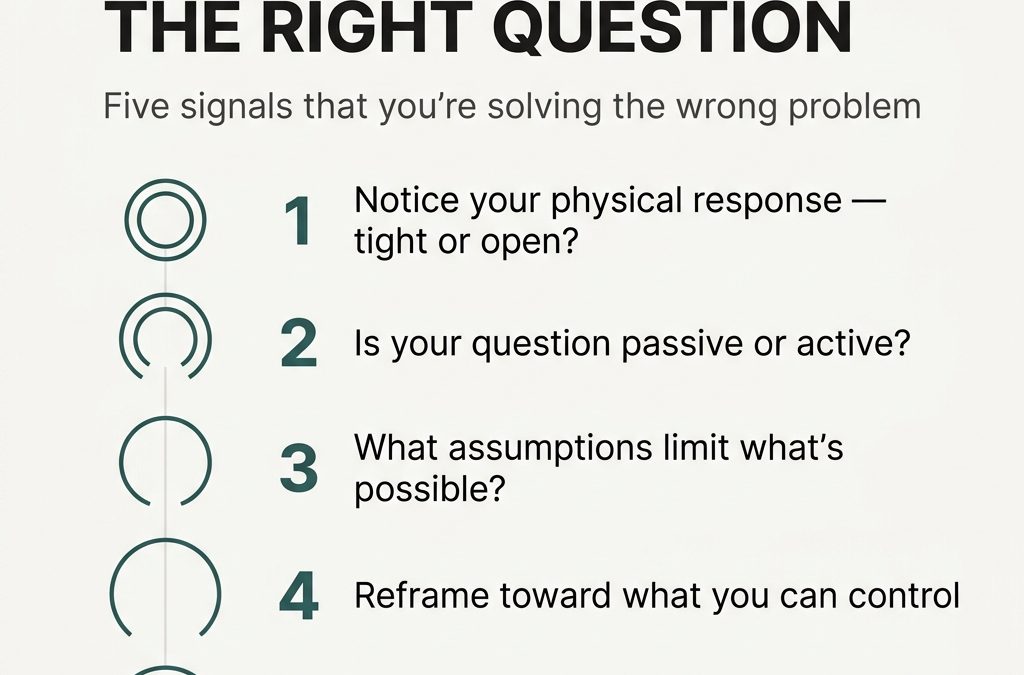
The Five-Step Diagnostic You Can Run Right Now
When you’re stuck, try running this check:
1. Notice your physical response. Does thinking about this problem make you feel tight and contracted, or more open and curious?
2. Examine the question you’re asking. Is it passive (“Can’t find X”) or active (“How do I create X”)?
3. Look for hidden constraints. What assumptions are you making about what’s even possible?
4. Reframe toward capability. Shift from “Why is this happening to me?” to “What’s actually within my control here?”
5. Test the new question. Does your inner experience expand? Do new possibilities start appearing?
This isn’t some motivational thinking exercise. It’s diagnostic. You’re not trying to just feel better. You’re trying to locate the actual problem.
Through a decade of working with leaders, creatives, and people facing all kinds of invisible barriers, I’ve seen this pattern over and over: most people excel at solving the wrong problems.
They jump into action because it taps into their existing knowledge, experience, and skills. They commit to a path before realizing they’re solving the wrong thing. And then they continue anyway because by now they’re invested.
The disaster becomes totally predictable.
Key point: Solving the wrong problem efficiently just gets you nowhere faster.
What Actually Shifted After the Salad Dressing
I now have this whole collection of low-calorie dressings that actually taste good. Tahini-lemon. Orange-peanut. Variations I never would’ve found if I’d just stayed stuck in that original question.
But the real shift wasn’t about food.
It was recognizing that attention shapes perception, and perception shapes what you see as reality. When you shift your focus from obstacles to possibilities, solutions that were always sitting there suddenly become visible.
The salad dressing thing was just the latest reminder of a pattern I first learned lying in bed with MS, asking why this was happening to me. And then asking how I could heal. That second question unlocked everything the first one kept hidden.
Sometimes the answer isn’t about finding something new.
It’s just asking a better question.
And your body already knows which questions lead where. You just need to pay attention to whether you’re expanding or contracting.
That’s your diagnostic. That’s the signal.
The rest is just following where it leads.
Common Questions About Question Reframing
What if I reframe the question but still don’t find solutions?
The reframe itself doesn’t guarantee you’ll find solutions. It just opens the search space. If you’re still stuck after reframing, you might need to reframe again from a different angle, or maybe the constraint is actually real (limited resources, external barriers you can’t change). The diagnostic is still useful though: does the new frame make your thinking expand or contract?
How do I know if I’m expanding or contracting?
Expansion feels like your breath deepening, posture opening up, ideas starting to flow. Contraction feels like chest tightening, breath getting shorter, mental loops. It’s a physical sensation, not just a thought. Pay attention to your body for like 10 seconds after you ask the question.
Does this work for every type of problem?
Nope. Some problems are genuinely unsolvable with your current resources or knowledge. The reframe helps you figure out which is which: problems that are truly constrained versus problems where you’ve just mentally boxed yourself in. If multiple reframes all lead to contraction, you’re probably facing a real constraint.
What’s the difference between positive thinking and question reframing?
Positive thinking tries to change how you feel about a problem. Question reframing changes what problem you’re actually solving. One is emotional management. The other is problem diagnosis. Reframing doesn’t necessarily make you feel better. It makes you see differently.
How long does it take to get good at this?
You’ll notice the pattern pretty much immediately once you start paying attention. Getting skilled at catching yourself in the wrong question before you waste weeks solving it? That takes some practice. I’d say maybe a few months of conscious application before it starts becoming automatic.
What if other people are framing the problem for me?
You don’t control how others frame problems. You only control whether you accept their frame. When someone hands you a problem, just pause. Ask yourself: is this actually the problem, or is this just one way to look at it? Then reframe it privately and see if new options show up.
Can you reframe too much and never actually take action?
Yeah, definitely. Some people use endless reframing as a way to avoid doing the hard things. The diagnostic is still the same: does another reframe make you expand (genuine new insight) or are you just stalling (contraction disguised as thinking)? After two or three reframes, just pick one and move.
What if the right question feels uncomfortable?
The right question often feels uncomfortable because it points straight toward capability and responsibility. “Why is this happening to me?” feels way safer than “What’s within my control?” That second question expands your options but it also removes the comfort of helplessness. Discomfort isn’t the same as contraction though. You can feel both expansion and discomfort at the exact same time.
Key Takeaways
-
Most problems aren’t unsolvable, they’re just incorrectly framed. The question you ask literally determines what solutions become visible to you.
-
Passive questions (“Can’t find X”) create mental boxes. Active questions (“How do I create X?”) open up the search space.
-
Your body tells you when you’re asking the wrong question through a physical sensation: expansion means right direction, contraction means wrong frame.
-
The shift from “Why is this happening to me?” to “What’s within my control?” unlocked solutions for both salad dressings and multiple sclerosis. Same exact pattern, just different scales.
-
Frame-storming (brainstorming the question itself) before you start problem-solving can prevent literal weeks of efficiently solving the wrong problem.
-
The diagnostic is pretty simple: notice your physical response when you ask a question. Trust expansion. Question the contraction.
-
Reframing isn’t positive thinking. It’s problem diagnosis. You’re not trying to feel better, you’re trying to see what you couldn’t see before.