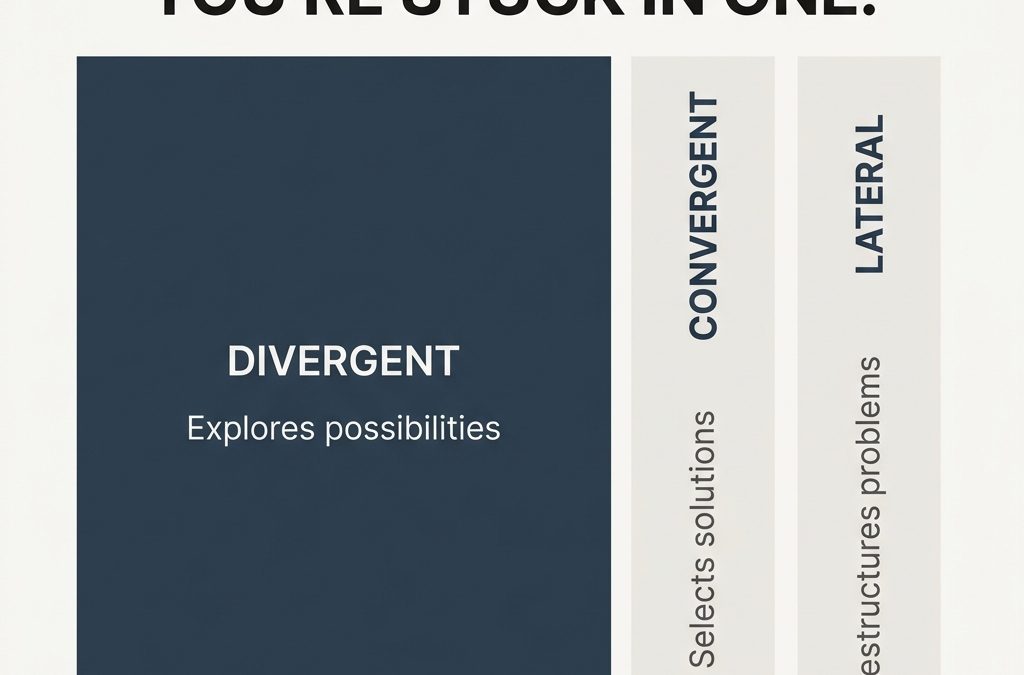
TL;DR: Your brain has three problem-solving modes, but you’re stuck using one. Divergent thinking explores possibilities. Convergent thinking selects solutions. Lateral thinking restructures problems. The people who break through learn to switch between all three. Here’s how to identify your default mode and expand your range.
-
Your brain suppresses the modes you’re not using, creating invisible walls in how you solve problems.
-
98% of children think divergently at genius level. Education buries this to 2% in adults.
-
Switching modes feels uncomfortable because of measurable “switch cost,” but cognitive flexibility leads to better life outcomes.
-
To expand: name your current mode, practice the one you avoid, separate modes by time or environment, accept temporary performance dips.
What Are the Three Problem-Solving Modes?
In 1956, psychologist J.P. Guilford identified two fundamental thinking patterns: divergent and convergent thinking. Edward de Bono later added lateral thinking.
These aren’t personality types. They’re cognitive functions everyone has.
Divergent thinking explores possibilities. You generate ideas without judgment. Volume and variety matter more than quality at this stage.
Convergent thinking selects solutions. You evaluate options through logical steps, refine them, and pick what works.
Lateral thinking restructures the problem. You don’t move forward step by step. You jump sideways to find what linear thinking misses.
Here’s the part nobody tells you: your brain actively suppresses the modes you’re not using.
MIT research found the mediodorsal thalamus suppresses representations not currently needed. This sharpens focus. But there’s a cost. Your brain builds invisible walls around your problem-solving range.
What this means: Each thinking mode is a tool. Your brain turns off the tools you’re not using to protect attention. This narrows your options without you noticing.
How Do You Identify Your Default Mode?
Most people don’t know which mode they’re operating in.
Research identifies this as one of the biggest obstacles to cognitive flexibility. People conflate these modes with identity instead of recognizing them as tools to be consciously selected.
Here’s how each mode shows up in your work:
You default to divergent thinking if:
-
You pump out brilliant ideas but struggle to finish projects
-
You see possibilities everywhere and feel overwhelmed by options
-
Structure feels limiting, so you resist
-
People call you creative but unreliable
You default to convergent thinking if:
-
You execute flawlessly but rarely question the direction
-
You want clear processes and measurable outcomes
-
Ambiguity or open-ended exploration makes you uncomfortable
-
People call you dependable but predictable
You default to lateral thinking if:
-
You challenge assumptions without thinking, sometimes to your detriment
-
You see connections others miss but struggle to explain your logic
-
Conventional approaches bore you
-
People call you insightful but hard to follow
None of these defaults are wrong.
The problem is staying locked in one.
What this means: Your default mode is where you feel comfortable. The other two modes hold your growth potential.
Why Does Switching Feel Impossible?
When you try to shift between modes, your brain resists.
Task switching and set shifting produce what researchers call “switch cost.” Response times slow. Accuracy drops. This happens because your brain needs time to shut down the previous response set and reconfigure for the new task.
The temporary performance dip is real. Measurable.
But here’s what research shows: individuals with greater cognitive flexibility have improved life outcomes, better social functioning, and reduced cognitive decline with age.
The discomfort of switching is the price of mental freedom.
I learned this during the hardest stretch of my life. When I was diagnosed with multiple sclerosis, I faced paralysis and blindness. I chose my mind as the one thing no disease would take. I spent 10 years rewiring my nervous system, learning to switch between analytical precision, creative exploration, and unconventional problem-solving.
Comfortable? Nope.
Necessary? Absolutely.
What this means: Your brain fights mode-switching because reconfiguration costs energy. The discomfort is evidence of neurological change, not failure.
What Happens When You Master All Three Modes?
Mode-switching separates exceptional performers from everyone else.
Recent cognitive research shows convergent thinking isn’t the opposite of creativity but part of the creative process. Ideas you produce during divergent thinking must be evaluated, selected, and refined through convergent reasoning to become practical innovations.
Breakthrough work happens at the intersection, not in isolation.
I see this pattern weekly in my coaching practice. The clients who move fastest are the ones who:
-
Generate multiple possibilities without attachment (divergent)
-
Evaluate those possibilities with clear criteria (convergent)
-
Challenge their own assumptions when stuck (lateral)
They don’t favor one mode. They toggle between all three based on what the situation requires.
Organizations embracing structured creative problem-solving innovate three times faster than those who don’t. Teams using these methods cut time-to-market by 40% compared to traditional approaches.
This isn’t about working harder. This is about expanding your range.
What this means: Each mode produces different results. Mastery comes from knowing which mode the moment needs, then switching to it deliberately.
How Do You Expand Your Problem-Solving Range?
Cognitive flexibility is trainable. But not how you think.
Research shows 98% of children think divergently at genius level. Education reduces this to 2% in adults. The capacity isn’t lost. Conditioning buried it.
Here’s what works:
1. Name the mode you’re in
Before you switch, recognize where you are.
Ask yourself: Am I generating options, evaluating them, or challenging the frame entirely?
Awareness precedes choice.
2. Practice the mode you avoid
If you default to divergent thinking, spend time converging. Set a timer. Force yourself to choose one idea and execute.
If you default to convergent thinking, spend time diverging. Generate 10 solutions to a problem without evaluating any of them.
If you default to lateral thinking, practice both divergent generation and convergent selection in sequence.
The discomfort signals expansion.
3. Build transitions into your process
Don’t try to do everything at once. Separate your modes by time or space.
Morning: divergent exploration. Afternoon: convergent refinement. Evening: lateral review.
Or separate by environment. Diverge while walking. Converge at your desk. Challenge assumptions in conversation.
Your brain adapts its flexibility level to suit environmental demands. Use context as a trigger.
4. Accept the switch cost
You’ll feel slower when you first start switching. Your accuracy will drop temporarily.
This is normal. This is growth.
The neuroscience is clear: each mode has a distinct neural signature. Upper alpha synchronization during divergent thinking. Desynchronization during convergent thinking. Your brain needs time to reconfigure.
Give it that time.
What this means: Cognitive flexibility is a muscle. Train it by deliberately using the modes you avoid, even when uncomfortable.
What Changes When You Master All Three?
I’ve watched this transformation hundreds of times.
The divergent thinker who learns to converge suddenly ships work instead of drowning in possibilities.
The convergent thinker who learns to diverge suddenly innovates instead of optimizing the same patterns.
The lateral thinker who learns both suddenly becomes someone others follow instead of admire from a distance.
The invisible wall most professionals never recognize: the belief you are your default mode.
You’re not stuck because you lack capability.
You’re stuck because you’ve unconsciously limited your range.
The capacity to switch is already there. You need to practice using it.
Where Should You Start?
Pick one problem you’re facing right now.
Spend 10 minutes in pure divergent mode. Generate as many solutions as possible without judgment.
Then spend 10 minutes in pure convergent mode. Evaluate each solution against clear criteria and choose one.
Then spend 10 minutes in lateral mode. Challenge the problem itself. What assumptions are you making? What would change if the opposite were true?
Notice which mode felt natural. Notice which mode felt uncomfortable.
The uncomfortable one is where your growth lives.
I’ve spent a decade helping people dissolve the walls they mistake for themselves. This is one of the most common: the belief you are your default mode.
You’re not.
You’re someone who chooses which tool to use based on what the moment requires.
Start practicing now.
Frequently Asked Questions
What’s the difference between divergent and lateral thinking?
Divergent thinking generates multiple solutions to a defined problem. Lateral thinking restructures the problem itself. Divergent asks “what else works?” Lateral asks “what if we’re solving the wrong problem?”
How long does it take to develop cognitive flexibility?
The neuroscience shows measurable changes within weeks of deliberate practice. But mastery takes months to years, depending on how deeply ingrained your default mode is. Expect discomfort for the first 30 days.
Which mode is most important for creative work?
None of them. Creative breakthroughs require all three. Divergent generates raw material. Convergent refines and selects. Lateral reframes when you’re stuck. The mode matters less than knowing when to switch.
What if I’m strong in two modes but weak in one?
Common pattern. Focus 80% of your practice time on the weak mode. The discomfort signals you’re expanding into new territory. Your strong modes will stay sharp with minimal maintenance.
Does cognitive flexibility decline with age?
Research shows cognitive flexibility declines naturally with age, but deliberate practice reverses this. People who train mode-switching maintain and even improve flexibility into their 70s and beyond.
How do I know if I’m actually switching modes or just thinking I am?
Track outputs, not intentions. Divergent mode produces volume (10+ ideas). Convergent mode produces decisions (one chosen path). Lateral mode produces reframes (new problem definitions). Measure what you produce, not what you feel.
What if my job only rewards one mode?
Short-term thinking. Organizations innovate three times faster when they use all three modes. If your role only values convergent execution, you’re vulnerable to automation and disruption. Build range now, even if your environment doesn’t reward it yet.
Is there a fourth mode researchers have identified?
Some researchers propose additional modes, but divergent, convergent, and lateral remain the most validated across decades of cognitive science. Master these three before exploring theoretical extensions.
Key Takeaways
-
Your brain has three problem-solving modes: divergent (explores possibilities), convergent (selects solutions), and lateral (restructures problems). Most people unconsciously lock into one.
-
Your brain suppresses unused modes to protect focus, creating invisible walls in your problem-solving range. This is neurological, not personal failure.
-
Switching modes produces measurable “switch cost” (slower response, lower accuracy), but people with cognitive flexibility have better life outcomes and reduced cognitive decline.
-
To expand your range: name your current mode, practice the mode you avoid, separate modes by time or environment, and accept temporary performance dips as evidence of growth.
-
Breakthrough work happens at the intersection of all three modes. Organizations using structured creative problem-solving innovate three times faster and cut time-to-market by 40%.
-
98% of children think divergently at genius level. Education buries this to 2% in adults. The capacity isn’t lost. Deliberate practice uncovers it.
-
You’re not your default mode. You’re someone who chooses which tool to use based on what the moment requires. Start practicing now.