by Christian Kresmann, Founder - Beyond Creativity | 2026, Mar, 11 | creativity
TL;DR: Three years studying 279 students revealed that task duration predicts creative achievement more than intelligence or natural talent. One-size-fits-all creativity training fails because different cognitive styles need different conditions. The solution isn’t finding creative people. It’s protecting time and matching instruction to how people actually think.
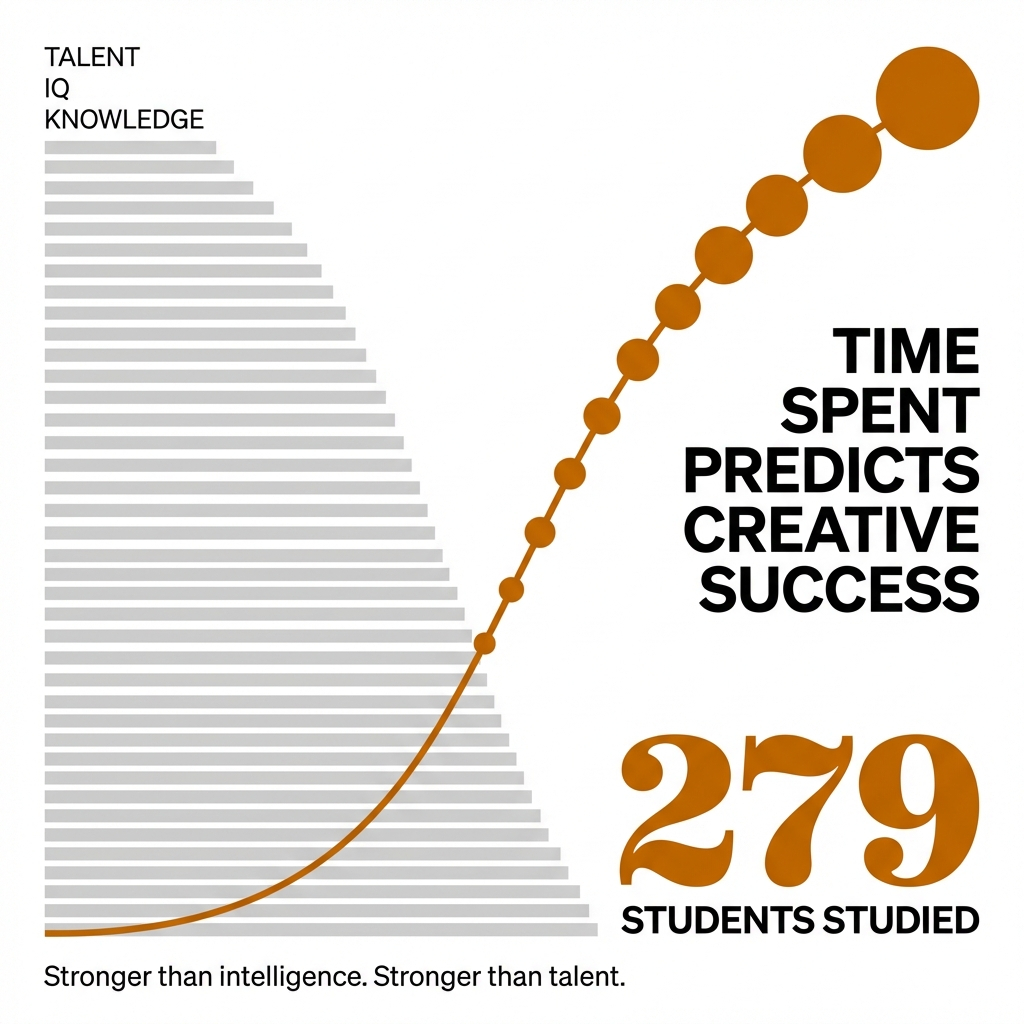
Time spent working predicts creative success more than intelligence, prior knowledge, or natural problem-solving style.
Different cognitive architectures need different instruction formats. Audio prompts work better for some people; written instructions work better for others.
Domain diversity matters more than domain mastery. Number of hobbies was the second-strongest predictor of creative achievement.
Psychological safety and internal stability are prerequisites. Anxiety blocks access to creative capacity regardless of tools or training.
Match instruction to cognitive style using frameworks like VIEW assessment. Developers need structure; Explorers need strategic context.
What I Got Wrong About Creativity
I spent three years studying 279 students to understand what predicts creative achievement. The results contradicted almost everything I believed.
I expected the explorers to dominate. The people who naturally play with ideas, who resist perfecting every detail. I thought they would breeze through creative tasks without needing much time because they were experimenting with concepts, not polishing them endlessly.
Wrong.
Task duration was the strongest predictor of creative achievement. Stronger than intelligence. Stronger than prior knowledge. Stronger than natural problem-solving style.
This finding changed how I approach creative work. It revealed something uncomfortable that most creativity training programs ignore: we can architect for creativity by protecting time, not by identifying creative people.
The research also revealed that how you deliver creative training matters as much as the content itself.
Key insight: Creative achievement depends more on conditions than traits. Protecting time for creative work outweighs all other interventions.
Why One-Size-Fits-All Training Fails: The Aptitude-Treatment-Interaction Problem
Most organizations approach creativity training the same way. Develop one program, roll it out to everyone, measure results.
Then they wonder why half the team thrives while the other half stagnates.
The problem is the assumption that identical input produces identical output across different cognitive architectures.
Aptitude-Treatment-Interaction research examines how outcomes depend on the match between cognitive style and instruction format. When you match treatment to aptitude, the effect is optimal. When there’s a mismatch, people learn in what feels like a foreign language.
I saw this clearly in my research.
We took the same creative exercise and presented the prompt differently based on problem-solving styles measured by the VIEW assessment. For people who process information internally, we gave written instructions they could read multiple times. For those who process externally or auditorily, we recorded spoken prompts.
The results were striking.
Some students excelled with audio prompts while struggling with written ones, even though they tested well on cognitive ability and reading comprehension. Intelligence was irrelevant. Cognitive architecture was everything.
One pattern surprised me: cognitive load. When people could only listen to a task instead of rereading a written prompt, their working memory capacity became a limiting factor we had underestimated. Some handled it beautifully. Others hit a wall.
This is what organizations miss when they deploy one-size-fits-all creativity training.
Bottom line: Matching instruction format to cognitive style produces better outcomes than generic training, regardless of content quality.
How the VIEW Framework Reveals Cognitive Architecture
What VIEW Measures
VIEW assesses three dimensions of creative problem-solving style:
Orientation to Change: Explorer versus Developer
Manner of Processing: External versus Internal
Ways of Deciding: Person-focused versus Task-focused
These measure preference, not ability. They show how you naturally approach problems when nobody tells you what to do.
Style vs. Behavior: The Critical Distinction
You cannot change your style. You can change your behavior.
When you use your preferred style, everything feels easy, automatic, natural. You’re not burning mental resources to engage with the task. When you operate outside your preference, everything takes more effort and produces results you perceive as inferior.
I learned this working with a marketing team.
The CMO had a strong Explorer preference: big picture, strategic, focused on why things matter. His entire team had strong Developer preferences: detail-oriented, execution-focused, concerned with how to implement.
They were speaking different cognitive languages.
Once we redesigned their creative process with the Developer preference in mind (providing more structure, clearer implementation steps, detailed frameworks), their retention improved and ROI increased by 28%.
The content stayed the same. The delivery architecture changed.
Practical takeaway: Assess your team’s cognitive preferences before designing training. Developers need structure. Explorers need strategic context. Mismatches waste everyone’s time.
Why Domain Diversity Beats Domain Mastery for Creative Work
The second strongest predictor of creative achievement in my research was surprising.
Number of hobbies.
This aligns with what I’ve observed in my practice. I transfer knowledge from one domain into another constantly. I use aikido techniques in leadership seminars. I apply marginal gains principles from cycling to organizational development. I translate mathematical concepts into cooking metaphors when explaining complex ideas.
Creativity operates at the structural level. You recognize patterns in one context and apply them where others miss the connection.
When I’m stuck on a problem, I deliberately shift domains. How would I describe this as a basketball metaphor? As a cooking process? As a physics problem? As a chess position?
The domain-specific imagery makes abstract constraints concrete. Then I translate that visceral understanding back into the original problem space.
Research backs this up. Individual differences in creativity reflect variations in the efficiency of cognitive processes. Those processes get more efficient when you have more raw material to work with.
Hobbies provide the architecture that makes creative synthesis possible.
What this means: Stop treating hobbies as distractions. Encourage cross-domain exploration. Creative synthesis requires diverse input, not deeper specialization.
The Psychological Safety Prerequisite Nobody Wants to Address
You give people better tools, faster processes, more data. Creative output declines anyway.
The missing piece is almost always psychological safety.
People cannot tinker or explore if they’re anxious about judgment. They cannot generate raw material if their internal critic shuts down ideas before they form. They cannot spend time on creative tasks when the culture punishes anything that does not immediately produce measurable results.
I’ve watched people literally exhale when given permission to play.
Muscle relaxation happens. Laughter emerges. The whole body language shifts.
Some people need explicit permission from authority to go there. They’ll ask: Is it okay to be this weird? And sometimes you say yes, you’re allowed to be weird here.
Permission alone is not enough.
The deeper issue (one most organizations avoid addressing) is that people need internal stability to access creative capacity. If you’re running on anxiety, if your baseline state is “not good enough,” if you’re constantly worried about achievement and success, you lack the mental resources to explore.
I’ve found that specific practices like Kriya yoga establish an internal chemistry of stability. Not general relaxation, rather a fundamental shift in baseline state. Being stable and in a good mood for no reason.
I’ve taught simple breathing exercises in twelve-minute sessions and watched people’s anxiety drop immediately. Every person is at a different point in their readiness to adopt these practices. Sometimes the intervention is: pause and drink your coffee instead of hustling through the day.
You meet people where they are. You show them what’s possible. You give them the next smallest step they take.
The reality: Creativity requires mental resources. Anxiety depletes those resources. Address internal state before optimizing processes.
What This Means: How to Develop Creative Capacity in Your Team
Stop measuring creative potential. Start measuring creative conditions.
The research is clear: achievement depends more on conditions than traits.
Five Actions That Work
If you want to increase creative output in your team, here’s what the research supports:
1. Protect time. Not meeting-free afternoons. Not innovation sprints squeezed between deliverables. Actual, protected, guilt-free time to explore without immediate productivity pressure.
2. Match instruction to cognitive architecture. Use the VIEW assessment or similar tools to understand how people naturally process information. Then deliver training in formats that align with those preferences.
3. Encourage domain diversity. Stop treating hobbies as distractions. Recognize that cross-domain knowledge transfer is the engine of creative synthesis.
4. Build psychological safety first. Before you optimize processes or deploy new frameworks, create space where people tinker without fear of judgment.
5. Address internal state. Creativity requires mental resources. If people are running on anxiety and achievement pressure, they lack those resources.
Most creativity training fails because it ignores these conditions. It treats creativity as a skill you teach through content delivery, when the research shows it’s an outcome that emerges when the right conditions exist.
You cannot force creativity. You can remove the invisible walls that prevent it.
Frequently Asked Questions
Q: What is the VIEW assessment and how does it work?
VIEW measures three dimensions of creative problem-solving style: Orientation to Change (Explorer vs. Developer), Manner of Processing (External vs. Internal), and Ways of Deciding (Person-focused vs. Task-focused). It reveals cognitive preferences, not abilities.
Q: Does more time always equal better creative output?
Task duration was the strongest predictor in my research, but time alone is not sufficient. You need psychological safety, matched instruction formats, and freedom from anxiety. Time without the right conditions produces busywork, not creativity.
Q: How do I know if my team needs different instruction formats?
If half your team thrives with your current training while the other half stagnates, you have a format mismatch problem. Assess cognitive preferences using VIEW or similar tools, then provide instruction in multiple formats (written, audio, visual, hands-on).
Q: What if my organization cannot protect time for creative work?
Then you cannot expect creative output. The research is unambiguous: task duration predicts creative achievement more than intelligence or talent. If time is not protected, you’re optimizing for efficiency, not creativity. Choose which outcome you want.
Q: How many hobbies should someone have for optimal creative performance?
The research measured number of hobbies as a predictor, not an optimal count. The principle matters more than the number: domain diversity provides raw material for creative synthesis. One person with three hobbies who actively transfers knowledge across domains will outperform someone with five hobbies kept separate.
Q: What is psychological safety and how do I create it?
Psychological safety means people can tinker, experiment, and fail without fear of judgment or punishment. You create it by explicitly permitting exploration, protecting time for non-productive play, modeling vulnerability, and addressing the cultural signals that punish anything without immediate measurable results.
Q: Can Developers learn to think like Explorers, or vice versa?
No. You cannot change your cognitive style. You can change your behavior and learn to operate outside your preference, though it requires more effort and feels less natural. The better approach: design processes that accommodate both styles rather than forcing one group to adapt.
Q: What are the warning signs that anxiety is blocking creative capacity?
Watch for: people asking for permission to explore, muscle tension during brainstorming, immediate self-criticism of ideas, inability to engage in play, constant focus on measurable outcomes, and baseline mood of “not good enough.” If these patterns exist, address internal state before adding more tools or training.
Key Takeaways
Task duration predicts creative achievement more powerfully than intelligence, prior knowledge, or natural problem-solving style. Protect time for creative work before optimizing anything else.
Different cognitive architectures require different instruction formats. One-size-fits-all training fails because it ignores how people actually process information. Use VIEW or similar assessments to match delivery to preference.
Domain diversity drives creative synthesis. Number of hobbies was the second-strongest predictor of creative achievement. Cross-domain knowledge transfer provides the raw material for recognizing patterns others miss.
Psychological safety and internal stability are prerequisites, not nice-to-haves. Anxiety blocks access to creative capacity regardless of tools, training, or talent. Address internal state before deploying new processes.
You cannot force creativity, but you can architect conditions that allow it to emerge. Stop measuring creative potential. Start measuring creative conditions: protected time, matched instruction, domain diversity, psychological safety, and internal stability.
Invisible constraints are the real blockers. Most people cannot see the walls preventing their creative work because they’re standing too close. When constraints become visible, they become modifiable.
The Question Worth Asking
I used to think my job was helping people become more creative.
Now I realize it’s helping them see the constraints they cannot perceive.
When those invisible walls become visible, they become modifiable. When they become modifiable, people do not need me anymore. They architect their own conditions for creative work.
What invisible constraint is operating in your creative process right now that you cannot see because you’re standing too close to it?
What would become possible if that wall disappeared?
by Christian Kresmann, Founder - Beyond Creativity | 2026, Mar, 7 | business, filmmaking

TL;DR: Rom-com releases dropped 67% since 2001 as studios chose franchise safety over original storytelling. Post-pandemic isolation created demand for genuine human connection that superhero films don’t satisfy. Reviving romantic comedies with psychological depth addresses societal needs (loneliness, AI anxiety, burnout) while rebuilding cinema’s extinct mid-budget ecosystem. Filmmakers should partner with psychologists and build community support before approaching distributors.
Quick Answer
-
Studios abandoned rom-coms for franchises because they’re easier to market, but 62% of audiences now prefer original stories over sequels
-
The pandemic created a loneliness gap that romantic comedies are uniquely positioned to fill with genuine human connection
-
Rom-coms built on the hero’s journey framework paired with psychological insights deliver entertainment plus emotional healing
-
Mid-budget films ($30-50M) offer better risk-reward ratios than tentpole blockbusters, as proven by “Crazy Rich Asians” ($30M budget, $238M gross)
-
Community-first strategy: Build grassroots support with targeted audiences before seeking studio distribution
I’ve been watching cinema eat itself alive for the past decade.
Studios keep churning out franchise installments nobody asked for. Audiences show up out of habit, not excitement. The mid-budget film—the space where romantic comedies once thrived—has nearly vanished.
The numbers tell a brutal story: rom-com releases dropped from 76 in 2001 to just 25 in 2017. That’s a 67% collapse.
Here’s what nobody’s saying: this isn’t about one genre dying. It’s about cinema forgetting what it’s supposed to do.
Why Did Studios Abandon Romantic Comedies?
The shift happened quietly, then all at once.
Studios realized they could pre-frame audience expectations with franchises. When you see a Marvel logo, you know exactly what you’re getting. Action. Quips. A post-credits scene teasing the next installment.
There’s no risk in that equation.
Romantic comedies require selling a new story every single time. You can’t build a cinematic universe around two people falling in love. Each film stands or falls on its own merit.
So studios made a calculated bet: why create something new when you can extend what already works?
The Equalizer got three films. John Wick got four. The DC and Marvel universes spawned dozens of interconnected stories.
The problem? Audiences are exhausted.
Recent research reveals only 29% of consumers keep up with most or all entries in a franchise. Meanwhile, 56% say too many releases feel repetitive, and 62% would prefer original stories over another sequel.
Bottom line: Studios went on autopilot. Audiences are tuning out.
What Created the Opening for Rom-Coms to Return?
The Pandemic Changed Everything
COVID-19 changed something fundamental in how people relate to stories.
We spent months isolated. Relationships strained under the weight of uncertainty. Human connection became something we couldn’t take for granted anymore.
This created an opening for romantic comedies.
The genre offers exactly what people are missing: genuine human connection, emotional vulnerability, and stakes that feel real. Not world-ending threats. Not CGI spectacle. Just two people trying to figure out if they belong together.
That’s not escapism. That’s recognition.
Romantic comedies could do more than entertain. They could heal.
You could structure a rom-com around the hero’s journey (the same framework Disney used in Tarzan and The Lion King) but make the psychological transformation explicit instead of implicit.
Start with a protagonist dealing with post-pandemic isolation. Show them struggling to share vulnerability with others. Take them through adventures and mishaps. Let them discover what’s been blocking real connection.
You’re watching a romantic comedy. You’re also watching someone learn to be human again.
What this means for filmmakers: The comedy makes difficult truths easier to accept. The romance makes the stakes personal. The psychological structure underneath does the real work.
What Are Audiences Really Craving?
People know something’s wrong with cinema. They just can’t articulate what.
It’s like being fed fast food for years and forgetting what a real meal tastes like. You know you’re unsatisfied. You know something’s missing. But you can’t quite name it.
The current cinematic diet consists of spectacle without substance. Fancy effects. Fast cuts. Gimmicks designed to hold attention for 120 minutes without leaving anything behind.
People want to feel stories, not just watch them.
They want transformational storytelling. They want to leave the theater changed, not just distracted.
This is an unconscious need right now. Most audiences can’t express that they’re longing for deeper structural levels in their entertainment.
But they’re starting to realize something’s missing.
Filmmakers have a responsibility here. We created this problem by chasing profit over purpose. We fix it by remembering what storytelling is for.
Key insight: Audiences feel the absence but lack words to describe their hunger for substance.
Do Rom-Coms Make Financial Sense?
The rom-com decline makes no financial sense.
Mid-budget films historically offered studios a profitable, lower-risk model. Movies like “Crazy Rich Asians” ($30 million budget, $238 million gross) prove the model still works.
But studios abandoned it anyway.
The logic goes like this: mid-budget movies carry more risk than low-budget films but don’t offer the massive returns of tentpole blockbusters. So why bother?
This thinking destroyed an entire ecosystem.
Legal dramas like “A Few Good Men.” Coming-of-age stories like “Dead Poets Society.” Romantic comedies like “The Proposal.” All migrated to streaming or disappeared entirely.
Matt Damon explained it perfectly: without DVD sales, films like “The Talented Mr. Ripley” and “The Informant”—his bread and butter—became economically unviable. So he started showing up in Thor movies instead. 😉
The mid-budget space is where careers get built. Where writers experiment. Where diverse stories get told without needing to justify a $200 million budget.
When that space vanishes, cinema becomes a binary: tiny overly artsy indies or massive franchises. Nothing in between.
Romantic comedies could rebuild that middle ground. They don’t require elaborate sets or expensive effects. They need good writing, compelling actors, and emotional honesty.
The reality: Studios stopped believing in a sustainable model because they’re chasing blockbuster returns instead of consistent profitability.
Why Aren’t Streaming Rom-Coms Enough?
Romantic comedies didn’t die. They moved.
While theaters abandoned the genre, streaming platforms embraced it. Netflix’s “To All the Boys I’ve Loved Before” became an instant hit, spawning two sequels and countless imitators.
The demand exists. The supply just shifted to a different medium.
But streaming creates its own problems.
When your goal becomes completion rate instead of cultural impact, scripts shift toward safety. Safe pacing. Safe jokes. Safe character arcs.
The algorithm punishes boldness that disrupts engagement flow.
Romance without risk starts feeling predictable. The very thing that made romantic comedies special—their ability to surprise you with genuine emotion—gets smoothed out in favor of metrics.
The theatrical experience matters for transformative rom-coms.
Going to the cinema creates a ritual. You plan it. You travel there. You sit in darkness with complete focus for 90 to 120 minutes.
That intentionality deepens the psychological impact. You worked for this experience. You created an event around it.
Streaming offers convenience and reach. But it can’t replicate that immersive intensity.
The solution: Design romantic comedies for the cinematic experience while ensuring they still deliver transformative impact at home.
What Themes Should Modern Rom-Coms Explore?
If we’re serious about reviving romantic comedies with psychological depth, we need to address what people are actually dealing with.
Isolation is obvious. Post-pandemic loneliness created a hunger for connection that franchises can’t satisfy.
But there are other themes begging for exploration.
Irrelevance anxiety driven by artificial intelligence. People watching their jobs get automated. Wondering if they still matter. A romantic comedy about two people finding value in each other while the world tells them they’re obsolete? That resonates.
Burnout culture accelerated by technology. We were promised AI would free up our time. Instead, it just raised expectations. Now you can do more, so you should do more. A rom-com about two overworked people learning to be present with each other? That’s medicine disguised as entertainment.
You create multiple films addressing the same theme from different angles. Each one explores a different facet of the human experience.
The approach: Collaborate with psychologists. Start with the psychological need. Build the hero’s journey around it. Add romantic comedy elements to make the medicine go down easier.
How Do You Get Studios to Take Rom-Coms Seriously?
Studios want proof before they’ll embrace this approach. But you can’t get proof without making the films first.
That’s the catch-22.
Filmmakers need to bypass traditional gatekeepers and go directly to communities.
Say you’re making a romantic comedy about two people dealing with serious health conditions—cancer and multiple sclerosis. That’s 20 million people worldwide who have personal experience with those challenges.
Reach out to patient organizations. Get community buy-in before approaching distributors.
Build grassroots support. Create proof of concept through engagement, not box office numbers.
Then take that community backing to Netflix, Amazon, HBO Max, or Disney. Show them there’s a passionate audience waiting for this story.
The power shift: You’re not asking permission. You’re demonstrating demand. Creating a movement before creating the movie.
What Does Success Look Like in 5 Years?
Five years from now, if this rom-com renaissance actually happens, what changes?
We go back to the roots.
Films like “Groundhog Day” prove you can balance entertainment with genuine character transformation. The rom-com golden era from 1999 to 2005 showed the genre’s potential before studios abandoned it.
Success means creating a new standard for quality.
Audiences leave theaters feeling transformed, not just distracted. They’re satisfied and fulfilled instead of vaguely disappointed.
That feeling—of being genuinely moved by a story—becomes normal again.
We rebuild the mid-budget ecosystem. Writers get to experiment. Diverse stories get told. Actors build careers without needing to join a franchise.
Cinema remembers its purpose: not just to entertain, but to help us understand what it means to be human.
The fancy effects don’t matter. The fast cuts don’t matter. The interconnected universes don’t matter.
Great storytelling matters.
Structure matters. Character transformation matters. Emotional honesty matters.
Romantic comedies could lead this shift because they’re uniquely positioned to do so. They’re accessible without being shallow. They’re entertaining without being empty.
Why this matters: The most interesting story is always about two people figuring out if they belong together. Not a small thing. Everything.
What Should Filmmakers Do Now?
Studios won’t lead this change. They’re too invested in the franchise model, too risk-averse to bet on something unproven.
The responsibility falls on filmmakers and producers.
We need to be bold. Trust ourselves. Create box office successes that prove the model works.
Collaborate with psychologists to identify current psychological crises. Structure stories using the hero’s journey framework. Add romantic comedy elements that make the medicine go down easier.
Build community support before seeking distribution.
Share the work directly with people who need these stories. Let them become advocates.
This approach combines the best of two worlds: the true purpose of storytelling with sustainable profitability.
It’s not easy. It requires bringing a new paradigm to an industry stuck on autopilot.
But the alternative is watching cinema continue eating itself. Watching audiences grow more disconnected. Watching the mid-budget ecosystem disappear completely.
Romantic comedies won’t save cinema by themselves. But they could remind us what cinema is supposed to do.
Tell stories that matter. Create characters we care about. Leave audiences feeling something real.
Final word: Not nostalgia. Necessity.
Frequently Asked Questions
Why did romantic comedies disappear from theaters?
Studios shifted to franchise-based filmmaking because pre-established universes (Marvel, DC) require less marketing effort. Rom-coms need fresh stories every time, making them harder to market despite their consistent profitability.
Are romantic comedies still profitable?
Yes. “Crazy Rich Asians” cost $30 million and grossed $238 million. Mid-budget rom-coms offer better risk-reward ratios than $200 million tentpole films. Studios abandoned them despite profitability, not because of it.
How do streaming rom-coms differ from theatrical ones?
Streaming platforms optimize for completion rates, leading to safer scripts. Algorithms punish boldness. Theatrical releases create rituals and intentionality, deepening psychological impact through immersive focus.
What psychological themes work best for modern rom-coms?
Post-pandemic isolation, AI-driven irrelevance anxiety, and technology-accelerated burnout culture. These themes address real societal needs while maintaining entertainment value through romance and comedy.
How do filmmakers prove rom-coms work without studio support?
Build grassroots community support first. For a rom-com about cancer patients, engage the 20 million people affected worldwide. Show distributors there’s proven demand before asking for funding.
What’s the hero’s journey approach to rom-coms?
Start with a psychological need (isolation, burnout). Structure the protagonist’s transformation through adventures and mishaps. Make the internal change explicit rather than implicit. Add comedy and romance to make the medicine easier to swallow.
Will rom-coms alone fix cinema’s problems?
No. But they remind the industry what storytelling is for: creating genuine human connection, emotional transformation, and cultural impact. They rebuild the extinct mid-budget ecosystem where diverse stories thrive.
Why does the theatrical experience matter for transformative rom-coms?
Going to the cinema creates ritual and intentionality. You plan it, travel there, sit in complete focus for 90-120 minutes. This investment deepens the psychological impact compared to at-home streaming.
Key Takeaways
-
Rom-com releases collapsed 67% from 2001 to 2017 because studios chose franchise safety over original storytelling, despite rom-coms offering better risk-reward ratios.
-
Post-pandemic isolation created unprecedented demand for stories about genuine human connection, emotional vulnerability, and relatable stakes.
-
Combining the hero’s journey structure with psychological insights (via psychologist collaboration) transforms rom-coms into healing entertainment that addresses societal needs.
-
The mid-budget film ecosystem ($30-50M) is nearly extinct, but rom-coms could rebuild it by proving consistent profitability without requiring $200M budgets.
-
Filmmakers should bypass traditional gatekeepers by building grassroots community support with targeted audiences before approaching distributors.
-
Streaming platforms optimize for completion rates rather than cultural impact, making theatrical releases essential for truly transformative storytelling experiences.
-
Success means audiences leave theaters feeling transformed rather than distracted, rebuilding trust between cinema and viewers through emotional honesty and great storytelling.