by Christian Kresmann, Founder - Beyond Creativity | 2026, Apr, 7 | creativity, leadership, mindset
TL;DR: Three weeks after my MS diagnosis, lying in bed, I learned something about how my mind works. Most people don’t need more creative techniques. They need to see when they’re sabotaging themselves. Self-awareness is the operating system. Everything else runs on top of it.
The core insight:
-
Teaching people to observe their own thinking beats teaching them creative methods
-
One person’s lack of self-regulation shuts down entire teams
-
Critical thinking without consciousness turns into sophisticated bias
-
Consciousness isn’t another skill. It’s the foundation all other skills need to work
How I Learned This Lying in Bed After My Diagnosis
Three weeks after my multiple sclerosis diagnosis, I was lying in bed.
My mind was racing. Horrifying visions of the future. Worst-case scenarios on loop. I worried myself into a bad mood, then worried about being in a bad mood.
Then something clicked.
I realized I was the one terrifying myself. Not the disease. Not the uncertainty. Me. My own attention, running on autopilot, dragging me down.
And if I was doing this to myself, I stopped.
I started paying attention to what was happening in the moment. I breathed. I felt my pulse. I heard sounds around me. I shifted my attention consciously to all those things instead of the mental horror show.
That moment changed how I see everything I do now. The coaching. The creativity training. The film work. All of it.
The pattern I keep seeing is this: people don’t lack creative techniques. They lack the consciousness to see when they’re blocking themselves.
Awareness of how you think matters more than what you think about.
Why a Screenwriter With Too Many Ideas Couldn’t Write
A screenwriter I worked with had the opposite problem people expect.
She generated ideas constantly. Dozens. Good ones.
But she couldn’t focus her attention on any specific part of what she was creating. She needed someone else to ask a question before she zoomed in on what mattered. Without the external prompt, she kept generating more ideas, never going deeper.
The problem wasn’t her creativity. It was her inability to consciously direct her own attention.
So I taught her to ask better questions. Not creative techniques. Not brainstorming methods. Questions.
Questions direct our attention toward answers. Once she learned to ask herself the right questions, she steered her own focus. She stopped needing me.
This is what I mean by consciousness being the missing piece.
Questions direct attention. Attention determines what you create.
What Research Shows About Metacognition and Creativity
This isn’t only my observation. The data backs this up.
A study on metacognitive training found something interesting: teaching people to think about their thinking improved creative problem-solving more than teaching them creative methods. Fifty minutes across eight sessions of metacognitive strategy training produced measurably better creative outcomes than no intervention.
Training people on how they think outperformed training them on what to think about.
Another study revealed something even more interesting. When people felt able to improve, self-evaluation didn’t hurt their creativity. But when they didn’t expect to improve, self-evaluation significantly reduced their creative performance.
Belief about capacity mattered more than the technique.
Research shows without self-awareness, people are incapable of creative accomplishments. People who self-monitor more frequently are significantly more innovative than those who self-monitor less.
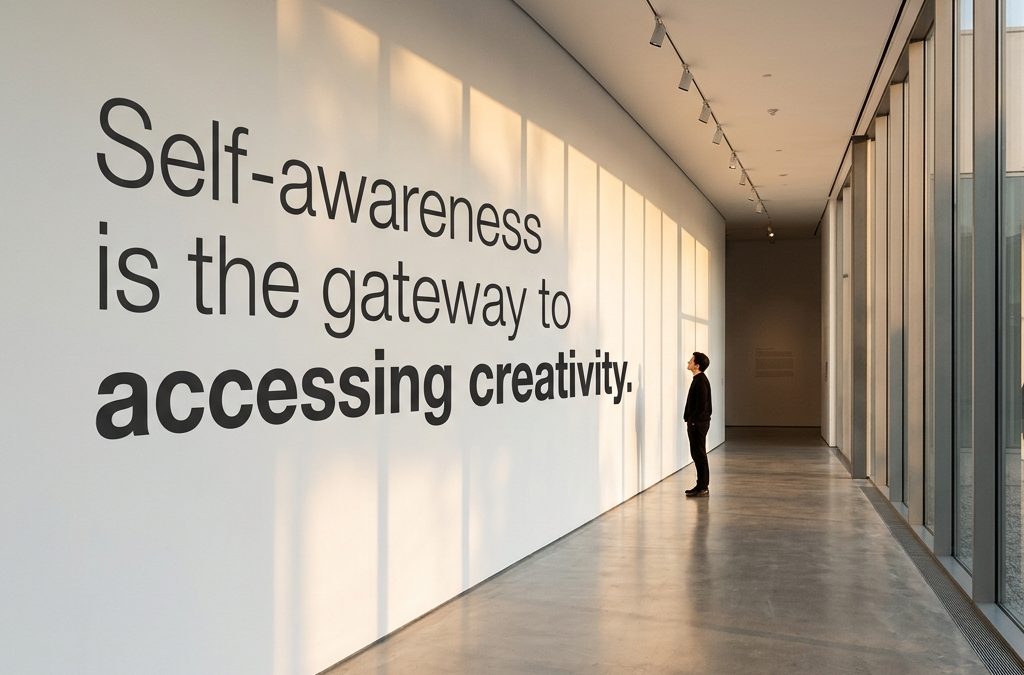
Self-awareness is the gateway to accessing creativity. Not a nice-to-have. The gateway.
Metacognitive training beats creative technique training. Self-awareness determines creative capacity.
How One Person’s Lack of Self-Regulation Stopped an Entire Film Set
We were on a film set. Everything was moving. Then one person lashed out because something wasn’t going as planned.
Immediately, everyone else had to regulate their own systems. The whole crew stopped what they were doing to manage the emotional fallout. If the person had caught their reaction before it exploded outward, none of this would’ve happened. Everyone would’ve kept working.
But they didn’t. The lack of self-regulation in one person hijacked the attention and energy of the entire group.
This is collaboration breaking down at the consciousness level. One person’s inability to notice their own state created a systemic distraction for everyone else.
The best collaborators I know all have one thing in common. They’re aware of their own triggers, biases, and patterns in group settings. They notice when they’re dominating, withdrawing, or reacting instead of responding.
This awareness is what makes collaboration work. Without it, you’re firefighting emotional disruptions instead of creating together.
One person’s unconscious reaction hijacks the entire team’s attention.
Why Critical Thinking Without Consciousness Becomes Sophisticated Bias
I see this all the time. People use critical thinking skills to defend beliefs they’re already committed to, rather than examining their own reasoning.
They assume something as true, then make inferences from the assumption. But they never question the basis of their thinking.
They’re building an entire logical structure on a foundation of unexamined assumptions. The critical thinking is solid. The starting point is flawed.
The consciousness piece is being able to step back and ask: Wait, what am I assuming here? Is this true, or is this the starting point I accepted without questioning?
Without that meta-awareness, critical thinking becomes a tool for reinforcing what you already believe.
Solid logic built on unexamined assumptions still produces bad thinking.
Consciousness Is the Operating System, Not Another Skill
I thought composure would be the fifth C. Then I realized composure is what happens when you’re consciously directing your attention.
Composure is downstream. Consciousness is the source.
Unconscious creativity is ideas happening to you, floating in from external influences without direction. Conscious creativity is where you point your attention. You decide what problem to focus on, what area to explore, and you direct your thinking intentionally toward solutions.
It’s the difference between being passively influenced and actively steering your creative process.
The same applies to the other Cs. Communication. Collaboration. Critical Thinking. They all require the ability to consciously direct your attention.
Without consciousness, you’re running on autopilot. With consciousness, you’re choosing where to focus, what to question, and how to respond.
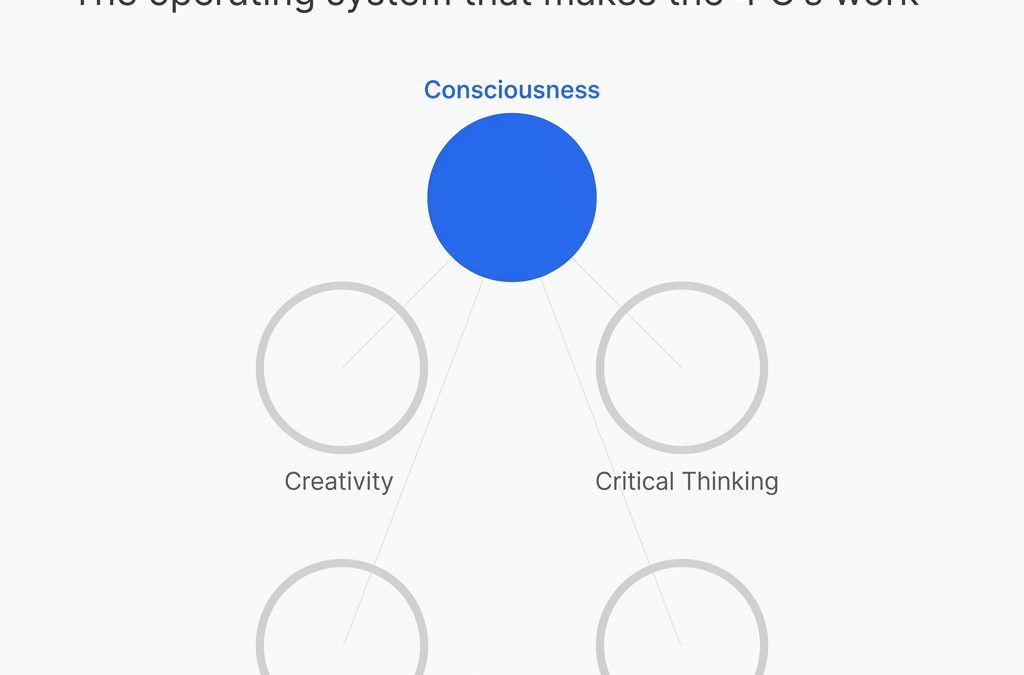
This is why I call consciousness the operating system. The other four Cs are applications. Consciousness is what runs them.
Consciousness is the OS. Communication, Collaboration, Critical Thinking, Creativity are the apps.
What Happens When I Build Capability in People
People come to me wanting to improve one skill. Usually communication or creativity.
Then they find consciousness work opens everything else.
Because once you consciously direct your attention, you:
-
Notice when you’re stuck in a mental loop and shift out of it
-
Catch yourself making assumptions and question them
-
Recognize when you’re reacting emotionally and choose a different response
-
Direct your focus to the specific aspect of a problem that needs attention
-
Ask yourself better questions instead of waiting for someone else to prompt you
This isn’t a technique. This is a different way of operating.
And this changes everything.
Consciousness work opens all other skills simultaneously.
Why Consciousness Matters More as Technology Evolves
Technology is evolving fast. AI is handling more tasks. The skills needed are shifting.
But here’s what I keep coming back to: people need to evolve their consciousness as technology evolves with them.
Because the more automated our external world becomes, the more critical our internal awareness becomes.
If you don’t consciously direct your attention, you’ll be pulled in whatever direction the loudest voice, the brightest screen, or the strongest emotion takes you.
If you do, you’ll be able to choose. To focus. To create. To collaborate. To think clearly.
This is the difference consciousness makes.
Consciousness isn’t another skill to add to the list. It’s the foundation the other skills need to work.
As automation increases, conscious attention becomes the differentiator.
Common Questions About Consciousness and Creativity
How is consciousness different from mindfulness?
Mindfulness is one form of conscious attention. Consciousness is broader. Noticing your thoughts, directing your focus intentionally, questioning your assumptions, choosing your responses. Mindfulness helps you observe. Consciousness lets you steer.
Do I need to learn meditation to develop consciousness?
No. Meditation helps some people, but it’s not required. You develop consciousness by practicing attention direction in your daily work. Ask yourself better questions. Notice when you’re reacting. Catch yourself making assumptions. This is consciousness training.
How long does it take to see results from consciousness work?
Some people notice shifts immediately, like I did lying in bed after my diagnosis. Others take weeks or months. The timeline matters less than the practice. Once you start directing your attention consciously, the change compounds.
If someone lacks self-awareness, how do they even start?
Start by noticing one pattern. When do you feel stuck? When do you react emotionally? When do you avoid something? Pick one pattern and watch for it. This is the entry point. Awareness of one pattern opens awareness of others.
Does consciousness training work for people with ADHD or other attention challenges?
Yes, but the approach shifts. People with ADHD often have strong awareness of where their attention goes. The work becomes learning to redirect it without judgment. The consciousness is there. The steering mechanism needs practice.
How do I know if I’m becoming more conscious or fooling myself?
You’ll notice you’re catching yourself mid-pattern instead of after the fact. You’ll ask yourself questions you didn’t think to ask before. You’ll recognize assumptions you used to treat as facts. Other people will notice you’re responding differently.
Does this apply to teams, or only individuals?
Both. Individual consciousness changes how you show up in teams. Team consciousness is when the group notices its own patterns. When someone dominates, when the team avoids conflict, when assumptions go unquestioned. The same principles apply at both levels.
What’s the relationship between consciousness and emotional intelligence?
Emotional intelligence requires consciousness. You need to notice your emotions before you regulate them. You need to observe others before you empathize. Consciousness is the foundation. Emotional intelligence is what you build on top.
Key Takeaways
-
Self-awareness unlocks creative capacity faster than learning more creative techniques
-
Metacognitive training (thinking about thinking) produces better problem-solving outcomes than method training
-
One person’s lack of self-regulation hijacks entire teams by forcing everyone else to manage the emotional fallout
-
Critical thinking without consciousness becomes a tool for defending existing beliefs with sophisticated logic
-
Consciousness isn’t another skill. It’s the operating system that runs all other capabilities
-
As technology automates more tasks, conscious attention becomes the primary differentiator
-
You develop consciousness through practice: asking better questions, catching assumptions, noticing reactions, directing focus intentionally
by Christian Kresmann, Founder - Beyond Creativity | 2026, Apr, 6 | creativity, leadership, mindset, spirituality
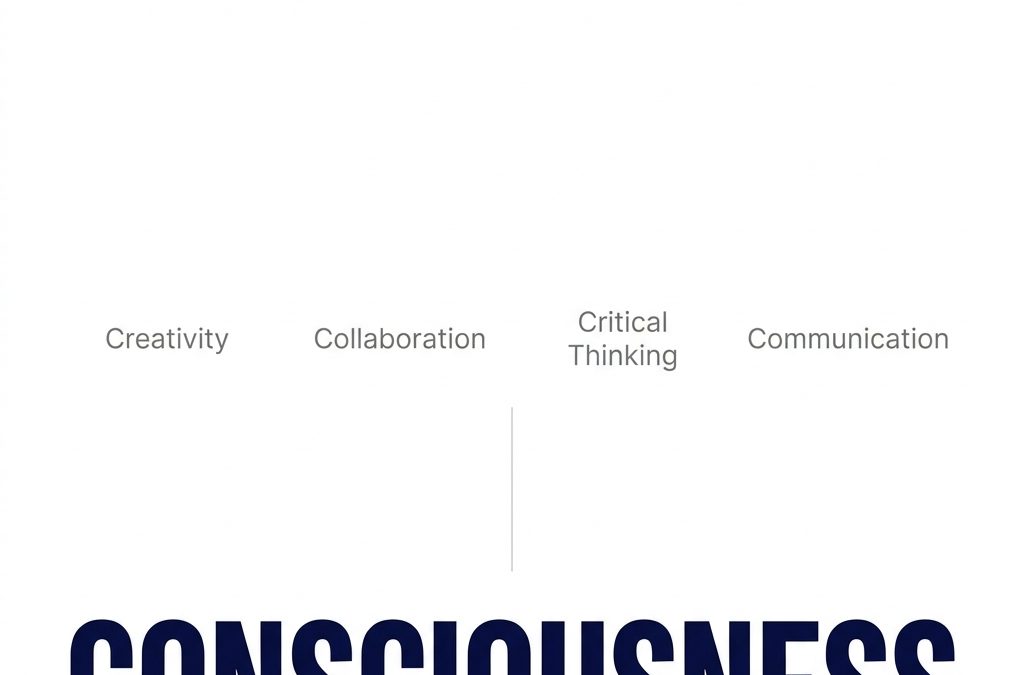
TL;DR: The 4 C’s (Creativity, Collaboration, Critical Thinking, Communication) are incomplete without Consciousness. Self-awareness is the operating system determining how well the other four skills work. Without the capacity to direct your attention and notice your own patterns, every other capability functions at half strength.
-
Consciousness means intentional redirection of attention
-
Collaboration fails when people cannot recognize their triggers and patterns in real time
-
Critical thinking without self-awareness becomes sophisticated rationalization
-
Communication breaks down at the attention level
-
Conscious creativity is directed; unconscious creativity is reactive
What Are the 4 C’s and Why Do They Fall Short?
The 4 C’s show up everywhere. Creativity, Collaboration, Critical Thinking, Communication. Every leadership program. Every future skills deck. Every corporate training.
They’re incomplete.
Here’s what I’ve seen working with hundreds of people over 11 years: most don’t lack creative techniques or communication skills.
They lack the consciousness to recognize when they’re blocking themselves.
A screenwriter I coached had ideas flooding in constantly. New angles. New scenes. New directions. She couldn’t focus attention on any single thread long enough to develop it.
She needed external prompts before she zeroed in on what mattered. Someone asking a question. Someone giving direction.
The problem was consciousness—the capacity to direct her own attention without needing someone else to steer.
I taught her to ask better questions. Questions direct attention toward finding answers.
The mechanism. Consciousness means intentional redirection.
The bottom line: Consciousness is the capacity to direct your own attention without external prompting. When people struggle with creativity or focus, the issue is whether they notice where their attention goes and choose to redirect it.
Why I Learned This Lying in Bed, Paralyzed by Fear
Three weeks after my multiple sclerosis diagnosis, I was lying in bed while my mind built catastrophes that hadn’t happened yet.
Racing. Catastrophizing. Spinning worst-case futures on repeat.
Three weeks straight. Same loop. Then something cracked open.
I realized I was the one terrifying myself.
Not the disease. Not the uncertainty. Me. My attention locked on disaster scenarios, feeding the loop with every thought.
The second I saw that pattern, I had a choice.
I redirected. Breathing. Pulse. Sounds in the room. Physical sensations anchored in now, not imagined wreckage three months out.
That’s when I understood what most frameworks miss.
Why Does Collaboration Fail Without Self-Awareness?
Last year on a film set, someone lost it.
Something went sideways. Happens constantly on sets. One crew member lashed out. Loud. Emotional. No filter.
Production stopped.
Not because the problem was unsolvable. Because 30 people now had to regulate their own systems in response to that outburst.
One person’s inability to manage their internal state hijacked the attention and energy of an entire crew.
Here’s the hidden cost of low consciousness in teams. If one person doesn’t self-regulate, the whole system pays for it.
Research backs this. A 2026 study analyzing the 4 C’s found collaboration is the most fragile competency. It stagnates or declines during scale-up more than any other skill.
It fails when people don’t notice their own triggers, biases, and patterns in group settings. When they don’t catch themselves dominating conversations, withdrawing when challenged, or reacting instead of responding.
The best collaborators I know share one trait: they see themselves in real time.
They notice when they’re about to interrupt. They catch the impulse to defend before listening. They recognize when ego drives the conversation instead of the work.
This is consciousness.
The bottom line: Collaboration breaks down when individuals lack real-time self-awareness. The ability to notice your own triggers, patterns, and impulses as they happen is what separates functional teams from dysfunctional ones. Training in collaboration techniques won’t fix what consciousness would.
How Does Critical Thinking Become Sophisticated Bias?
Here’s the uncomfortable truth: most people use critical thinking to defend beliefs they already hold.
They construct logical arguments. They cite evidence. They build airtight reasoning chains.
All of it resting on assumptions they never questioned.
I see this constantly. Someone presents a well-reasoned position. When you dig in, the entire structure sits on a foundation they accepted without examination.
They’re thinking from an unexamined starting point.
Real critical thinking requires stepping back and asking: What am I assuming here? Is that true, or is that where I started?
That’s a consciousness move. The ability to observe your own thinking process, not only the content of your thoughts.
Without that meta-layer, critical thinking becomes a tool for rationalization. You get good at justifying what you already believe.
The bottom line: Critical thinking without consciousness becomes rationalization dressed up as logic. Real critical thinking requires the meta-awareness to question your own assumptions and observe your thinking process, not only your conclusions.
Why Does Communication Break Down at the Attention Level?
I’ve watched brilliant people completely fail to communicate.
Their attention was somewhere else.
They were thinking about what to say next while the other person was still talking. They were defending against a perceived attack that hadn’t happened. They were running an internal narrative about what this conversation meant instead of listening.
Communication is an attention problem.
When your attention splits between what’s being said and what you’re preparing to say, you miss critical information. You respond to what you thought you heard, not what was communicated.
The fix: directing your full attention to what’s happening right now instead of rehearsing your response.
Consciousness in action.
The bottom line: Communication fails when attention is divided. The gap between good and great communicators is whether they direct full attention to what’s being said instead of what they’ll say next.
What Is the Difference Between Conscious and Unconscious Creativity?
Unconscious creativity is scrolling social media and getting influenced by whatever crosses your feed.
Ideas float in. You react. You generate something. You’re not steering the process.
Conscious creativity is different. You decide what problem to focus on. You direct your thinking toward specific constraints. You notice when you’re stuck in a familiar pattern and deliberately shift your approach.
Research on mindfulness and creativity found that five weeks of open awareness training significantly increased creative output. Not because people learned new techniques, but because they learned to see with fresh eyes instead of operating on autopilot.
Here’s the difference. Conscious creativity is directed. Unconscious creativity is reactive.
One lets you steer. The other leaves you waiting for lightning to strike.
The bottom line: Creativity means directing your attention to the right constraints and noticing when you’re stuck in autopilot. Conscious creativity means steering the process instead of reacting to whatever floats past.
Why Does Consciousness Matter More Now Than Ever?
Technology keeps evolving. AI handles more tasks. Automation takes over routine work.
The skills that matter are the ones machines don’t replicate: the ability to direct your own attention, regulate your own state, and choose your response instead of reacting.
Not a soft skill. The operating system.
A study on leadership effectiveness found that self-aware leaders consistently outperform their peers. They construct better teams, communicate more effectively, and get promoted more often.
Not because they’re smarter or more skilled. Because they see what they’re doing while they’re doing it.
The meta-skill. The one determining how well everything else functions.
The bottom line: As AI automates technical work, the irreplaceable skills are self-regulation and intentional attention. Consciousness is the operating system determining whether your other capabilities function when needed.
How Do the 5 C’s Work as a System?
Here’s what I’ve learned after 11 years building capability: you don’t fix communication without addressing consciousness.
You don’t strengthen collaboration without teaching people to notice their own patterns.
You don’t sharpen critical thinking if people don’t question their own assumptions.
You don’t free up creativity if attention stays scattered across a dozen distractions.
Consciousness is the foundation the other four rest on.
When someone comes to me wanting to improve communication, we start with attention. Where is it going? What’s pulling it away? Do you redirect it intentionally?
When someone wants to be more creative, we look at how they’re directing their thinking. Are they consciously exploring a problem space, or reacting to whatever pops up?
When collaboration breaks down, we ask: Does each person see their own contribution to the dysfunction?
The work: developing the capacity to direct the skills you already have.
The bottom line: The 5 C’s form an integrated system where Consciousness is the foundation. You won’t strengthen communication, collaboration, critical thinking, or creativity without first developing the capacity to notice and redirect your own attention and patterns.
What Does Developing Consciousness Look Like in Practice?
Not meditation retreats or spiritual practices.
Noticing when your mind is racing and choosing to redirect it.
Catching yourself mid-interruption and letting the other person finish.
Recognizing when you’re defending a position because your ego is attached, not because the logic holds.
Small moves. Repeated constantly.
Consciousness develops through thousands of micro-redirections becoming automatic.
The screenwriter I mentioned? She still generates ideas constantly. Now she focuses her attention on one thread long enough to develop it. She asks herself better questions. She steers her own thinking.
The film set example? That person learned to notice the physical sensation of frustration building before it exploded outward. They developed a gap between stimulus and response. Not perfect. Functional.
The goal: functional self-awareness where you choose your response instead of being hijacked by your reactions.
The bottom line: Consciousness develops through small, repeated micro-redirections. Notice when your mind races and choose to redirect it. Catch yourself mid-interruption. Recognize when ego drives your position. These tiny moves, repeated thousands of times, become automatic.
What Happens When You Train Skills Without Consciousness?
We keep training people in the 4 C’s and wondering why results plateau.
We teach communication frameworks, creativity techniques, collaboration models, and critical thinking methods.
Then we’re surprised when people still struggle.
The foundation is missing.
Without consciousness—the ability to direct your own attention and regulate your own state—every other skill operates at half capacity.
You have all the techniques in the world. If you don’t notice when you’re blocking yourself, they won’t help.
Consciousness isn’t optional.
The operating system determining whether the other four C’s function when you need them.
Right now, most people are running outdated software.
The bottom line: Training people in the 4 C’s without developing consciousness is why results plateau. Techniques don’t work if people lack the self-awareness to notice when they’re blocking themselves. Consciousness is the foundation.
Common Questions About the Fifth C
What is the fifth C in the 4 C’s framework?
The fifth C is Consciousness—the capacity to direct your own attention, notice your patterns, and regulate your internal state. While the traditional 4 C’s (Creativity, Collaboration, Critical Thinking, Communication) are important skills, Consciousness is the operating system that determines how effectively the other four function.
Why isn’t Consciousness included in most skills frameworks?
Most frameworks focus on observable outputs and teachable techniques. Consciousness is harder to measure and requires personal awareness work rather than step-by-step instruction. Organizations tend to train what’s easiest to standardize, not what’s most foundational.
How do you develop Consciousness as a skill?
Not sure if we actually develop “Consciousness” but lets go with this idea: Through repeated micro-redirections. Notice when your mind races and choose to redirect it. Catch yourself interrupting and stop. Recognize when ego drives your thinking. These small awareness moves, practiced thousands of times, become automatic. Start with one: noticing where your attention goes during conversations.
Does Consciousness require meditation or spiritual practice?
Of course. 🙂 And then again…No. While those practices are essential, we as human beeings already are conscious. However, Developing Consciousness means building functional self-awareness in daily situations as well. Noticing your triggers in meetings. Catching yourself before you react. Observing your thought patterns as they happen. The practice is embedded in your regular work and interactions.
How does Consciousness improve collaboration specifically?
Collaboration fails when people don’t notice their own patterns in real time. With Consciousness, you catch yourself dominating conversations, recognize when you’re withdrawing defensively, and see your contribution to team dysfunction. Self-aware team members regulate their own states instead of hijacking the group’s energy.
What’s the difference between critical thinking and critical thinking with Consciousness?
Critical thinking without Consciousness becomes sophisticated rationalization. You build logical arguments on unexamined assumptions. With Consciousness, you observe your own thinking process and question your starting points. You notice when you’re defending beliefs rather than examining truth.
How long does it take to develop functional Consciousness?
Functional improvement starts within weeks of consistent practice. Noticing one pattern and choosing to redirect it creates immediate change. Deeper capability develops over months and years as micro-redirections become automatic. The timeline varies by person, but small wins happen fast when you start paying attention.
Why do leaders with high Consciousness outperform their peers?
Self-aware leaders see what they’re doing while they’re doing it. They notice when their ego drives decisions. They catch themselves before reacting. They regulate their state instead of spreading dysfunction. This meta-awareness lets them access their other skills—communication, collaboration, creativity, critical thinking—when those skills are needed most.
Key Takeaways
-
Consciousness is the fifth C and the foundation for the other four—without self-awareness and intentional attention, Creativity, Collaboration, Critical Thinking, and Communication operate at half capacity
-
Consciousness is (in this framework) intentional redirection of attention, not passive awareness—it’s the ability to notice where your focus goes and choose to steer it differently
-
Collaboration breaks down when individuals lack real-time self-awareness of their triggers, patterns, and contributions to team dysfunction
-
Critical thinking without consciousness becomes sophisticated rationalization built on unexamined assumptions
-
Communication fails at the attention level—the gap between good and great communicators is whether they direct full attention to listening instead of rehearsing responses
-
Conscious creativity is directed and strategic while unconscious creativity is reactive—the difference is whether you steer the process or wait for inspiration to strike
-
Consciousness develops through thousands of small micro-redirections repeated until they become automatic—noticing when your mind races, catching yourself before interrupting, recognizing when ego drives your position
by Christian Kresmann, Founder - Beyond Creativity | 2026, Apr, 6 | business, creativity, leadership, mindset
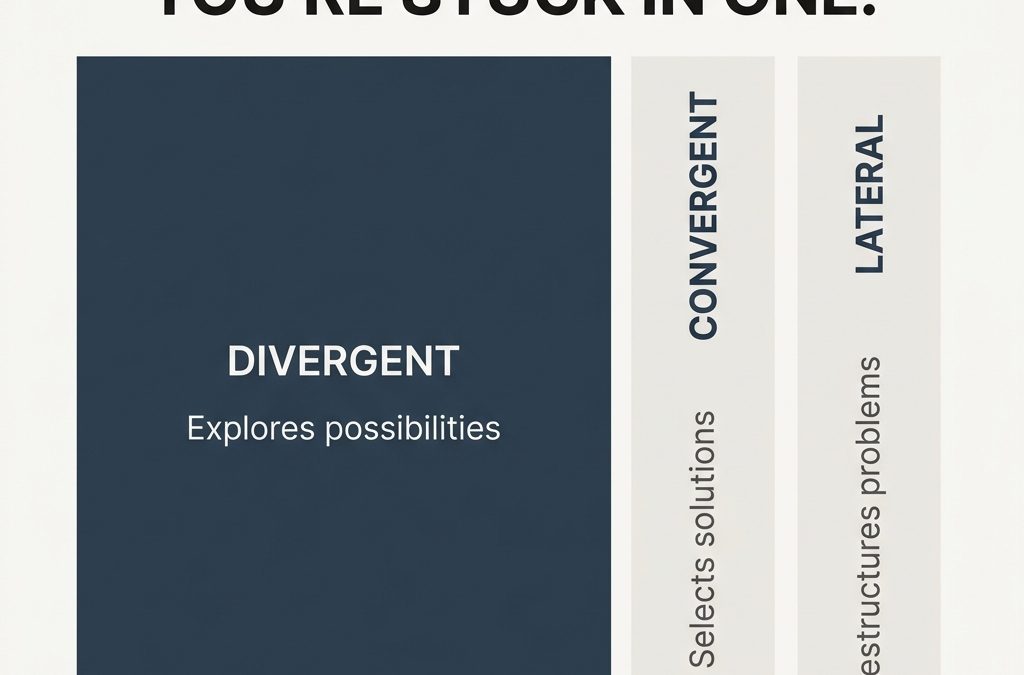
TL;DR: Your brain has three problem-solving modes, but you’re stuck using one. Divergent thinking explores possibilities. Convergent thinking selects solutions. Lateral thinking restructures problems. The people who break through learn to switch between all three. Here’s how to identify your default mode and expand your range.
-
Your brain suppresses the modes you’re not using, creating invisible walls in how you solve problems.
-
98% of children think divergently at genius level. Education buries this to 2% in adults.
-
Switching modes feels uncomfortable because of measurable “switch cost,” but cognitive flexibility leads to better life outcomes.
-
To expand: name your current mode, practice the one you avoid, separate modes by time or environment, accept temporary performance dips.
What Are the Three Problem-Solving Modes?
In 1956, psychologist J.P. Guilford identified two fundamental thinking patterns: divergent and convergent thinking. Edward de Bono later added lateral thinking.
These aren’t personality types. They’re cognitive functions everyone has.
Divergent thinking explores possibilities. You generate ideas without judgment. Volume and variety matter more than quality at this stage.
Convergent thinking selects solutions. You evaluate options through logical steps, refine them, and pick what works.
Lateral thinking restructures the problem. You don’t move forward step by step. You jump sideways to find what linear thinking misses.
Here’s the part nobody tells you: your brain actively suppresses the modes you’re not using.
MIT research found the mediodorsal thalamus suppresses representations not currently needed. This sharpens focus. But there’s a cost. Your brain builds invisible walls around your problem-solving range.
What this means: Each thinking mode is a tool. Your brain turns off the tools you’re not using to protect attention. This narrows your options without you noticing.
How Do You Identify Your Default Mode?
Most people don’t know which mode they’re operating in.
Research identifies this as one of the biggest obstacles to cognitive flexibility. People conflate these modes with identity instead of recognizing them as tools to be consciously selected.
Here’s how each mode shows up in your work:
You default to divergent thinking if:
-
You pump out brilliant ideas but struggle to finish projects
-
You see possibilities everywhere and feel overwhelmed by options
-
Structure feels limiting, so you resist
-
People call you creative but unreliable
You default to convergent thinking if:
-
You execute flawlessly but rarely question the direction
-
You want clear processes and measurable outcomes
-
Ambiguity or open-ended exploration makes you uncomfortable
-
People call you dependable but predictable
You default to lateral thinking if:
-
You challenge assumptions without thinking, sometimes to your detriment
-
You see connections others miss but struggle to explain your logic
-
Conventional approaches bore you
-
People call you insightful but hard to follow
None of these defaults are wrong.
The problem is staying locked in one.
What this means: Your default mode is where you feel comfortable. The other two modes hold your growth potential.
Why Does Switching Feel Impossible?
When you try to shift between modes, your brain resists.
Task switching and set shifting produce what researchers call “switch cost.” Response times slow. Accuracy drops. This happens because your brain needs time to shut down the previous response set and reconfigure for the new task.
The temporary performance dip is real. Measurable.
But here’s what research shows: individuals with greater cognitive flexibility have improved life outcomes, better social functioning, and reduced cognitive decline with age.
The discomfort of switching is the price of mental freedom.
I learned this during the hardest stretch of my life. When I was diagnosed with multiple sclerosis, I faced paralysis and blindness. I chose my mind as the one thing no disease would take. I spent 10 years rewiring my nervous system, learning to switch between analytical precision, creative exploration, and unconventional problem-solving.
Comfortable? Nope.
Necessary? Absolutely.
What this means: Your brain fights mode-switching because reconfiguration costs energy. The discomfort is evidence of neurological change, not failure.
What Happens When You Master All Three Modes?
Mode-switching separates exceptional performers from everyone else.
Recent cognitive research shows convergent thinking isn’t the opposite of creativity but part of the creative process. Ideas you produce during divergent thinking must be evaluated, selected, and refined through convergent reasoning to become practical innovations.
Breakthrough work happens at the intersection, not in isolation.
I see this pattern weekly in my coaching practice. The clients who move fastest are the ones who:
-
Generate multiple possibilities without attachment (divergent)
-
Evaluate those possibilities with clear criteria (convergent)
-
Challenge their own assumptions when stuck (lateral)
They don’t favor one mode. They toggle between all three based on what the situation requires.
Organizations embracing structured creative problem-solving innovate three times faster than those who don’t. Teams using these methods cut time-to-market by 40% compared to traditional approaches.
This isn’t about working harder. This is about expanding your range.
What this means: Each mode produces different results. Mastery comes from knowing which mode the moment needs, then switching to it deliberately.
How Do You Expand Your Problem-Solving Range?
Cognitive flexibility is trainable. But not how you think.
Research shows 98% of children think divergently at genius level. Education reduces this to 2% in adults. The capacity isn’t lost. Conditioning buried it.
Here’s what works:
1. Name the mode you’re in
Before you switch, recognize where you are.
Ask yourself: Am I generating options, evaluating them, or challenging the frame entirely?
Awareness precedes choice.
2. Practice the mode you avoid
If you default to divergent thinking, spend time converging. Set a timer. Force yourself to choose one idea and execute.
If you default to convergent thinking, spend time diverging. Generate 10 solutions to a problem without evaluating any of them.
If you default to lateral thinking, practice both divergent generation and convergent selection in sequence.
The discomfort signals expansion.
3. Build transitions into your process
Don’t try to do everything at once. Separate your modes by time or space.
Morning: divergent exploration. Afternoon: convergent refinement. Evening: lateral review.
Or separate by environment. Diverge while walking. Converge at your desk. Challenge assumptions in conversation.
Your brain adapts its flexibility level to suit environmental demands. Use context as a trigger.
4. Accept the switch cost
You’ll feel slower when you first start switching. Your accuracy will drop temporarily.
This is normal. This is growth.
The neuroscience is clear: each mode has a distinct neural signature. Upper alpha synchronization during divergent thinking. Desynchronization during convergent thinking. Your brain needs time to reconfigure.
Give it that time.
What this means: Cognitive flexibility is a muscle. Train it by deliberately using the modes you avoid, even when uncomfortable.
What Changes When You Master All Three?
I’ve watched this transformation hundreds of times.
The divergent thinker who learns to converge suddenly ships work instead of drowning in possibilities.
The convergent thinker who learns to diverge suddenly innovates instead of optimizing the same patterns.
The lateral thinker who learns both suddenly becomes someone others follow instead of admire from a distance.
The invisible wall most professionals never recognize: the belief you are your default mode.
You’re not stuck because you lack capability.
You’re stuck because you’ve unconsciously limited your range.
The capacity to switch is already there. You need to practice using it.
Where Should You Start?
Pick one problem you’re facing right now.
Spend 10 minutes in pure divergent mode. Generate as many solutions as possible without judgment.
Then spend 10 minutes in pure convergent mode. Evaluate each solution against clear criteria and choose one.
Then spend 10 minutes in lateral mode. Challenge the problem itself. What assumptions are you making? What would change if the opposite were true?
Notice which mode felt natural. Notice which mode felt uncomfortable.
The uncomfortable one is where your growth lives.
I’ve spent a decade helping people dissolve the walls they mistake for themselves. This is one of the most common: the belief you are your default mode.
You’re not.
You’re someone who chooses which tool to use based on what the moment requires.
Start practicing now.
Frequently Asked Questions
What’s the difference between divergent and lateral thinking?
Divergent thinking generates multiple solutions to a defined problem. Lateral thinking restructures the problem itself. Divergent asks “what else works?” Lateral asks “what if we’re solving the wrong problem?”
How long does it take to develop cognitive flexibility?
The neuroscience shows measurable changes within weeks of deliberate practice. But mastery takes months to years, depending on how deeply ingrained your default mode is. Expect discomfort for the first 30 days.
Which mode is most important for creative work?
None of them. Creative breakthroughs require all three. Divergent generates raw material. Convergent refines and selects. Lateral reframes when you’re stuck. The mode matters less than knowing when to switch.
What if I’m strong in two modes but weak in one?
Common pattern. Focus 80% of your practice time on the weak mode. The discomfort signals you’re expanding into new territory. Your strong modes will stay sharp with minimal maintenance.
Does cognitive flexibility decline with age?
Research shows cognitive flexibility declines naturally with age, but deliberate practice reverses this. People who train mode-switching maintain and even improve flexibility into their 70s and beyond.
How do I know if I’m actually switching modes or just thinking I am?
Track outputs, not intentions. Divergent mode produces volume (10+ ideas). Convergent mode produces decisions (one chosen path). Lateral mode produces reframes (new problem definitions). Measure what you produce, not what you feel.
What if my job only rewards one mode?
Short-term thinking. Organizations innovate three times faster when they use all three modes. If your role only values convergent execution, you’re vulnerable to automation and disruption. Build range now, even if your environment doesn’t reward it yet.
Is there a fourth mode researchers have identified?
Some researchers propose additional modes, but divergent, convergent, and lateral remain the most validated across decades of cognitive science. Master these three before exploring theoretical extensions.
Key Takeaways
-
Your brain has three problem-solving modes: divergent (explores possibilities), convergent (selects solutions), and lateral (restructures problems). Most people unconsciously lock into one.
-
Your brain suppresses unused modes to protect focus, creating invisible walls in your problem-solving range. This is neurological, not personal failure.
-
Switching modes produces measurable “switch cost” (slower response, lower accuracy), but people with cognitive flexibility have better life outcomes and reduced cognitive decline.
-
To expand your range: name your current mode, practice the mode you avoid, separate modes by time or environment, and accept temporary performance dips as evidence of growth.
-
Breakthrough work happens at the intersection of all three modes. Organizations using structured creative problem-solving innovate three times faster and cut time-to-market by 40%.
-
98% of children think divergently at genius level. Education buries this to 2% in adults. The capacity isn’t lost. Deliberate practice uncovers it.
-
You’re not your default mode. You’re someone who chooses which tool to use based on what the moment requires. Start practicing now.
by Christian Kresmann, Founder - Beyond Creativity | 2026, Apr, 5 | creativity, leadership, mindset, spirituality
TL;DR: The widely-taught 4 C’s of 21st century skills (Creativity, Critical Thinking, Collaboration, Communication) operate at half capacity without a fifth element: Consciousness. This is the meta-skill that lets you direct attention, notice your own patterns, and choose how to deploy your other abilities. Research shows metacognitive ability explains 33.8% of performance variance, and AI productivity gains only materialize for employees with high self-awareness. Without consciousness, you have skills you can’t access when you need them most.
Core Answer:
-
The 4 C’s (Creativity, Critical Thinking, Collaboration, Communication) are incomplete without Consciousness as the fifth C
-
Consciousness is the operating system that makes the other four skills work when you need them
-
Metacognitive ability (thinking about your thinking) explains 33.8% of performance variance across teams
-
AI productivity gains only appear in workers with high metacognitive skill
-
Without consciousness, critical thinking becomes sophisticated bias and collaboration collapses under emotional reactivity
What I Learned Lying in Bed After My MS Diagnosis
Three weeks after my multiple sclerosis diagnosis, I was lying in bed building horrifying visions of the future. My mind raced. I terrified myself into a state I couldn’t escape.
Then I noticed something.
I was the one doing the terrifying.
I could feel my pulse. I could hear sounds in the room. I could breathe. All those chemical reactions happening in my body were real, happening right now. I could shift my attention to them. Consciously.
That moment rewired how I see everything we teach about 21st century skills.
Key Point: Consciousness is the ability to direct your own attention. Most people never learn this exists, let alone how to train it.
The Framework Everyone Teaches (And Why It Falls Short)
You know the 4 C’s: Creativity, Critical Thinking, Collaboration, Communication.
Schools teach them. Companies train them. Consultants sell them.
They’re incomplete.
I’ve trained hundreds of people in creativity over the past 11 years. Most don’t lack creative techniques. They lack the consciousness to recognize when they’re blocking themselves.
I worked with a screenwriter who generated ideas constantly. Brilliant ones. But she couldn’t direct her attention to specific parts of those ideas without an external prompt. Someone had to ask her a question before she could focus.
She had the creativity skill. She lacked the meta-awareness to self-regulate her focus.
I taught her to ask better questions. Questions direct attention. They force you to search for answers. Once she learned to ask herself the right questions, she didn’t need me anymore.
That’s consciousness at work.
Key Point: You need more than skills. You need the meta-awareness to know when and how to deploy them.
Why the 4 C’s Operate at Half Capacity Without Consciousness
Research backs this up in ways most people miss.
Metacognitive ability explains 33.8% of performance variance across work teams. Not creativity. Not communication skills. The ability to think about your own thinking.
What This Looks Like in Practice
Two people have identical critical thinking training. Same frameworks. Same analytical tools. One outperforms the other by a significant margin.
Why?
The high performer notices when they’re building an argument on an unexamined assumption. They catch themselves. They question the foundation before constructing the logic.
The other person uses critical thinking to defend beliefs they already committed to. They never turn that analytical lens on their own starting point.
Critical thinking without consciousness is sophisticated bias.
How This Shows Up in Collaboration
The same pattern appears everywhere.
I’ve seen it on film sets. One person lashes out because something didn’t go as planned. Immediately, everyone else has to regulate their own systems. They stop working. They manage the emotional fallout.
That person lacked the consciousness to notice their reaction before it exploded outward. One person’s inability to self-regulate hijacked the attention and energy of the entire group.
Collaboration collapsed because consciousness was missing.
Key Point: Skills without self-awareness become tools you can’t access under pressure.
The AI Productivity Paradox: Why Consciousness Matters More Now
The data on AI makes this even clearer.
A field experiment published in the Journal of Applied Psychology found something unexpected. AI productivity gains only materialized for employees with high metacognitive skill.
AI didn’t make everyone smarter. It made self-aware thinkers more effective.
The people who could monitor their own thinking, recognize their blind spots, and adjust their approach got massive gains. Everyone else saw minimal improvement.
Technology evolves. If consciousness doesn’t evolve with it, the gap widens.
Employees with high metacognitive abilities are 35% more likely to navigate organizational changes and maintain productivity during uncertainty.
That’s not a small edge. That’s the difference between thriving and surviving.
Key Point: AI amplifies what you already do. If you lack self-awareness, AI won’t fix that.
What Consciousness Actually Does (And Why It’s Different)
Consciousness isn’t another skill on the list. It’s the operating system that makes the other four work.
Unconscious vs. Conscious Creativity
Unconscious creativity happens to you. Ideas float in from external influences. You react to what’s around you.
Conscious creativity is different. You point your attention at a specific problem. You decide what area to explore. You direct your thinking toward solutions.
How This Applies to Communication and Collaboration
Same with communication. You have perfect technique and still fail if you don’t notice when you’re dominating a conversation, withdrawing from conflict, or reacting instead of responding.
The best collaborators I know all share one thing. They’re aware of their own triggers, biases, and patterns in group settings. They catch themselves before the pattern takes over.
Research on soft skills metacognition showed that when knowledge about these skills moves from tacit to conscious, performance improves. Training people to think about their soft skills led to increases in self-efficacy and adaptive performance.
You can’t optimize what you can’t see.
Key Point: Consciousness transforms passive skills into active choices you make in real time.
The Gap Between What We Teach and What Employers Actually Need
Here’s the uncomfortable part.
There are subtle and sometimes glaring differences in what an employer thinks “critical thinking” means versus how a university defines it.
We struggle to locate these trans-disciplinary skills and match them to what employers seek.
Research on instructional materials revealed that teachers’ integration of the 4 C’s competencies was classified as “Not yet reached competency,” with means ranging from 1.57 to 1.92 on a 4-point scale.
Even educators struggle to operationalize these abstract skills.
Maybe that’s because we’re teaching the outputs without teaching the operating system.
Key Point: We’re teaching people what to do, not how to know when to do it.
How Decision-Making and Attention Actually Work
Neuroscience research understands attention as a distinct form of decision based on the utility of information.
You’re not focusing. You’re deciding what deserves your cognitive resources.
Self-awareness of your goals, together with the capacity to predict possible obstacles, drives every step of the decision-making process. From problem identification to outcome evaluation.
Each step is marked by different levels of self-awareness.
Research on perceptual decision mechanisms highlights the role of top-down attentional control and conscious awareness in selecting a decision strategy to optimize detection performance.
Consciousness isn’t passive awareness. It’s active selection.
Key Point: Every moment of focus is a decision about where to allocate your mental resources.
What This Means for How We Build Skills That Actually Work
People come to me wanting to improve one skill. Communication or creativity, mostly.
Then they find out that consciousness work opens everything else.
I don’t teach creativity techniques in isolation. I teach people to notice when they’re stuck in a pattern. I teach them to ask different questions. I teach them to direct their attention consciously toward what they need to create.
The techniques matter. But without the meta-layer of consciousness, they’re tools you can’t access when you need them most.
The Fifth C: Consciousness
The 4 C’s aren’t wrong. They’re incomplete.
Consciousness is the fifth C.
It’s the ability to direct your attention. To notice your own patterns. To question your assumptions before you build arguments on top of them. To catch yourself before you hijack a team’s energy with an unregulated reaction.
Technology will keep evolving. The 4 C’s will keep getting taught.
But if we don’t evolve consciousness alongside them, we’re building skills on a foundation that can’t hold the weight.
I learned that lying in bed after my diagnosis. My mind was the one thing the disease couldn’t touch.
But only if I learned to direct it consciously.
That’s what we need to teach.
Key Point: Without consciousness, you have skills you can’t deploy when pressure hits.
Questions People Ask About the Fifth C
What’s the difference between consciousness and self-awareness?
Self-awareness is knowing your patterns exist. Consciousness is the active ability to direct your attention away from those patterns or toward different choices in real time. You notice the reaction before it runs you.
How do you train consciousness if schools don’t teach it?
Start with questions that redirect attention. When you’re stuck, ask yourself: What am I paying attention to right now? What am I assuming without checking? What would I notice if I looked at this differently? Questions force your brain to search, which breaks automatic patterns.
Does this mean the 4 C’s are useless without consciousness?
No. They’re necessary. But they operate at half capacity without “the meta-skill” of consciousness directing when and how to use them. You need both the tools and the awareness to deploy them.
Why don’t employers just test for metacognitive ability?
Most don’t know how. Metacognition is harder to measure than technical skills or even creativity. Plus, we’ve built hiring systems around what’s easy to test, not what predicts performance. That’s changing, slowly.
Is consciousness the same thing as mindfulness?
There’s overlap, but consciousness is broader. Mindfulness teaches present-moment awareness. Consciousness includes that, plus the ability to direct attention strategically, question your assumptions, and choose responses instead of reacting. It’s awareness with agency.
What happens when someone has high skills but low consciousness?
They become unpredictable under pressure. Their skills disappear when stress hits, emotions spike, or patterns get triggered. They know what to do in theory but can’t access it when the stakes are high.
How long does it take to develop consciousness as a skill?
There’s no fixed timeline. Some people have breakthrough moments in weeks. Others build it gradually over months or years. The difference is whether you’re practicing attention direction daily or waiting for it to happen by accident.
Does AI make consciousness more important or less?
More. AI handles information processing. Consciousness handles decision-making about what information matters, when to question your own thinking, and how to deploy AI as a tool instead of a crutch. Research shows AI productivity gains only show up in people with high metacognitive ability.
Key Takeaways
-
The 4 C’s (Creativity, Critical Thinking, Collaboration, Communication) are incomplete without Consciousness as the fifth C
-
Consciousness is the operating system that makes the other four skills accessible under pressure
-
Metacognitive ability explains 33.8% of performance variance across teams, more than creativity or communication skills alone
-
AI productivity gains only materialize for workers with high metacognitive skill, not everyone who uses AI
-
Critical thinking without consciousness becomes sophisticated bias. Collaboration without consciousness collapses under emotional reactivity.
-
Training consciousness means learning to direct attention, question assumptions, and notice patterns before they run you
-
Employees with high metacognitive abilities are 35% more likely to navigate change and maintain productivity during uncertainty
by Christian Kresmann, Founder - Beyond Creativity | 2026, Apr, 3 | acting, business, creativity, leadership, mindset, spirituality
TL;DR: We ask meaningful questions but fail to listen to the answers, turning genuine inquiry into performance. This creates emotional harm equivalent to physical pain and erodes trust in relationships. The fix is simple: if you ask, wait for the answer.
Core insights:
-
Asking questions without listening communicates “you don’t matter” and activates the same brain regions as physical pain
-
Only 2% of people are skilled at active listening, yet 60% of workplace failures stem from poor listening
-
Real listening creates inter-brain synchrony, a neurological bond that technology can’t replicate
-
The solution: if you’re not interested in the answer, don’t ask the question
What Performative Curiosity Looks Like
Someone asks how your new job is going.
You start to answer. Mid-sentence, their eyes drift. They check their phone. Or they interrupt with their own story about their career transition three years ago.
The question wasn’t a question. It was theater.
I’ve watched this pattern repeat across family dinners, professional meetings, coffee with friends. The setting changes. The behavior stays the same.
Someone poses a meaningful question, then vanishes before the answer arrives.
Why Deeper Questions Get Less Attention
Here’s what I notice: the deeper the question, the faster people disappear.
“How are you handling your father’s illness?”
“What does this career change mean for you?”
“How did that conversation with your partner go?”
These aren’t small talk. These are invitations into someone’s inner world. And the person asking often treats them like they’re discussing the weather.
Research shows only 2% of people are skilled at active listening. Meanwhile, 69% of leaders say it’s essential. That gap tells you everything.
We value something we refuse to practice.
The result? 65% of employees feel misunderstood due to poor listening skills. And 60% of workplace failures stem from inadequate listening, not lack of knowledge or skill.
We’re failing at the one thing that matters.
Key point: We ask vulnerable questions but treat them like small talk, creating a gap between what we say matters and what we practice.
What Being Unheard Does to Your Brain
When someone asks you a question but doesn’t listen to your answer, something specific happens in your body.
It feels like a slap in the face.
That’s not metaphor. Research shows social rejection and being ignored activate the same brain regions as physical pain. Your brain processes being unheard like a scraped knee or kicked shin.
It’s neurological violence.
I feel it as layers. First comes the sense of being unimportant. Then the realization that I’m not seen or heard. Finally, the understanding that what I think and how I go about life doesn’t matter to this person.
Each layer compounds.
And here’s what makes it worse: the person asking the question is often doing it because they don’t feel seen and heard either. They’re using you as an outlet for their own thoughts and opinions. They want to feel smart, to show they understand how the world works.
The question becomes a way of showing off.
Key point: Being ignored triggers the same neural pathways as physical pain. When we ask questions we don’t listen to, we’re inflicting neurological harm.
How We Lost Our Attention Span
Our attention spans have collapsed. Dr. Gloria Mark’s research tracked them declining from 150 seconds in 2004, to 75 seconds in 2012, to 47 seconds in 2024.
We’re losing the capacity to stay present long enough to hear a full answer.
People check their phones up to 80 times per day while believing they only check 25 times. Half of us admit we don’t stop checking our smartphones even when we should be focusing.
The mental garbage we carry interrupts our capacity for human connection. The vacation we’re planning. The meeting we’re worried about. The argument we had this morning.
We think these preoccupations are important. They’re not. They’re noise masquerading as meaning.
And here’s the paradox: we think we’re too busy for the kind of attention real listening requires. But the chance to relax, to be present, to connect is already available in the moment with the person in front of us.
We’re too distracted to notice.
Key point: Our attention spans have dropped to 47 seconds. We’re physically losing the ability to listen, treating connection as less important than the noise in our heads.
What Genuine Listening Feels Like
I notice when someone is genuinely listening through an invisible bond between us. There’s a magnetism that either strengthens or fades.
When it’s there, time stops. It also feels like eternity. Our life energies tie together. There is no other human being in the world for me. Only the person in front of me.
Yale research discovered that face-to-face conversations create coordinated neural activity between two brains. A literal synchronization that’s suppressed during Zoom or digital interactions. Real listening creates what scientists term “inter-brain synchrony” that technology doesn’t replicate.
This isn’t poetry. It’s neuroscience.
When two people genuinely connect through eye contact and deep listening, their brainwaves sync up. This synchrony enhances empathy, trust, and emotional regulation.
But it only happens with authentic presence. Performative questioning kills it.
Key point: Real listening creates inter-brain synchrony, a neurological bond where two people’s brainwaves align. Performative questions destroy this connection.
The One Rule That Changes Everything
If you’re not interested in the answer, don’t ask the question.
That’s it. That’s the whole thing.
Don’t prompt someone to share if their words will be met with distraction or indifference. Don’t request vulnerability you have no intention of honoring.
There’s a distinction worth noting: casual exchanges about weather or commutes don’t carry the same weight. Those surface-level pleasantries serve a different function. They’re social lubricant.
The issue arises with questions that matter. Questions that touch on things of substance.
Those require space, patience, and listening.
Key point: The rule is simple. If you ask a meaningful question, wait for the answer. Anything less is performative cruelty.
What Fake Listening Communicates
When we ask a question but don’t wait for the answer, we communicate something specific: you don’t matter. Your feelings don’t matter. All I care about is my own well-being.
And here’s the part we miss: my well-being would be far greater by including you.
We think too much of ourselves. We think we’re the most important person in the world. We ignore that we’re a tiny speck in the whole cosmos. We’re unimportant even in the city we live in, even more unimportant in our country, and especially insignificant among the 8 billion people on this planet.
Underneath that is a basic thought pattern: we divide and exclude rather than recognizing that every life on earth is part of ourselves.
If we understood that every life is part of ourselves, we would slow down. We would taste every answer given. We would have compassion about the story between the words spoken out loud.
Because we would be listening to ourselves.
Key point: Not listening tells someone they don’t matter. We miss that our well-being depends on including others, not prioritizing ourselves.
Why Real Engagement Is So Rare
True engagement requires more than surface-level inquiries. It demands follow-up questions, sustained attention, and genuine curiosity about the response.
Leaders especially should master this: asking “How’s the new job?” then absorbing the answer instead of rushing to the next topic or pivoting the conversation back to themselves.
The frustration intensifies when someone prompts a response, then talks over the answer with their own thoughts, redirecting everything back to their experience.
The conversation becomes a monologue disguised as dialogue.
Research shows 74% of employees say being heard at work boosts engagement and motivation. Yet more than half of managers fail to listen effectively to their teams.
We’ve normalized asking questions as performance rather than genuine inquiry.
Key point: 74% of employees say being heard boosts engagement, but most managers fail to listen. We’ve turned questioning into performance art.
How I Know When I’m Failing at This
I catch myself sometimes starting to do the thing I hate when others do it to me.
I notice the other person drifting away with their thinking. It’s in their eye movement. They get restless. The invisible bond between us slowly fades. The magnetism loses its power.
I also notice it when I start to articulate worse. When I ramble. When I lose my focus and presence. When I get lost in my thoughts.
That’s the signal. That’s when I shift focus back to the other person.
I like to listen 80% of the time and only speak 20% of the time. Unless I’m asked to speak. Then I go all in as a coach or trainer or actor or speaker on stage.
But in regular conversations, I like to give space.
Because real questions deserve real attention.
Key point: The signal that I’m not listening: the other person gets restless, I start to ramble, the bond fades. That’s when I shift back to them.
The Long-Term Damage of Not Being Heard
Prolonged experiences of not being heard lead to increased stress hormones, diminished self-worth, emotional isolation, trust breakdown, and learned helplessness where people stop trying to be heard even when opportunities arise.
The psychological cost compounds over time.
From the day we’re born, being seen and heard by others are fundamental human needs. Going unheard for extended periods leads to erosion of self-worth, emotional suppression, chronic stress, and physical health consequences.
This isn’t rudeness. It’s a form of violence we’ve normalized.
And here’s what makes it tragic: the solution is simple.
Wait for the answer.
If the answer matters enough to ask about, it matters enough to wait for. Real questions deserve real attention.
Anything less is noise masquerading as conversation.
Key point: Chronic experiences of being unheard cause stress, diminished self-worth, and learned helplessness. The damage compounds over time.
What Shifts When We Actually Listen
If someone understood that every life on earth is part of themselves, what would change about how they ask questions?
They would slow down.
They would taste every answer given.
They would have compassion about the story between the words spoken out loud.
Because they would be listening to themselves.
The invisible bond would strengthen instead of fade. The magnetism would grow. Time would stop in the best possible way.
And both people would walk away having experienced something rare: genuine human connection.
That’s what’s available when we stop performing curiosity and start practicing it.
The question is whether we’re willing to slow down long enough to find out.
Common Questions About Active Listening
How do I know if someone is genuinely listening to me?
You’ll feel an invisible bond, a magnetism between you. Their eye contact stays consistent. They ask follow-up questions. Time seems to slow down. You feel seen, not judged.
What’s the difference between small talk and questions that require real listening?
Small talk serves as social lubricant (weather, commutes). Real questions invite vulnerability (“How are you handling your father’s illness?”). The latter requires patience, space, and genuine attention.
Why do people ask questions they don’t want answered?
Often because they don’t feel seen and heard themselves. They use questions as a way to show off their thinking, to feel smart, to get their opinions out. It’s performance, not curiosity.
What happens in my brain when someone ignores me after asking a question?
Social rejection and being ignored activate the same brain regions as physical pain. Your brain processes being unheard like a scraped knee. It’s neurological violence, not just rudeness.
How do I catch myself when I’m not listening?
Watch for these signals: the other person gets restless, their eyes drift, you start rambling, you lose focus. The invisible bond between you fades. When you notice that, shift your attention back to them.
What’s inter-brain synchrony?
When two people genuinely connect through eye contact and deep listening, their brainwaves sync up. This neurological alignment enhances empathy, trust, and emotional regulation. It only happens with authentic presence.
How long should I wait before responding to someone’s answer?
Long enough to taste every word. Long enough to hear the story between the words spoken out loud. If you’re already formulating your response while they’re talking, you’re not listening.
What’s the long-term cost of not being heard?
Increased stress hormones, diminished self-worth, emotional isolation, trust breakdown, and learned helplessness. People eventually stop trying to be heard even when opportunities arise. The damage compounds over time.
Key Takeaways
-
Asking questions without listening activates the same brain regions as physical pain. It’s neurological violence we’ve normalized.
-
Only 2% of people are skilled at active listening, yet 60% of workplace failures stem from poor listening, not lack of knowledge.
-
Real listening creates inter-brain synchrony where two people’s brainwaves align, enhancing empathy and trust. Performative questions destroy this bond.
-
Our attention spans have collapsed from 150 seconds in 2004 to 47 seconds in 2024. We’re physically losing the ability to listen.
-
The simple rule: if you’re not interested in the answer, don’t ask the question. Anything less is performative cruelty.
-
When we ask but don’t listen, we communicate “you don’t matter.” We miss that our well-being depends on including others.
-
The solution is simple: slow down, taste every answer, have compassion for the story between the words. Real questions deserve real attention.
by Christian Kresmann, Founder - Beyond Creativity | 2026, Mar, 18 | creativity, leadership, mindset
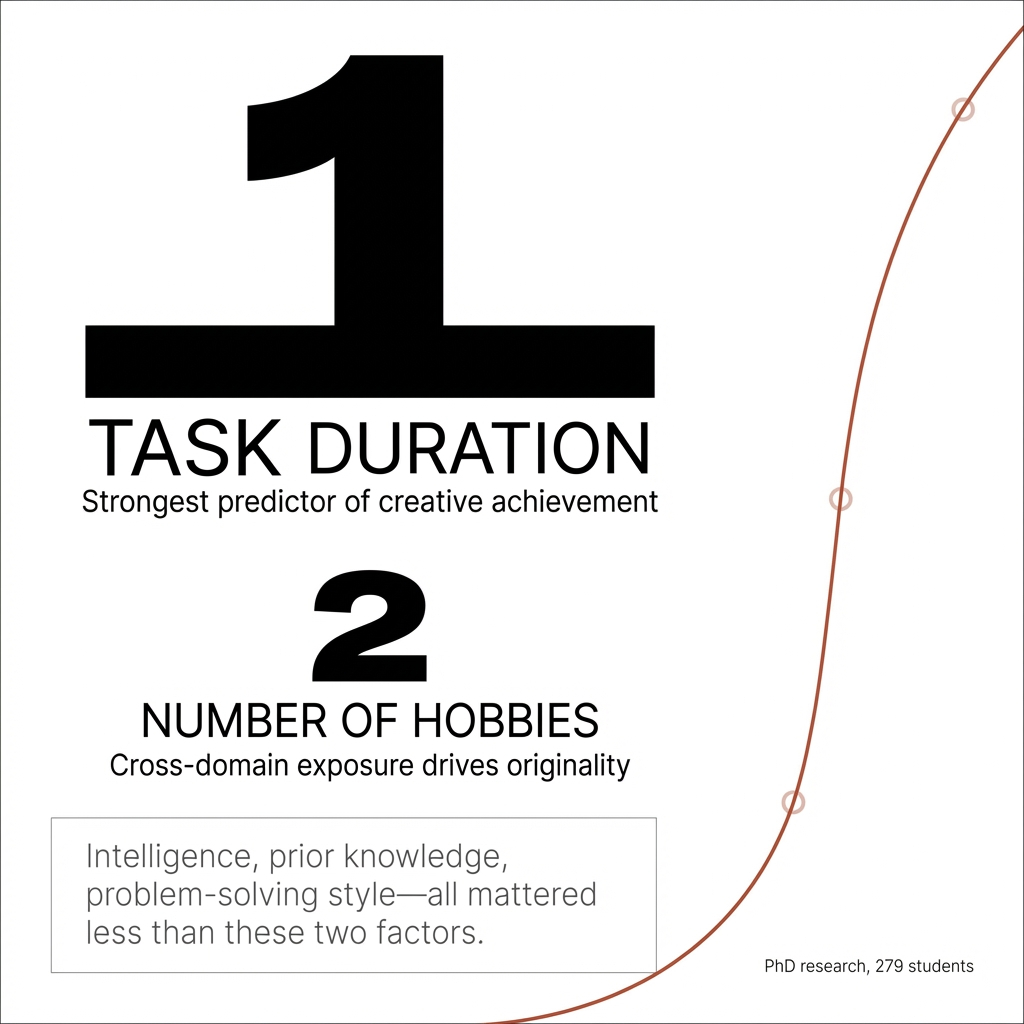
TL;DR: Research with 279 tenth-graders revealed that time spent on creative tasks predicts achievement more than intelligence, prior knowledge, or problem-solving style. The second strongest factor was variety of hobbies. These findings apply directly to teams and organizations struggling with creative output.
Core Findings:
-
Task duration was the strongest predictor of creative achievement among tenth-graders
-
Number of hobbies (not depth) was the second strongest predictor
-
Creative output depends more on conditions than on individual traits
-
Psychological safety and time to iterate matter more than brainstorming techniques
-
Cross-domain knowledge transfer drives creative recontextualization
I spent years researching creativity for my PhD. Tested 279 tenth-grade students. Measured their intelligence, prior knowledge, interest levels, problem-solving styles.
I expected the explorers to dominate. You know, the kids with the playful, experimental mindset who throw ideas around without attachment.
They didn’t.
The strongest predictor of creative achievement wasn’t intelligence. Wasn’t prior knowledge. Wasn’t even problem-solving style.
Task duration.
How long students spent on the work mattered more than how smart they were or what they already knew.
What the Data Showed Me About Time and Creativity
This finding contradicted everything I assumed. I thought explorers would breeze through tasks, playing with ideas without perfecting them. Less time needed because they weren’t obsessing over details.
Wrong.
The data showed a clear pattern. More time created more opportunities for ideas to emerge. Even among explorers, those who spent more time produced better creative work.
This wasn’t about grinding. It was about creating space for iteration.
Research with 208 fifth and sixth-grade students found student creativity varied in a positive and linear relationship with attentiveness in class. Attentive students were more likely to be creative in specific learning areas. Students with higher creative potential also controlled their attentiveness better.
Attention and time aren’t separate variables. They’re connected.
Key Point: Creative achievement increases with task duration because more time allows iteration and idea emergence. Even naturally exploratory thinkers need time to produce better work.
How to Architect for Creativity in Real Work
After this research, I realized something. We design for creativity.
Not by hoping inspiration strikes. By protecting time.
The problem? Outside constraints push back hard. On film sets, we want more takes, more rehearsal time, more iteration. Costs money. Everyone needs to get paid. For individual creative work, more iteration means more of your own time or budget.
Companies face the same tension. They need good work in a reasonable timeframe. Economic reality collides with creative needs.
I developed two practices:
First, present the choice clearly. When someone pushes for speed, I ask: do you want fast or do you want good? Perfect needs iteration. Make the trade-off visible.
Second, decide what’s good enough. Ask yourself: is this already good enough to move forward? You iterate later. Circle back when there’s time. Apply the lean principle. Ship a workable solution, knowing where you’ll improve it next.
Picasso created over 5,000 pieces of art in his lifetime. He spent time in his craft. He also shipped. Didn’t wait for perfect.
Key Point: Creativity needs protected time, but perfect doesn’t exist. Present the speed versus quality trade-off clearly, and ship workable solutions while knowing where to iterate next.
Why Variety of Hobbies Predicts Creative Achievement
Number of hobbies was the second strongest predictor of creative achievement in my research.
Not quality of hobbies. Not depth of expertise. Variety.
I’m not a hobbyist in the traditional sense. I transfer knowledge from one domain into another constantly. The underlying mechanism hobbies activate.
I use aikido techniques in leadership seminars. Train leaders with martial arts principles. Redirecting energy instead of resisting it. I pull from marginal gains theory in cycling and apply it to leadership development.
Creativity is recontextualization. Taking something from one domain and using it where others don’t see the connection.
Sometimes these metaphors surface naturally as I speak. Other times, I actively search for them. When I’m stuck on what to do next, I think: how would I describe this problem as a basketball player? As a chef? As a physicist? As a chess player?
Domain-specific imagery lets me argue on a structural level while making it visceral.
A study with 380 adolescents found both openness to experience and intrinsic motivation significantly predicted creativity. Together, they explained 34% of variance in creative performance.
Hobbies create openness. They force you to process information differently. They build cognitive diversity.
Key Point: Cross-domain knowledge transfer drives creativity. Variety of hobbies matters more than depth because different domains provide different thinking patterns you recontextualize for new problems.
Why Creative Output Declines Despite Better Tools
We’ve given people better tools. Faster processes. More data.
Creative output went down.
The problem isn’t resources. Mindset blocks.
People lack the mental space to tinker. They’re not allowed to brainstorm without immediately judging their ideas as not good enough. They’ve internalized the judgment before the idea even forms.
This is a climate issue. Does your company allow tinkering moments? Do people feel psychologically safe to explore?
Research shows traditional verbal face-to-face brainstorming groups tend not to be particularly effective. While waiting to share ideas, people forget what they meant to say or get distracted. Participation becomes uneven as some dominate discussions.
85% of employees want employers to prioritize creative development. Traditional brainstorming sessions improve problem-solving by only 45%.
We’re using broken tools and wondering why creativity suffers.
Key Point: Creative output declines when psychological safety is absent. Better tools don’t fix mindset blocks. People need permission to tinker without immediate judgment.
What Blocks Creativity at the Foundation Level
Working with organizations taught me something. The fundamental issue is human stability.
People don’t think creatively when they’re anxious about not being good enough. When they’re caught in the achievement pressure cycle. When their baseline state is stress.
I’ve taught specific breathing practices in seminars. Twelve minutes of alternate nostril breathing. People report immediate calm. Anxiety drops.
Every person is at a different point in their journey. Invisible walls limit their willingness or ability to practice these things. I know I need to practice more yoga to stay in a calm state consistently. I’m not there yet. Better than five years ago, though.
I meet people where they are. Sometimes teaching a simple breathing exercise. Sometimes suggesting they pause for coffee instead of hustling through the day.
Small interventions matter when people aren’t ready for big ones.
Key Point: Anxiety blocks creative thinking. Human stability matters more than brainstorming techniques. Meet people where they are with small, accessible interventions.
How Creativity Unlocks in Real Time
I’ve seen this shift happen in real time. When people finally get permission to play and tinker without judgment, you watch someone who was drowning finally take a breath.
Literally. They exhale. Inhale more deeply. Laugh. Their muscles relax.
Some people need explicit permission from authority to go there. They ask: is it okay to be this weird? I say yes. You’re allowed to be weird here.
Then I reframe what success looks like. I bring in stories from other domains. The Japanese sushi chef who practices for seven years to cook rice perfectly. Those reference points shift what people think is legitimate.
Research with 350 middle school students found creative metacognition (knowing your own creative strengths and limitations, plus knowing when and how to be creative) significantly moderates the relationship between risk-taking and creative performance.
High creative metacognition benefits performance. Low creative metacognition degrades it, especially when people take risks without understanding their own creative process.
You don’t tell people to be more creative. You help them understand how they create.
Key Point: Permission to explore without judgment creates visible physical and emotional shifts. People need to understand their own creative process, not receive generic creativity advice.
Why Conditions Matter More Than Individual Traits
We spend enormous energy trying to identify creative people.
The research shows achievement depends more on conditions than traits.
Task duration. Psychological safety. Permission to tinker. Time to iterate. Cross-domain exposure.
Conditions you build. You don’t need to hire different people. You need to change the environment.
A systematic review of 65 studies on adolescent creativity found 94% didn’t consider social contextual factors. We’re measuring individual traits while ignoring the environment that enables or blocks creative work.
For young adolescents, the intense pressure to conform and not stand out is one key factor for continued loss of creativity. Teens are known for being impulsive risk-takers, but within academic circles they tend to be the opposite.
The same pattern shows up in organizations. People have the capacity. The environment kills it.
Key Point: Focus on building conditions (time, safety, permission to tinker) instead of searching for creative individuals. The environment matters more than traits.
How This Research Changed My Practice
This research changed my entire creative approach.
I consciously protect time for iteration. Spending more time increases the chances something creative emerges. I don’t wait for inspiration. I create conditions where it shows up.
I actively pull from multiple domains. When I’m stuck, I shift contexts. Think about the problem as if I were in a different field. Cross-domain translation generates new approaches.
I build psychological safety first. Before any creative work happens, I make sure people know they explore without judgment. The exhale has to happen before ideas flow.
I’ve stopped measuring creativity as a fixed trait. I measure conditions. Did we protect enough time? Did we create safety? Did we allow tinkering? Did we pull from diverse domains?
Those are the levers moving creative output.
Key Point: Apply the research by protecting time for iteration, pulling from diverse domains when stuck, building psychological safety first, and measuring conditions rather than traits.
What the Pattern Reveals Across Contexts
Tenth-graders in my PhD research. Executives in leadership seminars. The same factors predict creative achievement.
Time matters more than talent.
Diverse exposure matters more than deep expertise in one area.
Psychological safety matters more than brainstorming techniques.
We keep looking for creative people when we should be building creative conditions.
Students who spent more time on tasks produced better creative work. Students with more hobbies showed higher creative achievement. Students who felt safe to explore generated more original ideas.
Your team probably has the creative capacity already. The question is whether you’ve built the conditions letting it emerge.
Frequently Asked Questions
What was the strongest predictor of creative achievement in the research?
Task duration. How long students spent on creative work mattered more than intelligence, prior knowledge, or problem-solving style. More time creates more opportunities for ideas to emerge and iterate.
Why do hobbies matter for creativity?
Variety of hobbies (not depth) was the second strongest predictor because hobbies activate cross-domain knowledge transfer. Different domains provide different thinking patterns you recontextualize for new problems.
How do you balance creative time with business constraints?
Present the trade-off clearly. Ask: do you want fast or good? Perfect needs iteration. When time is limited, decide what’s good enough to ship now and where you’ll iterate next. Apply lean principles.
What is creative metacognition?
Knowing your own creative strengths and limitations, plus knowing when and how to be creative. Research shows high creative metacognition benefits performance, while low creative metacognition degrades it, especially when taking risks.
Why don’t traditional brainstorming sessions work?
Traditional verbal face-to-face brainstorming tends not to be particularly effective. While waiting to share ideas, people forget what they meant to say or get distracted. Participation becomes uneven as some dominate discussions. They improve problem-solving by only 45%.
How do you create psychological safety for creativity?
Give explicit permission to explore without judgment. Some people need authority figures to say it’s okay to be weird or experimental. Address the foundation of human stability first. Anxiety blocks creative thinking.
What conditions should organizations measure instead of traits?
Task duration. Psychological safety. Permission to tinker. Time to iterate. Cross-domain exposure. These are conditions you build by changing the environment, not by hiring different people.
How quickly do creative interventions work?
Small interventions create immediate shifts. Twelve minutes of alternate nostril breathing produces immediate calm and drops anxiety. Permission to explore creates visible physical relaxation. Meet people where they are.
Key Takeaways
-
Task duration predicts creative achievement more than intelligence, prior knowledge, or problem-solving style. More time allows iteration and idea emergence.
-
Variety of hobbies matters more than depth because cross-domain knowledge transfer drives creative recontextualization.
-
Creative output depends on conditions (time, psychological safety, permission to tinker) more than individual traits.
-
Traditional brainstorming techniques are broken. Psychological safety and time matter more than structured sessions.
-
Anxiety blocks creativity at the foundation level. Address human stability before expecting creative output.
-
Organizations should stop searching for creative people and start building creative environments.
-
Measure conditions, not traits. Ask: Did we protect time? Create safety? Allow tinkering? Pull from diverse domains?